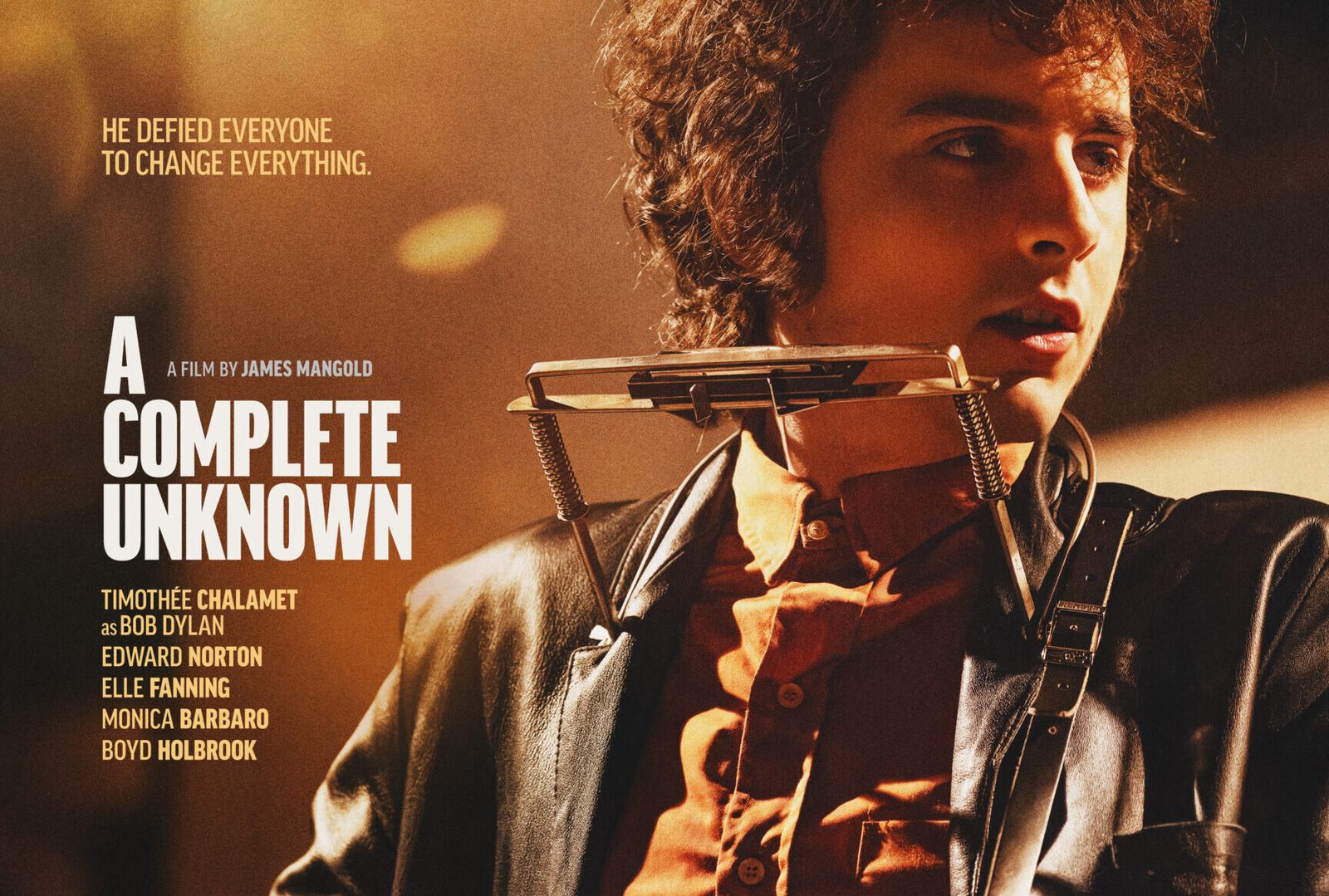
New York, 1961. A 19-year-old Bob Dylan arrives in Greenwich Village with nothing but a guitar. Who is he? Where does he come from? He offers no answers. The title says it all: he is completely unknown.
*Complete Unknown* is not a film that sets out to dissect the Dylan legend, nor does it pretend to understand him. It does quite the opposite. For 141 minutes, it demonstrates just how impossible he is to pin down. That is the film's most courageous choice.
Timothée Chalamet's performance goes well beyond impersonation. The walk, the tilt of the head, the precise moment when his eyes seem to withdraw from whoever is in front of him — Chalamet has absorbed it all. In the scenes where he picks up the guitar and sings, the camera moves close to his face, and you feel something almost physical: a vibration that seems to spill off the screen. Chalamet's decision to sing live rather than lip-sync saves the film. For the first 25 minutes or so, you are still aware that you are watching an actor playing Dylan. After that, only Dylan remains.
The supporting cast more than holds its own. To call Edward Norton's Pete Seeger his finest work in a decade is no exaggeration. Norton renders, with exquisite restraint, the emotional complexity of a man who loves Dylan and is betrayed by him. Monica Barbaro's Joan Baez commands the screen through voice alone, her presence enough to draw the eye away from Chalamet. Five months of intensive vocal and guitar training before filming are evident in every moment she takes the stage — those scenes rank among the most beautiful in the film. Boyd Holbrook's Johnny Cash leaves a vivid impression despite limited screen time. And Elle Fanning, as Dylan's girlfriend Sylvie, conveys quietly but with great clarity the pain of a woman who is slowly erased by proximity to genius.
The film's limitations arise from Dylan himself. He is magnetic, yet deeply disagreeable — turning his back on everyone who helped him, lying even to the woman he loves. Mangold does not glamourise him, and that takes courage. But it also keeps the audience at arm's length. You want to be let inside Dylan's inner world; the film keeps the door firmly shut. The distance is deliberate, but it sometimes feels too great.
Then comes the final scene: the 1965 Newport Folk Festival. Dylan takes the stage with an electric guitar. The crowd boos. He does not care. This moment encapsulates the entire film. Bob Dylan is not a man who shapes himself to other people's expectations. Like a brilliant star, he traces his own orbit and drifts freely through it — ungrasped, unknowable. And that, precisely, is why he became a legend.
★★★☆☆ (3.0/5.0)
In a word: "Chalamet and the supporting cast are dazzling. But Dylan, the star himself, remains just out of reach to the very end."