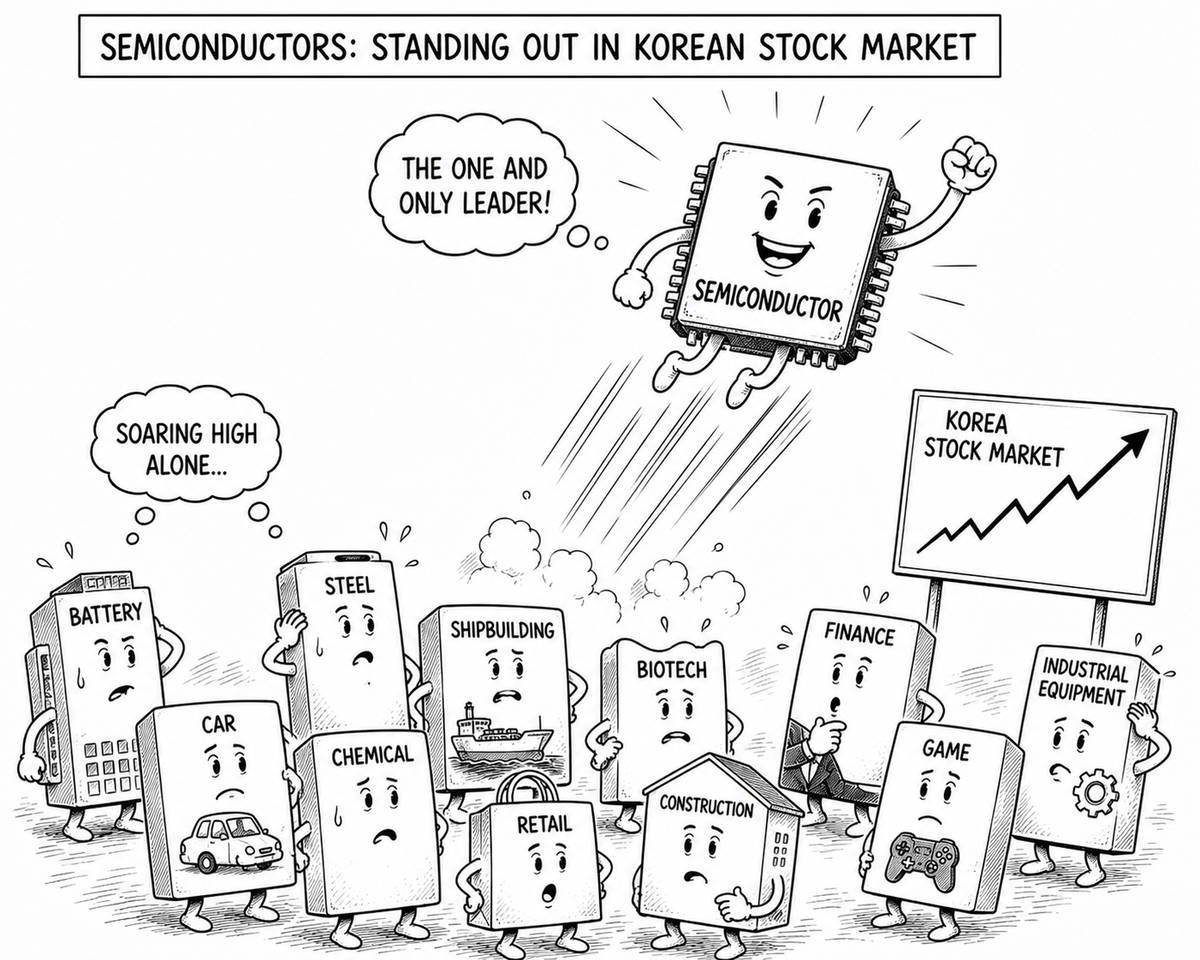
In financial markets, a single number can sometimes settle an entire argument. This time, that number is 70.
According to LS Securities, South Korea's KOSPI index — the country's main stock exchange — rose 101.1% in 2026, and roughly 70% of those gains came from just two companies: Samsung Electronics and SK Hynix. Their individual contributions to the index's rise were 34.3% and 35.5% respectively. Some headlines drew the inevitable conclusion: strip out the chipmakers, and the KOSPI would stand at just 4,100 points.
The framing provoked an unusual response. President Lee Jae-myung pushed back directly, likening the argument to "talking about Son Heung-min without his footballing ability." South Korea's semiconductor industry, he argued, is central to its economy and cannot simply be excised from any honest assessment of the market. Remove semiconductors and the KOSPI at 4,100 should be a source of pride, not alarm, he suggested. The same number, in other words, can read as crisis or confidence depending on who is holding it. The data, in the end, must adjudicate.
Is South Korea unusually concentrated? Compare before concluding.
To judge whether the concentration is extreme, a reference point helps. Samsung and SK Hynix together account for 52% of the KOSPI by market weight. Yet on the Taiwan Stock Exchange, a single company — TSMC — accounts for 42%. Two companies making up 52% of South Korea's market looks rather less alarming when set against one company making up 42% of Taiwan's. Brokerage analysts drew the same conclusion: "Leading-stock concentration in a bull market is common, not a warning sign." When an AI-driven investment boom causes chipmakers' earnings to surge, their share prices following suit is the expected outcome, not a distortion.
Concentrated, but not expensive — an apparent paradox
The most striking feature of this rally is the valuation picture. Normally, when capital floods into a single sector, that sector's valuations become stretched. Here, the opposite is true. Jung Da-woon, an analyst at LS Securities, highlights a figure that stands out: Samsung trades at a 12-month forward price-to-earnings ratio of 6.6 times, and SK Hynix at 6.9 times — both well below the KOSPI average of 8.4 times.
The implication is clear. This concentration is not a bubble inflated by hope alone; it is the rare combination of earnings growth running faster than share-price appreciation. Stocks have risen sharply, yet the profits underpinning them have risen faster still, leaving valuations cheaper relative to the broader market even after the rally.
Memory chip prices are what made this possible. An analyst at SK Securities put it bluntly: "Korea's memory chipmakers have the highest earnings and profitability among all global AI-related stocks. When you factor in improving structural earnings stability and a broadening buyer base, the case for re-rating has barely begun." He cites memory price strength in the second quarter of 2026, anticipated price increases across all HBM (high-bandwidth memory) products in 2027, and the spread of long-term supply agreements (LTAs) — every variable pointing in the same direction.
Target prices that demand attention
The conviction is quantified in broker forecasts. Nomura raised its target price for Samsung from 370,000 won to 570,000 won, then again to 590,000 won. For SK Hynix, it set a target of 4,000,000 won. Analyst Chae Min-sook argues that as average selling prices for commodity DRAM and NAND flash lead the industry's recovery, Samsung — with its commanding advantage in commodity memory production capacity — stands to benefit more than its peers. Customers with existing supply contracts and those without are both reportedly requesting excess allocations, leaving Samsung as the natural beneficiary. Nomura also forecasts that Samsung will target the number-one position in HBM market share from 2027.
SK Hynix's earnings forecasts have been revised sharply upwards. Nomura lifted its 2026 operating profit estimate by 9%, to 279.548 trillion won — a 492% increase year on year — and its 2027 forecast by 4%, to 378.862 trillion won, a further 36% rise. The firm argues that memory manufacturers are in advanced discussions with major customers on LTAs offering favourable terms on volumes, prices and prepayments. Should LTAs become the industry's new standard commercial model, Nomura believes high profitability could persist for years.
Consensus data from Investing.com reflects similar confidence: 36 analysts rate Samsung a buy against a single sell recommendation, with an average target price of 428,076 won — implying upside of nearly 21% from current levels.
Structural forces reinforcing the rally
Beyond fundamentals, market mechanics are amplifying the concentration. Kim Jun-young of IM Securities notes that momentum investing — where rising stocks attract further buying — is a global phenomenon, adding that "this rally is not only grounded in fundamentals but is being strongly propelled by options-market flows." He also points to two structural factors specific to South Korea: the growing popularity of bond-hybrid ETFs eligible for inclusion in retirement pension accounts, and the fact that Samsung and SK Hynix are the only two stocks in South Korea to have dedicated single-stock leveraged ETFs. "Since the 2x leveraged ETFs on Samsung and Hynix were launched, the concentration has intensified further," he observes.
Jung Da-woon at LS Securities acknowledges the structural dynamics while flagging potential volatility ahead. He does not dispute the logic of momentum-driven, leading-stock markets — but notes that upcoming events, including the possible listing of SpaceX, the June Federal Open Market Committee meeting and the US mid-term election schedule, could introduce turbulence.
Why the crane stands out — and what that reveals
The Korean idiom 군계일학 — a crane among chickens — captures the essence of this market: one exceptional entity towering over undistinguished surroundings. The question facing investors is not whether Samsung and SK Hynix dominate the KOSPI, but what sustains that dominance. Three data points currently argue against the bubble interpretation: a market concentration still lower than Taiwan's TSMC-heavy exchange; forward PER multiples below the broader KOSPI average; and earnings forecasts that are revised upward quarter after quarter.
Yet the idiom contains a second, less comfortable truth. A crane appears magnificent partly because the birds around it are ordinary. The semiconductor sector's towering performance casts a long shadow over every other part of the South Korean market — sectors that are, by definition, receiving far less attention and capital. How deep that shadow falls, and where, will be the subject of a subsequent analysis.
What to watch: Samsung and SK Hynix will report second-quarter results in July. The key question is whether HBM price increases and the spread of long-term supply agreements show up as concrete numbers in those figures. The aggressive targets set by Nomura and SK Securities can only be justified if these two variables materialise in the quarterly earnings.
Metric | Samsung Electronics | SK Hynix
Contribution to 2026 KOSPI rally | 34.3% | 35.5%
12-month forward PER | 6.6x | 6.9x (vs. KOSPI average: 8.4x)
Nomura target price | 590,000 won | 4,000,000 won
2026 operating profit forecast | — | 279.5 trillion won (+492% YoY)
2027 operating profit forecast | — | 378.9 trillion won (+36% YoY)
Key catalysts | Commodity DRAM/NAND capacity advantage; HBM market-share leadership target | LTA expansion; HBM price increases across all products