One number captures the strange mood gripping South Korea's semiconductor equipment sector. Jusung Engineering, a maker of chip deposition tools, is trading at a price-to-earnings ratio of 1,534 times. In a market where a multiple of 20 to 30 times is considered aggressive for a growth stock, that figure means investors are pricing in not this year's earnings, nor next year's, but a vision of the company several years hence—and paying handsomely for the privilege. Since the start of the year, Jusung's shares have risen 570%, comfortably outpacing Samsung Electronics (up 199%) and SK Hynix (up 262%).
Yet within the same equipment sector, Hanmi Semiconductor tells an entirely different story. In the first quarter, the company's operating profit collapsed 88% year on year, to a mere 8.5bn won (roughly $6m)—a startling figure for a business with a market capitalisation of 35trn won. And yet brokerages are forecasting full-year operating profit of around 4trn won. Something extraordinary must be expected to happen between the first quarter and the last three.
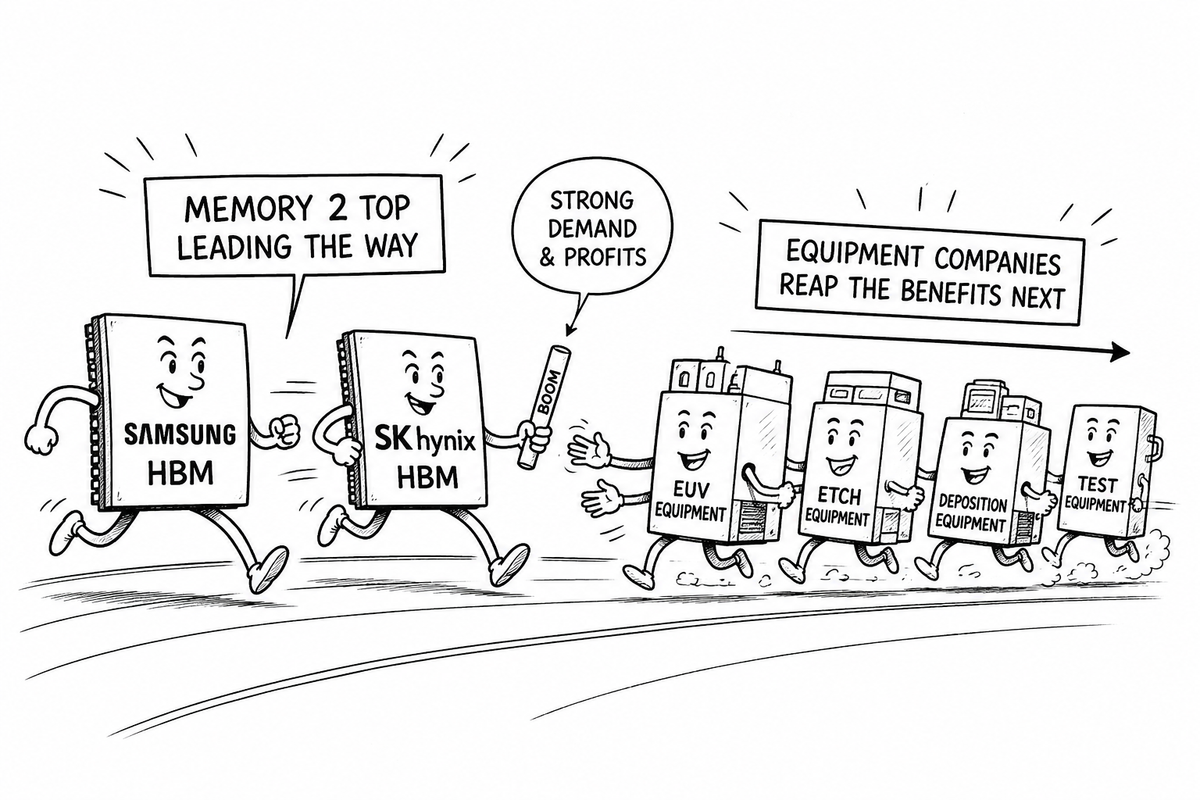
The semiconductor equipment industry is currently two markets inhabiting one label. Back-end equipment—used in packaging and assembly—is already seeing orders recover. Front-end equipment—used in the earlier wafer fabrication stages—has seen its share prices race ahead on promises that may not crystallise until 2027. Understanding which is which matters enormously for investors.
The back-end: money flowing now
Hanmi Semiconductor's first-quarter shock confused many investors. The company makes TC Bonders—the thermal-compression bonding tools that are central to packaging HBM (high-bandwidth memory) chips, the kind used in AI accelerators. HBM is supposedly in a supercycle. So why were profits down 88%? The shares fell more than 23% in two days after the results.
The answer, according to Jung Min-gyu, an analyst at Sangsangin Securities, is timing rather than demand destruction. "The first-quarter weakness reflected the off-season combined with a gap in investment by the company's key customers," he wrote. HBM is transitioning from the third generation (HBM3) to the fourth (HBM4), and chipmakers paused equipment orders during the changeover. The tap was not turned off; it was merely being rerouted.
Evidence that demand remained intact was not hard to find. By April, Hanmi's order backlog from SK Hynix—its largest customer—already exceeded the total revenue it recorded from that client in all of 2024. On June 8th the company signed a fresh supply contract with SK Hynix worth 44.2bn won for TC Bonders specifically designed for HBM4 production. At roughly 3bn won per unit, that single contract represents 14 to 15 machines.
Hanmi's chairman, Kwak Dong-shin, told analysts after the first-quarter results that HBM4 mass production was accelerating orders, and that momentum would build further in the second half. Bank of America raised its price target on the stock to 500,000 won and maintained a buy rating. Sangsangin Securities forecast second-quarter operating profit of 110.3bn won—a sequential jump of 1,197%—and projected full-year revenue of 785bn won with an operating margin of 47%.
The company is also looking beyond South Korea. It plans to establish a local subsidiary, Hanmi USA, in San Jose, California by the end of this year, in a bid to embed itself directly into the American AI chip supply chain.
Not everything is straightforward, however. Hanwha Semitec competes with Hanmi in the TC Bonder market, and Samsung Electronics appears to be diversifying its supplier base rather than concentrating orders as SK Hynix has done. JP Morgan has estimated Samsung's TC Bonder procurement at between 275bn and 440bn won, but stopped short of declaring Hanmi the clear beneficiary. LS Securities analyst Cha Yong-ho forecasts that Hanmi's share of SK Hynix's TC Bonder purchases will rise from 50% in 2025 to 60% in 2026—but the Samsung variable remains unresolved.
The front-end: buying 2027 today
Jusung Engineering makes ALD (atomic layer deposition) and CVD (chemical vapour deposition) tools—equipment used to deposit ultra-thin films onto wafers during chip fabrication. As semiconductors grow more complex and vertically stacked, the precision of ALD becomes ever more critical, and the theoretical case for Jusung benefiting from the AI chip boom is compelling.
The actual numbers tell a different story. The company's order backlog shrank from 288.7bn won at the end of 2023 to 97.7bn won at the end of 2025. Operating cash flow swung from a 225bn won surplus in 2024 to a 31bn won deficit in 2025. Meanwhile, the company invested over 100bn won in a new R&D centre in Yongin. It is spending more than it earns.
Despite all this, the shares soared from 27,700 won at the start of the year to an intraday high of 250,000 won—a gain of 570%. Two catalysts drove the move.
The first was a technical milestone. On May 18th, Jusung announced that it had shipped what it described as the world's first semiconductor manufacturing equipment based on ALG (atomic layer growth) technology—an advance on ALD in which atoms find their optimal positions autonomously during deposition. Shares hit the daily upward limit on the day of the announcement. For investors who had been waiting for proof that the technology worked outside a laboratory, this was it.
The second catalyst was anticipation of a resumption in capital expenditure by Samsung Electronics and SK Hynix. IBK Investment & Securities wrote in May that surging demand for HBM and DRAM used in AI servers would prompt both chipmakers to accelerate investment from the second half of 2026, placing Jusung's ALD tools "directly in the line of benefit." Korea Investment & Securities went further, forecasting that Jusung's annual revenues would exceed 1trn won by 2028.
Not everyone is so sanguine. BNK Investment Securities downgraded Jusung from buy to hold in April, arguing that the good news was already reflected in the share price and that meaningful earnings improvement would not materialise until next year. A PER of 1,534 times is a statement of faith, not of fact. That faith has yet to be validated by actual results.
Wonik IPS, another front-end equipment maker specialising in deposition and etching tools—and a direct competitor to Jusung in the ALD market—surged 20.82% this week on identical logic: the anticipation that Samsung's eventual investment restart would channel large ALD orders its way. Wonik has a history of co-development projects with Samsung, lending some credibility to the expectation.
The broader market for ALD equipment is, at least, genuinely large. According to Global Market Insights, the global ALD equipment market is projected to grow from $4.7bn in 2025 to $13.2bn by 2035, a compound annual growth rate of 10.9%. The question is not whether the pie will grow, but when the first slices will be served.
The variable that divides the two worlds
The gulf between back-end and front-end equipment ultimately comes down to one thing: when Samsung Electronics will restart meaningful capital investment.
SK Hynix has been investing aggressively in expanding its HBM4 production capacity. That is why Hanmi Semiconductor is recovering orders. Samsung, by contrast, has been focused on improving HBM4 yields and restoring profitability in its contract manufacturing (foundry) business, and has been more restrained about committing to new capacity. That restraint is why front-end equipment companies are watching their backlogs shrink even as their share prices rise.
There are tentative signs of change. Market speculation this week suggested that Samsung is planning a semiconductor packaging facility in Gwangju, and that SK Hynix is considering back-end facilities in the Honam region of south-west Korea. If confirmed, such investments would unlock orders across both front-end and back-end suppliers. The week's sharp gains in Simtech (+21.74%), Wonik IPS (+20.82%), Eugene Technology (+15.11%), and EO Technics (+15.07%) reflect exactly that anticipation.
But speculation is not a purchase order. There is typically a lag of six months to a year between a formal investment announcement and actual equipment deliveries. Every month Samsung delays its decision pushes back the earnings recovery for front-end suppliers by the same amount.
Two bets, one sector
The semiconductor equipment sector currently contains two distinct types of investor. The first is betting on a trickle-down effect that is already becoming visible in second-quarter orders—the Hanmi Semiconductor trade. The second is betting on a vision of 2027 and 2028 that remains firmly in the realm of expectation—the Jusung trade. Neither bet is obviously wrong. They simply require different tolerances for waiting.
Back-end equipment is already flowing. Front-end equipment is waiting for the reservoir to fill. The reservoir is Samsung and SK Hynix's capital expenditure budgets. When those commitments are made, the temperature difference between the two halves of this sector will begin to close.
Two events are worth watching closely. First, any official announcement regarding Samsung's Gwangju packaging plant or SK Hynix's Honam facilities. Second, Hanmi Semiconductor's second-quarter results, due in July. If the forecast of a 1,197% sequential rebound in operating profit proves accurate, it will add considerable credibility to the loftier valuations being assigned to front-end equipment companies still waiting for their moment.
*Key comparisons across the three leading stocks:*
Hanmi Semiconductor (back-end / TC Bonders for HBM packaging): Q1 operating profit 8.5bn won, down 88% year on year; Q2 forecast 110.3bn won, up 1,197% quarter on quarter; full-year consensus 369–404bn won. Key risk: Samsung diversifying its TC Bonder supplier base.
Jusung Engineering (front-end / ALD and ALG deposition tools): operating losses; order backlog down sharply; PER of 1,534 times; meaningful earnings improvement expected no earlier than 2027. Key risk: severe overvaluation if Samsung's investment restart is delayed.
Wonik IPS (front-end / ALD, CVD, and etching tools): results weak; recovery expected from 2027 onwards. Key risk: uncertainty over the timing of Samsung's capital expenditure resumption.