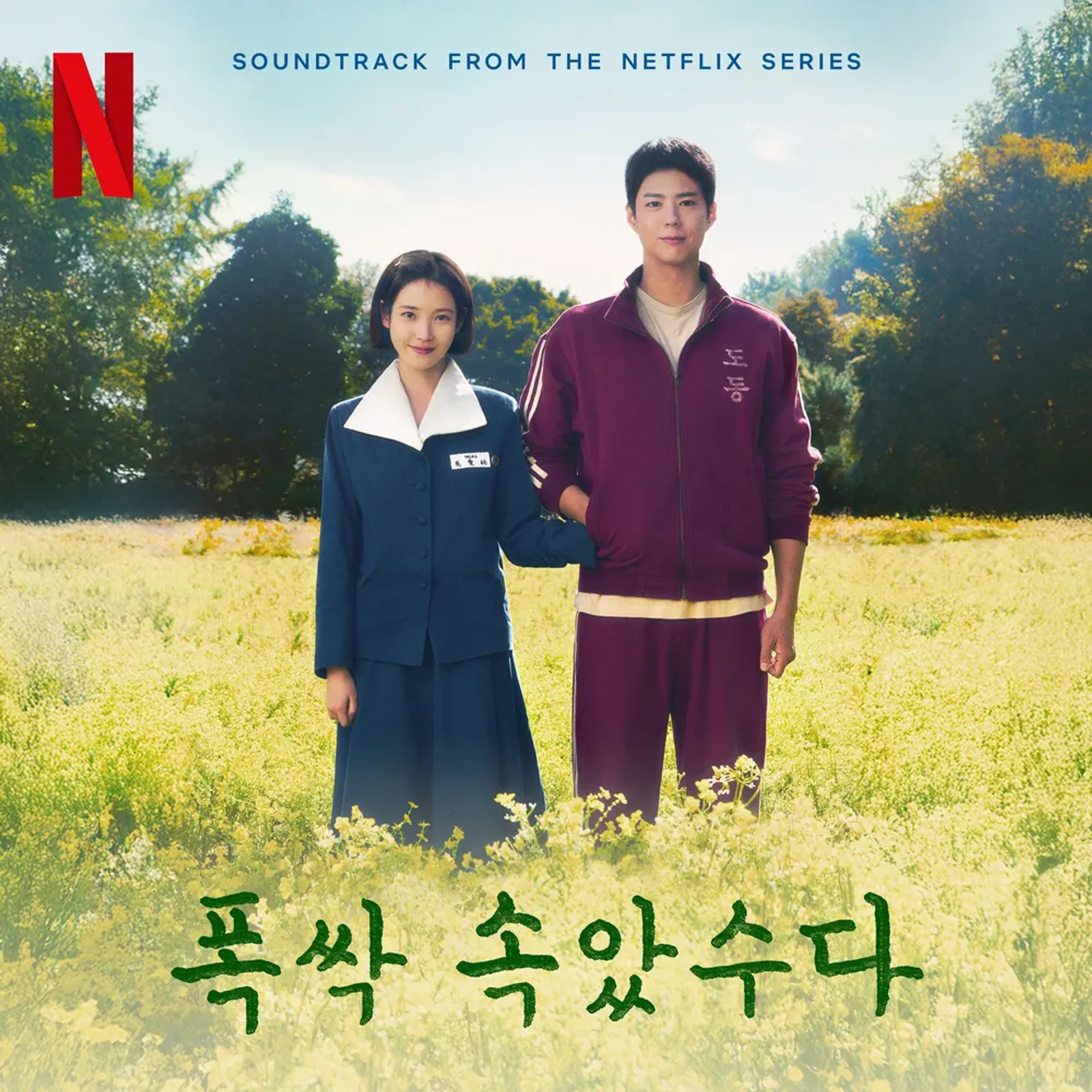
Editor's note: *This is the sixth instalment of our Behind the Scenes series. This edition covers* Pok-ssak Sok-assuda *(internationally titled* My Mister/Goodbye My Love *— known in Korean by a Jeju dialect phrase meaning roughly "I've been utterly fooled"), *a Netflix series released in March 2025. The account below draws on production press conferences and crew interviews to reconstruct the decisions made off-camera.*
Released on Netflix on 7th March 2025, *Pok-ssak Sok-assuda* spans roughly 65 years of Korean life — from 1960s Jeju Island to the present day — across 16 episodes. After all four acts were made available on 28th March, the series topped Netflix's global top-ten non-English TV chart for the week of 31st March to 6th April, logging 5.4m views. Almost nothing of the era it depicts physically survives. The production team bridged that gap through sets, music and a carefully observed philosophy of restraint.
A Jeju fishing village built in Andong, with stone shipped from Vietnam
At the production press conference, director Kim Won-seok was circumspect about the reported budget of 60 billion won (roughly $45m), saying he was "not entirely sure of the precise figure himself." He did confirm, however, that open-air sets and visual effects accounted for a large share of the cost.
According to the art department, both the Jeju fishing village and the Jeju town-centre sets were constructed in Andong, in North Gyeongsang Province — some 300 kilometres from the island they were meant to represent. Finding suitable land on Jeju itself proved too difficult. A single set was repeatedly reconfigured to reflect different decades. Hundreds of tonnes of earth were brought in to shape the terrain. Jeju's distinctive basalt lava rock — legally protected and impossible to remove from the island — was sourced instead from Vietnam and Cheorwon. Vegetation came from the southern coastal region of Namhae and from Jeju. The sea visible in the Andong sets was extended digitally.
Each era demanded different spaces. A 1990s Seoul street scene required the production to dress entire blocks in the cities of Jeonju and Gunsan. The "Cannes Theatre" in the Bongcheon-dong district of Seoul was assembled from four separate locations: a period film set in Hapcheon, locations in Gwangju and Jongno, and an interior studio. A church used for a wedding scene and a hospital used for a health check-up were filmed as found, without alteration. Banners, flyers and posters were researched down to the typography, vocabulary and colour palette of the period, then printed by hand and artificially aged. The director personally reviewed the lettering on props.
"Don't overdo it"
A large budget might easily have tempted a production towards visual excess. Director of photography Choi Yun-man consciously moved in the opposite direction. His guiding principle, he said, was simply: "Don't overdo it." He was determined not to constrain actors' movements for the sake of a better angle or more flattering light. The goal, particularly for scenes depicting poverty, was matter-of-fact plainness rather than heightened drama.
Many scenes involved large ensemble casts, and the crew chose to shoot extensively to capture individual character. A scene depicting the couple's first night together in a roadside inn after running away was filmed in a single unbroken camera movement — a take that required numerous attempts to execute. A swimming scene shot in Busan and a separate scene filmed in Jangheung had to be matched for weather texture, with colour grading in post-production used to unify their tonal register.
82 tracks, and a re-recording requested from the original artist
The music was constructed era by era and emotion by emotion. Music director Park Sung-il identified three distinct sonic periods: the 1960s, the 1980s and 1990s, and the present. He said his focus throughout was on feeling rather than genre. The series ultimately used 82 pieces of music in total: 59 Korean pop songs, four Western pop tracks, three folk songs and five classical pieces.
Copyright clearance was the single greatest obstacle, and several originally chosen tracks had to be replaced with newly composed pieces. For a pivotal death scene in episode twelve, the team settled on "Gwiro" ("The Way Home"), a 2016 song by the veteran Korean singer Jeong Mi-jo. Wanting a more subdued emotional register, they asked her to re-record the song in a lower key — an approach the music director described as unusual, since returning to an original artist to re-record an existing work is rare.
Securing the rights to the Beatles' "Yesterday" for use in a Korean drama required substantial cost and time to navigate international licensing. The music director noted he had been told this was the first time a Beatles original had been used in a Korean television drama.
Traditional Korean instruments were woven throughout the score. In "Ae-soon's Theme," a *piri* (a double-reed wind instrument) took the role normally played by a flute. A track called "Song of Youth" placed a *geomungo* (a six-stringed zither) over a disco rhythm. Of the original compositions, the first to be completed was "To the Land of Hope," performed by the singer Choi Baek-ho; its orchestral parts were recorded in the Czech Republic. A song called "Name," performed by singer-songwriter Kwak Jin-eon, was composed in three minutes the evening before the recording session. The entire soundtrack was mixed in Dolby Atmos, with spatial audio designed so that when the camera moves, the music moves with it.
"Every one of them was the writer's choice"
The casting, too, had its own story. Director Kim Won-seok said that screenwriter Lim Sang-chun "wanted the actors who could give the finest performances." Of the supporting cast — Jung Hae-kyun, Yum Hye-ran and veteran actress Na Moon-hee — he said: "Every one of them was the writer's pick. She wanted them from the very beginning." For the lead role of Ae-soon, the director said, "I couldn't think of anyone but IU for the spirited, mischievous version of the character." Actor Park Bo-gum, returning from mandatory military service, chose the series as his comeback project; he said he was drawn to the beauty of Ae-soon and Gwan-sik's story on the page. The director continued to consult the screenwriter throughout editing and scoring, and coordinated the emotional nuances of characters with her by telephone even during filming.
Reception and awards
Two international outlets named the series the best Korean drama of 2025. At the 61st Baeksang Arts Awards — South Korea's most prestigious television and film prizes — held at COEX in Seoul on 5th May, the series won four trophies: Best Drama Series, Best Supporting Actor (Choi Dae-hun), Best Supporting Actress (Yum Hye-ran) and Best Screenplay (Lim Sang-chun). The two leads, IU and Park Bo-gum, did not receive awards. At the press conference, the director described the series as "both a tribute to an age that has passed and a song of encouragement for the age to come."
*In brief: A production that spent its considerable budget not on visual grandeur, but on the meticulous work of bringing a vanished era back to life.*