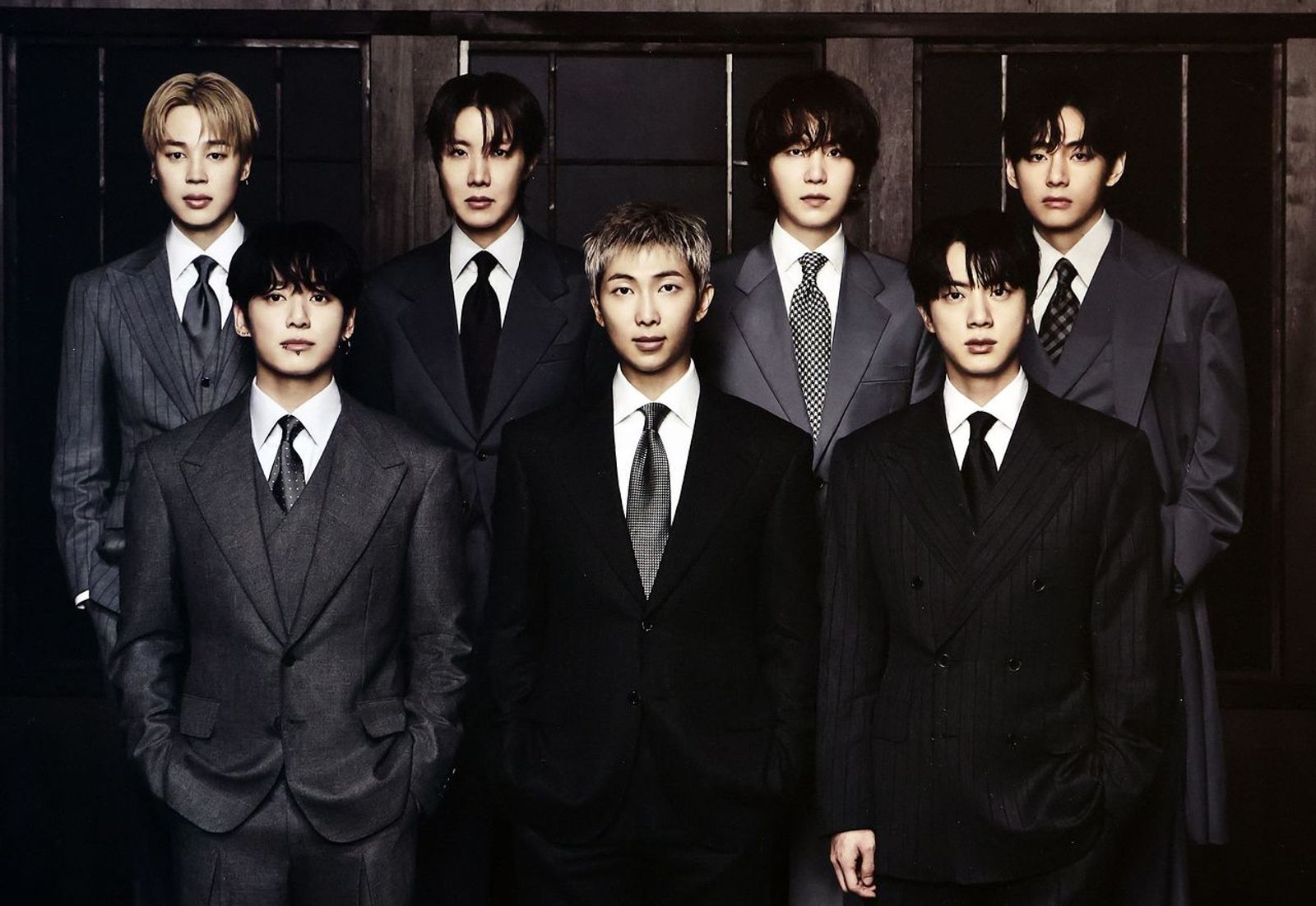
The Group
BTS is a seven-member South Korean boy group comprising RM, Jin, Suga, J-Hope, Jimin, V, and Jungkook. They debuted on 13th June 2013 under Big Hit Music, a small Seoul-based entertainment agency. Their fandom goes by the name ARMY. The group's name, an abbreviation of the Korean phrase *Bangtan Sonyeondan* (防彈少年團), translates roughly as "bulletproof boy scouts"—a declaration of intent to shield young people from social prejudice and oppression.
From the moment they became the first K-pop act to win a Billboard Music Award in 2017, BTS rewrote the rules of the global music industry. They topped the Billboard Hot 100, performed at the Grammy Awards, addressed the United Nations General Assembly, and visited the White House. More than any other act, they proved that K-pop could occupy the centre of global popular culture rather than its margins.
From Obscurity to Global Dominance
The origins of BTS were modest. When the group debuted in 2013, Big Hit Entertainment was a minor agency with a few dozen employees, competing in a market dominated by the "Big Three" labels—SM, YG, and JYP Entertainment. The odds against a newcomer breaking through were long.
Their strategy was to make social media their stage. Before the official debut, they shared footage of their rehearsals and training, communicated with fans directly, and—unusually for K-pop—wrote and composed much of their own material. The music told their own stories rather than narratives crafted by label executives.
The turning point came in 2017. After their first Billboard Music Award, the records fell in quick succession. "Dynamite" reached number one on the Billboard Hot 100—the first K-pop song to do so. "Butter" held the top spot for ten weeks. They delivered four consecutive Grammy performances. In 2020, even as the pandemic shuttered concert venues worldwide, one million people logged on for their "Permission to Dance on Stage" online concert. The share price of HYBE, Big Hit's successor company and the agency that manages BTS, soared in tandem with the group's rise.
Then, in 2022, BTS announced they would fulfil their mandatory military service obligations—a legal requirement for virtually all South Korean men. Jin was the first to enlist, followed by the others in sequence. It was the longest forced hiatus in K-pop history. HYBE's share price lurched, and the industry asked itself: what becomes of K-pop after BTS?
The members found different ways to remain present during their absence. Suga attracted controversy when he was involved in a drink-driving incident during a solo tour. J-Hope, among the first to be discharged, returned with "Sweet Dreams (feat. Miguel)", which entered the Billboard Hot 100. Then, on 20th March 2026, all seven members having completed their service, BTS reunited and released their fifth studio album, *ARIRANG*.
**The Return: *ARIRANG* and What Comes Next**
*ARIRANG* is less an album than a manifesto. The title itself signals intent: it is borrowed from Korea's most famous folk song, a melody that carries centuries of longing and resilience. The lead single, "Body to Body", samples the traditional *arirang* melody before pivoting into hip-hop and pop. The production roster is formidable—Diplo, Ryan Tedder, Kevin Parker, Mike Will Made It, and JPEGMafia all contributed. First-week sales reached 4.17 million copies. The album debuted at number one on the Billboard 200. On South Korea's Circle Chart (the domestic equivalent of the Billboard charts), BTS commanded a 22.1% share of total first-quarter album sales. The numbers remain staggering.
The comeback was not without turbulence. On 21st March 2026—the day after the group performed at Seoul's Gwanghwamun Square to mark their return—questions were raised about whether it had been appropriate to perform "FYA", a song built around fire imagery, given that a factory fire in the city of Daejeon the previous day had left dozens of people dead or injured. Big Hit Music issued a formal apology. It was an ill-timed controversy to emerge in the glow of a triumphant return.
The K-pop market BTS re-entered had changed considerably during their three-year absence. NewJeans had become a cultural phenomenon. IVE had broken through. New acts had reshaped the competitive landscape. ARMY, BTS's notoriously devoted fanbase, remained intact—but it is equally true that many younger fans had moved on to other idols during the hiatus. BTS came back to a world that had been waiting for them, but it was not quite the same world they had left.
The Challenge Ahead
The paradox BTS now faces is that their greatest burden may be their own name. The "ARIRANG World Tour", running from April 2026 to March 2027, is their first full-group tour in seven years. Tickets sold out within minutes. Fandom loyalty, by any measure, remains extraordinary.
Yet loyalty is not what BTS needs to prove. The question is whether they have grown as artists—whether they have changed as much as the world around them has. *ARIRANG* was their first answer. It was not a perfect one, but then BTS have rarely begun perfectly. Their history is one of imperfect starts followed by outcomes that approach perfection.
For HYBE, the full reunion carries implications well beyond music. The company's heavy financial dependence on BTS was painfully exposed during the hiatus: revenue streams tied to the group—album sales, merchandise, touring, and licensing—dried up in ways that no other act in HYBE's portfolio could compensate for. The group's return promises to lift both earnings and the share price simultaneously. The entire K-pop industry is watching to see what BTS does next.