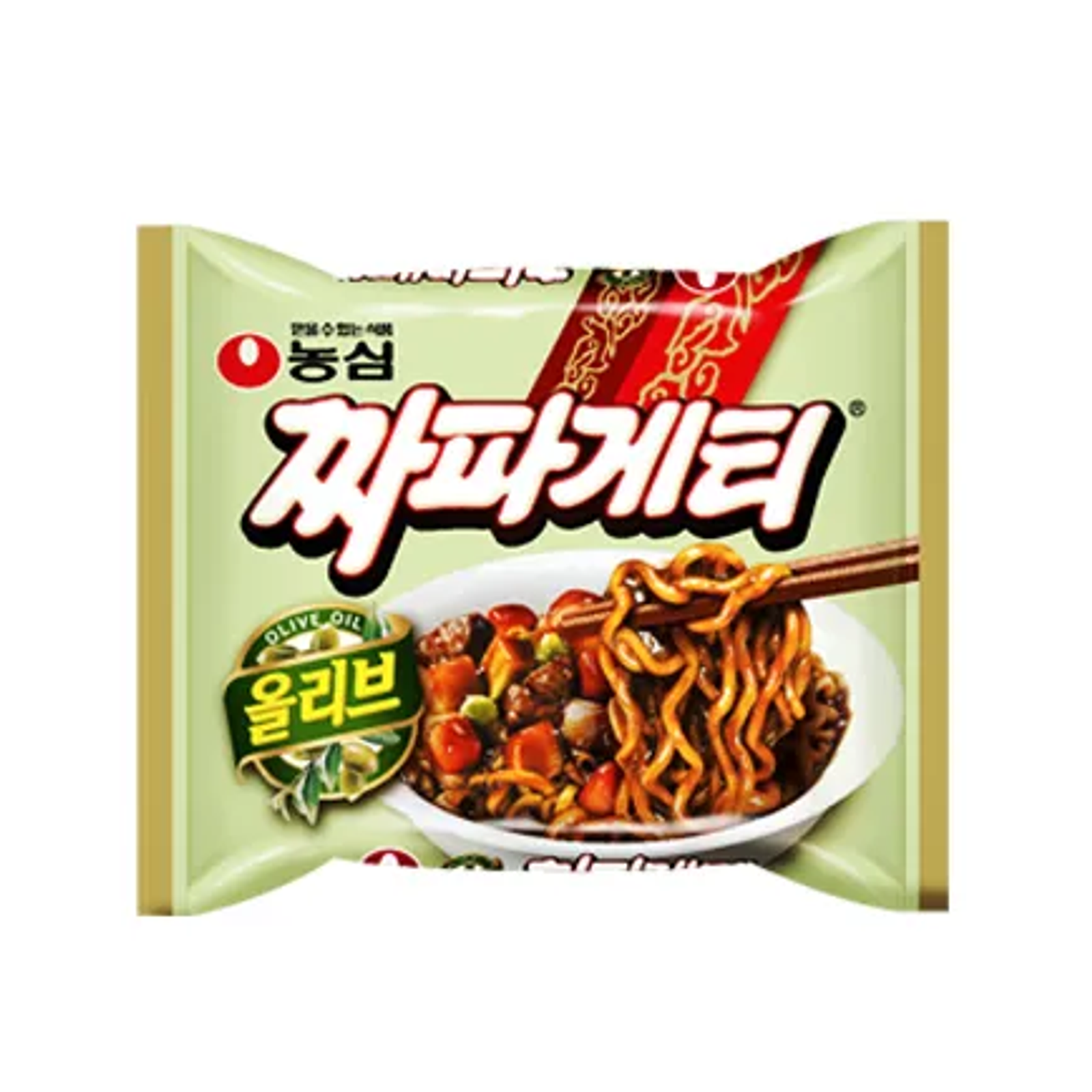
19th March 1984. A packet of instant noodles went on sale for 200 won. Its name, Chapagetti, was a portmanteau of *jjajangmyeon* (a Korean-Chinese noodle dish coated in black-bean sauce) and spaghetti. Forty years on, cumulative sales stand at 9.4 billion packets. Its share of the black-bean noodle market is 80%. Nationally, only Nongshim's own Shin Ramyun outsells it. It is also the only instant noodle to appear in a film that won four Academy Awards. By the numbers alone, Chapagetti is a perfect king.
But it has sat on its throne for rather too long.
The Story
Chapagetti was born of obsession. When Nongshim launched its first black-bean instant noodle in 1970, demand outstripped supply even with production lines running at full capacity. Copycat products flooded the market. Determined to make something impossible to imitate, Nongshim sent researchers touring black-bean noodle restaurants across the country to collect recipes. The result was Chapagetti. Even its name set it apart. It introduced Korea's first granule-based seasoning powder — a fine, sand-like formulation designed to blend evenly with the noodles — and packaged the whole thing as something new rather than a mere replica of a Chinese-Korean restaurant staple.
It sold furiously from the outset. An advertising slogan — "Sunday is the day I'm a Chapagetti chef" — turned fathers who rarely entered the kitchen into weekend cooks. Rivals arrived in force. From 1985 onwards, Samyang's Jjajjaroni and a procession of competing black-bean noodles entered the market. None cleared the bar Chapagetti had set. For four decades, the category was effectively a one-brand show.
The fiercest challenge came in 2015, and it originated inside Nongshim itself. Jjawang, a premium black-bean noodle featuring thicker 3mm noodles and a richer sauce, reached number two in overall ramen sales within a month of launch. A broader boom in black-bean noodles followed, with Ottogi, Paldo and Samyang all entering the fray. For the first time, Chapagetti's dominance seemed genuinely precarious. Yet Jjawang and the rest proved to be short-lived sensations; the trend quickly pivoted to premium spicy seafood noodles, led by Ottogi's Jinjjambbong. Today Nongshim still holds 81% of the black-bean noodle market, while Ottogi, Samyang, Paldo, Harim and Pulmuone collectively fight over the remaining 19%. After forty years, the competitive landscape is essentially unchanged.
The real inflection point was 2013. A scene on the popular MBC reality programme *Dad, Where Are We Going?* — in which a child named Yoon-hu made "Chapaguri", a mashup of Chapagetti and Nongshim's Neoguri seafood noodle — sent sales of both products soaring: Chapagetti up 78%, Neoguri up 20%. Nongshim signed the father-and-son duo from the show as brand ambassadors.
Then came 2020. Bong Joon-ho's film *Parasite* swept the Oscars, winning four awards including Best Picture. A scene featuring Chapaguri prepared with premium Korean beef travelled around the world, and Chapagetti's international sales more than doubled year-on-year. Import requests arrived from countries — Chile, Bahrain, Palau, Sudan — where the product had never been sold. The number of export markets expanded to over 70.
At the precise moment Chapagetti became globally famous, it was Chapaguri, not Chapagetti alone, that the world had fallen for.
Tasting Notes
Chapagetti is good. Still, even now. The rich, savoury black-bean seasoning remains as consistent as it has ever been. The noodles are pleasingly thick and springy. An oil sachet containing olive oil produces the satisfyingly sticky, slightly glossy coating that defines a well-made stir-style instant noodle. The deep black sheen of the finished dish is a visual pleasure all of its own.
Honesty, however, demands a qualification. Having eaten Chapagetti The Black — a premium version launched for the 40th anniversary in 2024 — and then returning to the original, one notices an absence. The Black achieves a deeper, more complex flavour profile. That a derivative product built on a four-decade-old recipe should outperform its source is simultaneously a compliment and an indictment.
The more fundamental problem is that Chapagetti performs best when it is not eaten alone. Chapaguri, the combination with fried chicken and cheese known colloquially as *jjagye-chi*, variations with grilled pork belly — the noodle seems to reach its potential only when something else is added. Exceptional versatility as a culinary base is a genuine asset, but it also implies that the product, by itself, is no longer quite sufficient.
Verdict
Chapagetti is the undisputed sovereign of black-bean instant noodles, undeposed for forty years. It has also sat on that throne for rather too long. *Parasite* introduced the world to Chapagetti, but what the world actually encountered was Chapaguri — a co-creation, not a solo triumph. Every time a challenger has appeared over four decades, Chapagetti has outlasted it. Jjajjaroni, Jjawang, Ottogi's Jinjjajang — all eventually retreated. Yet there is a difference between a throne defended through competition and one retained simply because no rival proved strong enough to seize it. Unchallenged thrones gather dust.
It is delicious. But that is all it is. The time has come to shake the dust off.
★★★☆☆ (3.0 / 5.0)
In a sentence: "Forty years of dominance carry real weight — but that weight is beginning to slow Chapagetti down."