Company overview
CJ CheilJedang is South Korea's largest integrated food company, operating across three divisions: food, bio-materials, and feed-and-care. It is the flagship subsidiary of CJ Group, a conglomerate that was spun off from Samsung in the 1990s, and it regularly ranks among the top companies by market capitalisation on the KOSPI, South Korea's main stock exchange. Its consolidated revenues have held in the 29–30 trillion won range in recent years. The 2019 acquisition of Schwan's, an American frozen-food business, gave it a significant foothold in the global frozen-foods market.
Yet for all its scale, CJ CheilJedang has been unable to escape what analysts call the "low PBR trap." Since 2025 its price-to-book ratio has languished between 0.3 and 0.5 times — meaning the market values the company at a steep discount to its net assets. With retained earnings exceeding 5 trillion won, the paradox of a cash-rich company whose share price continues to drift lower has made CJ CheilJedang one of the most-cited examples in South Korea's ongoing debate about corporate undervaluation.
When the South Korean government launched its formal "Value-Up" programme in 2024 — a policy initiative encouraging listed companies to improve shareholder returns and narrow the gap between book value and market price — CJ CheilJedang duly pledged to expand distributions and enhance corporate value. Whether those pledges represent genuine change, however, remains an open question. Slowing earnings, a complex group restructuring, and a looming ownership succession within the founding family have clouded the picture considerably.
Business foundations and financial performance
*Three-division structure*
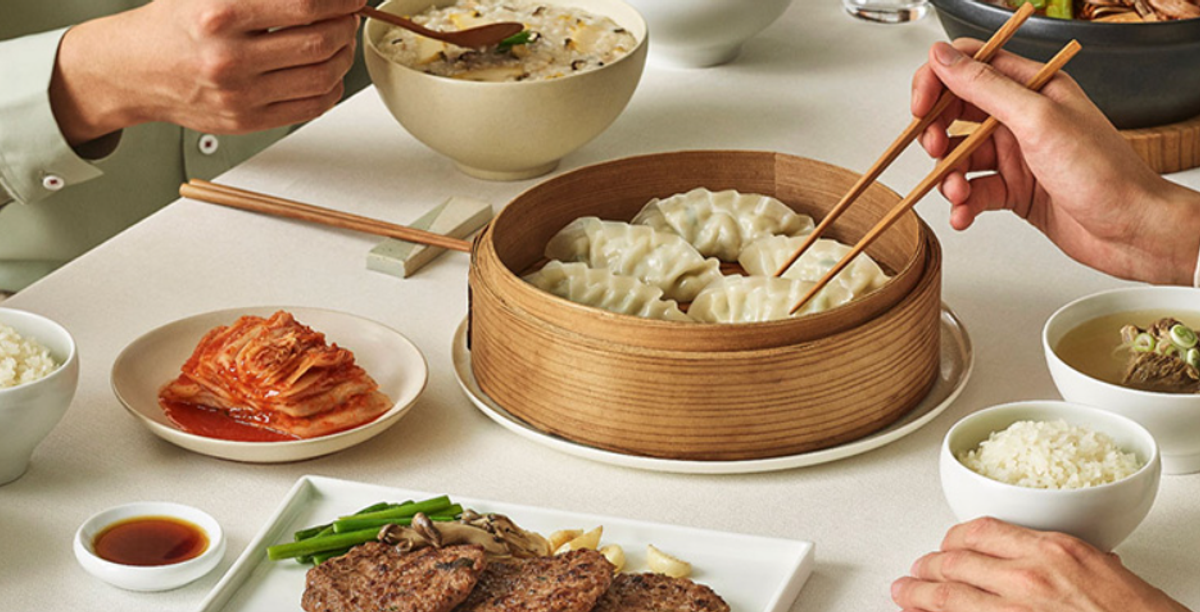
CJ CheilJedang's business divides into three segments. The food division encompasses domestic processed-food brands — including Hetbahn (ready-cooked rice) and Bibigo (Korean-style dumplings and sauces) — as well as frozen-food operations in the United States and Europe inherited from the Schwan's acquisition. The bio division produces fermentation-derived amino acids and nucleotides sold into global food and feed markets. The feed-and-care division handles animal feed and veterinary pharmaceuticals.
The bio division is the most volatile of the three. Its margins are highly sensitive to global commodity prices and cyclical oversupply in fermentation ingredients, which introduces a structural source of earnings instability that undermines the group's overall profitability.
*Financial results*
Revenue grew sharply after the Schwan's deal closed, but profitability moved in the opposite direction. Rising interest costs on acquisition debt, a prolonged downturn in the bio segment, and softer consumer demand globally have all weighed on margins. Net profit has declined visibly in recent years.
Year | Revenue (consolidated, estimated) | Operating profit (estimated) | Key developments
2021 | ~26 trillion won | ~1 trillion won | Covid tailwinds; Bibigo global expansion
2022 | ~30 trillion won | ~900 billion won | Input-cost pressure; rising interest rates
2023 | ~29 trillion won | ~700 billion won | Bio-segment slump; Schwan's interest burden
2024 | ~29 trillion won | ~750 billion won | Restructuring and efficiency drive begins
2025 | ~28 trillion won | Similar to prior year | Revenue contraction; dividend commitment maintained
*Note: Figures above are estimates based on public filings and media reports and may differ from final audited results.*
*The gap between retained earnings and share price*
As of July 2025, CJ CheilJedang's retained earnings stood at approximately 5.7 trillion won — a substantial sum relative to its market capitalisation. The resulting picture, of a balance sheet growing stronger while the share price drifts lower, has become a textbook illustration of the inefficiency the government's Value-Up programme is designed to address. Some investors suspect the accumulated surplus is being preserved as ammunition for the group's ownership restructuring rather than being returned to shareholders — a concern that continues to suppress the valuation.
Value-Up milestones
*August 2025 — Interim dividend raised 50% despite falling revenues*
Even as first-half revenues declined year on year, CJ CheilJedang announced a 50% increase in its interim dividend compared with the same period a year earlier. Management described the move as a demonstration of its commitment to the Value-Up programme and to maintaining investor confidence despite near-term earnings headwinds.
*November 2025 — Treasury shares and succession concerns surface*
Attention turned to the volume of treasury shares held across the CJ group. Affiliates including CJ Logistics held approximately 13% of their own shares in treasury, while CJ Olive Young held around 23%. Market observers noted that treasury shares of this scale could serve as a key instrument in a fourth-generation ownership succession — that is, transferring control to the children of CJ Group chairman Lee Jae-hyun. The episode brought into sharp relief the tension between shareholders demanding that treasury shares be cancelled (which would boost per-share value) and the founding family's interest in retaining them for use in a future restructuring.
*December 2025 — Full-year dividend commitment honoured despite profit decline*
With annual net profit having deteriorated, CJ CheilJedang confirmed it would honour the dividend guidance issued at the start of the year. Reactions were divided. Some analysts credited management for not allowing short-term results to override its shareholder commitments. Others questioned whether maintaining dividends without a recovery in underlying earnings was financially sustainable over the longer term.
*January 2026 — Mandatory cancellation proposals accelerate succession timetable*
South Korean financial regulators began examining rules that would require companies to cancel, rather than merely hold, treasury shares. If enacted, such a requirement would foreclose the option of using treasury shares to facilitate an ownership transition — prompting analysts to conclude that CJ Group would need to move more quickly on its succession plans before any new rules took effect. The episode underscored the degree to which the Value-Up agenda and the group's internal succession strategy are intertwined.
*March 2026 — Public apology at AGM; chief executive declares "year of innovation"*
At the annual general meeting in March 2026, management offered shareholders a public apology for the company's operational underperformance and declared that 2026 would be "the founding year of growth and innovation" under chief executive Yoon Seok-hwan. Shortly afterwards, group chairman Lee Jae-hyun made a high-profile visit to a flagship Olive Young store in central Seoul, which was widely read as a signal of renewed personal commitment to expanding the beauty-and-wellness retailer and reviving the group's broader Value-Up effort.
*March 2026 — Annual results announcement; dividend maintained*
Alongside its full-year 2025 results, CJ CheilJedang formally reiterated its intention to hold dividends steady, consistent with its Value-Up commitments. The market response remained cautious, with concerns about financial sustainability sitting alongside acknowledgment that the company was at least keeping its word to shareholders.
*April 2026 — Low valuation persists; analysts see no quick fix*
By April 2026, CJ CheilJedang's PBR had still not improved materially. Commentary in the financial press concluded that dividend increases alone were insufficient to re-rate the stock, and that a genuine recovery in profitability and a simplification of the group's ownership structure were prerequisites for any meaningful valuation improvement.
*May 2026 — Company becomes a market laggard during broader KOSPI rally*
As the KOSPI rallied strongly in May 2026, CJ CheilJedang's share of total market capitalisation roughly halved. The sardonic phrase circulating among investors — "the only thing worth owning in CJ is Olive Young" — captured the frustration. While peers such as Samsung, SK, and Hyundai were being re-rated on the back of the Value-Up programme, CJ CheilJedang remained conspicuously left behind.
Challenges ahead
Analysts broadly agree on three preconditions for a genuine valuation recovery.
The first is restoring profitability. Dividends require earnings to sustain them. That means a cyclical recovery in the bio segment, a reduction in the interest burden inherited from the Schwan's acquisition, and improved margins in the domestic food business — all at the same time.
The second is governance transparency. The suspicion that accumulated treasury shares are earmarked for succession purposes will not dissipate until CJ provides an explicit, credible account of what those shares are for. Without that, shareholders will struggle to take pledges of cancellation or enhanced distributions entirely at face value.
The third is unlocking the value of CJ Olive Young. The beauty and health retailer is widely regarded as the group's most valuable asset. A stock-market listing of Olive Young would put a public price on CJ's stake, likely catalysing a re-rating of the parent company's shares. Under Mr Yoon, delivering on that potential has become one of management's most closely watched obligations.
Assessment
The overall verdict on CJ CheilJedang's Value-Up effort is that intent has been demonstrated but results have not. Maintaining and even raising dividends through a period of declining profits shows a willingness to honour commitments to shareholders. But the core problems — a sub-0.5 PBR, a shrinking market-cap footprint, and eroding investor confidence — remain unresolved. Whether the AGM apology and the declaration of an "innovation year" translate into genuine operational and structural improvement, or prove to be another round of well-meaning but ultimately empty gestures, will determine how this company's Value-Up story is ultimately judged.
Key controversies
*Value-Up versus succession: the treasury-share conflict*
The sharpest controversy surrounding CJ CheilJedang's Value-Up efforts is the question of what the group intends to do with its treasury shares. Cancelling them would raise per-share value and benefit all shareholders unambiguously. Retaining them preserves the option of using them — through swaps, mergers, or other mechanisms — to consolidate the founding family's control during a generational ownership transfer. As long as that ambiguity persists, and as long as proposed legislation to mandate cancellation remains unresolved, shareholders cannot be certain which interest will ultimately prevail.
*Dividends without earnings: a sustainability question*
Paying out — and increasing — dividends during a period of falling net profit is a short-term gesture of goodwill that risks long-term damage to the balance sheet. If sustained too long without a recovery in underlying earnings, the policy could either expand the company's debt or erode its capacity to invest in growth. Some analysts have described this approach as "performative Value-Up" — prioritising optics over fundamentals.
*Structural roots of the low valuation*
CJ CheilJedang's low PBR is not solely a function of disappointing profits. It also reflects the structural complexity of the broader CJ Group: circular cross-shareholdings, the opacity of unlisted subsidiaries' valuations, and the so-called "double discount" that equity markets typically apply to holding-company structures. Addressing these factors requires simplifying the group's corporate architecture — a far more demanding undertaking than raising a dividend.
*Becoming a market laggard*
The fact that CJ CheilJedang's market-cap weight declined during a broader equity bull market, even as the government's Value-Up programme was lifting valuations across many other large Korean companies, is the most pointed evidence of how far it has to travel. Possessing a hidden gem in Olive Young is of limited comfort if that value is never effectively converted into returns for shareholders of the parent company.
Summary data
Year | Dividend per share (est.) | Treasury-share developments | Operating profit (est.) | PBR (est.) | Key Value-Up event
2022 | Maintained | None notable | ~900bn won | ~0.5× | Dividend policy sustained
2023 | Maintained | None notable | ~700bn won | ~0.4× | Bio-segment downturn
2024 | Maintained / slight increase | Discussions begin | ~750bn won | ~0.4× | Formal Value-Up participation announced
2025 | +50% (interim); full-year guidance honoured | Succession-linked treasury-share issue emerges | Similar to prior year | ~0.3–0.4× | Dividend pledge kept despite revenue contraction
2026 | Maintenance reaffirmed | Mandatory-cancellation legislation debated | Recovery targeted | Low PBR persists | AGM apology; "year of innovation" declared
*Note: All figures are estimates reconstructed from public filings and media reports. PBR estimates are based on annual average share prices and may differ from audited figures.*