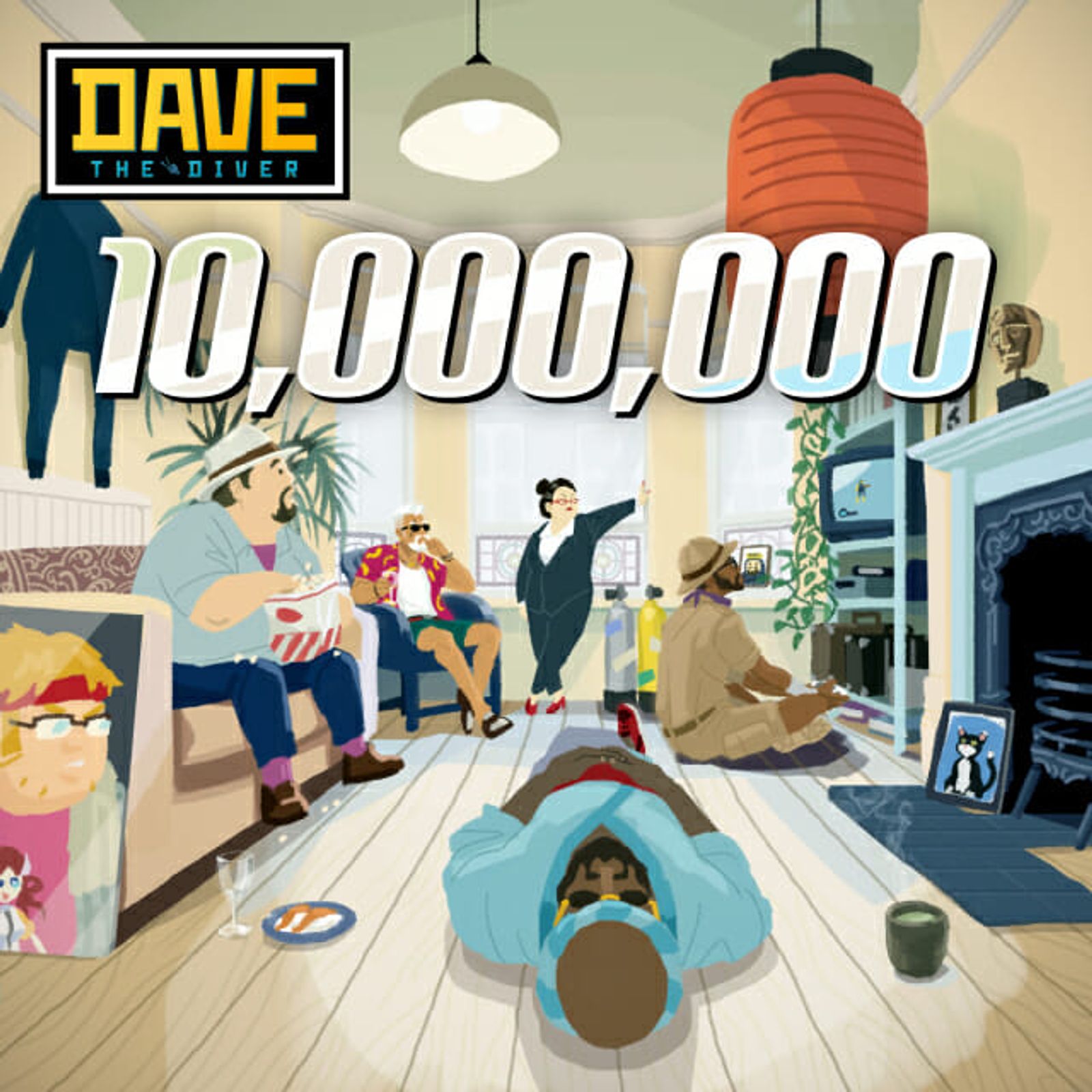
Dave the Diver, developed by Mint Rocket, a subsidiary studio of Korean gaming conglomerate Nexon, has surpassed ten million copies sold. Achieved roughly two years and three months after its official release in June 2023, this milestone is virtually without precedent for a Korean-developed indie title in the global market. The figure is more than a box-office statistic; it marks a structural turning point for South Korea's games industry.
Nexon's Experiment Pays Off
Mint Rocket was established by Nexon in 2021 as an independent development unit operating at arm's length from the parent company's core business. Where Nexon traditionally builds massive online games with large teams and long development cycles, Mint Rocket was designed around a different philosophy: small teams, rapid prototyping, and an indie sensibility.
Dave the Diver was its first major release. The game draws players into a dual loop: by day, they dive into the ocean to catch fish and collect ingredients; by night, they run a sushi restaurant. This clever structure, combined with a distinctive visual style blending pixel art with high-resolution 3D graphics, voluminous storytelling, and an array of mini-games, earned the title a reputation for polish unusual in the indie space. On Steam, the dominant PC gaming marketplace, it maintains an "Overwhelmingly Positive" user rating, and holds a Metacritic score of 89 on PC.
Between Indie and AAA: A New Category Emerges
The game's success sparked a debate that reverberated across the industry: is Dave the Diver actually an indie game? When it was nominated for Best Independent Game at The Game Awards 2023—the industry's most prominent annual ceremony—some independent developers objected, arguing that a title backed by a publisher of Nexon's scale had no business competing in that category. The game did not win the award, but it was also nominated for Game of the Year, a distinction that underscored its broader impact.
Paradoxically, the controversy only elevated the game's profile. It demonstrated that a new segment—sometimes called "mid-core indie," too polished for the indie shelf and too unconventional for the AAA blockbuster category—could command a global audience. According to market research firm Newzoo, titles from small and mid-sized developers accounted for more than 30% of total PC gaming revenues worldwide in 2024.
A New Direction for Korean Gaming
South Korea's games industry has long been dominated by massively multiplayer online role-playing games (MMORPGs) and free-to-play monetisation models. This structure has generated enormous domestic revenues, but it has drawn persistent criticism from Western audiences and observers for prioritising aggressive in-game spending mechanics over gameplay quality. The model, epitomised by the Lineage franchise, remains highly profitable, yet it has constrained Korean publishers' brand image and their ability to expand into new markets.
Dave the Diver took a different approach: a one-time purchase price, supplemented by paid downloadable content (DLC). Reaching ten million sales without subscription fees or randomised loot mechanics—so-called gacha systems—demonstrates that Korean developers can compete on terms familiar to global consumers.
According to the Korea Creative Content Agency's 2024 games industry white paper, South Korean game exports reached approximately $9.7bn in 2023. However, the overwhelming majority of that figure derived from mobile free-to-play titles. Diversifying into premium console and PC games—of the kind that Dave the Diver represents—has long been identified as a strategic priority for the industry.
Lessons from Palworld and Elden Ring
Comparison with contemporaneous global successes sharpens the picture. Palworld, released in early 2024 by Japanese studio Pocketpair, sold ten million copies within three days of launch, generating enormous attention. But player numbers subsequently declined sharply, and the title became embroiled in legal disputes over alleged similarities to Nintendo's Pokémon franchise. Dave the Diver, by contrast, accumulated its sales steadily over more than two years—a trajectory that speaks more convincingly to longevity.
The parallel with FromSoftware's Elden Ring is equally instructive. That title sold over 25 million copies and demonstrated that premium, content-driven games—bought once, with no ongoing spending required—can recapture audiences at massive scale. Dave the Diver has reinforced the same lesson on a smaller but still significant stage: a well-crafted game, free of pay-to-win mechanics, can attract ten million players across cultures and markets.
Platform Expansion and IP Strategy
Mint Rocket has steadily broadened the game's reach beyond its Steam launch, bringing it to the Nintendo Switch, PlayStation 4 and 5, and Xbox Series consoles. A listing on Netflix's gaming subscription service has further extended its audience. The ten-million figure is, in part, the cumulative product of this multi-platform strategy.
Nexon is keeping its options open for further development of the Dave the Diver intellectual property. The studio has already released collaborative DLC with external partners—including content produced in association with Studio Ghibli—suggesting that an IP ecosystem strategy is already under way.
What It Means for the Broader Industry
Dave the Diver's milestone poses several uncomfortable questions for South Korea's gaming establishment. Can large developers preserve the small-team structure and creative sensibility that produced this success? Can the industry meaningfully diversify away from free-to-play monetisation towards premium, content-led revenue models? And, most pressingly, is this a repeatable formula?
Mint Rocket's experience offers a cautious but genuine affirmative to all three. The fact that a single well-made game, built without a blockbuster marketing budget or a single gacha mechanic, convinced ten million paying customers worldwide is a meaningful precedent for Korean developers.
The industry's next question is whether Mint Rocket can replicate the feat with its subsequent projects, and whether Nexon can embed the lesson institutionally—turning an experiment into a template.