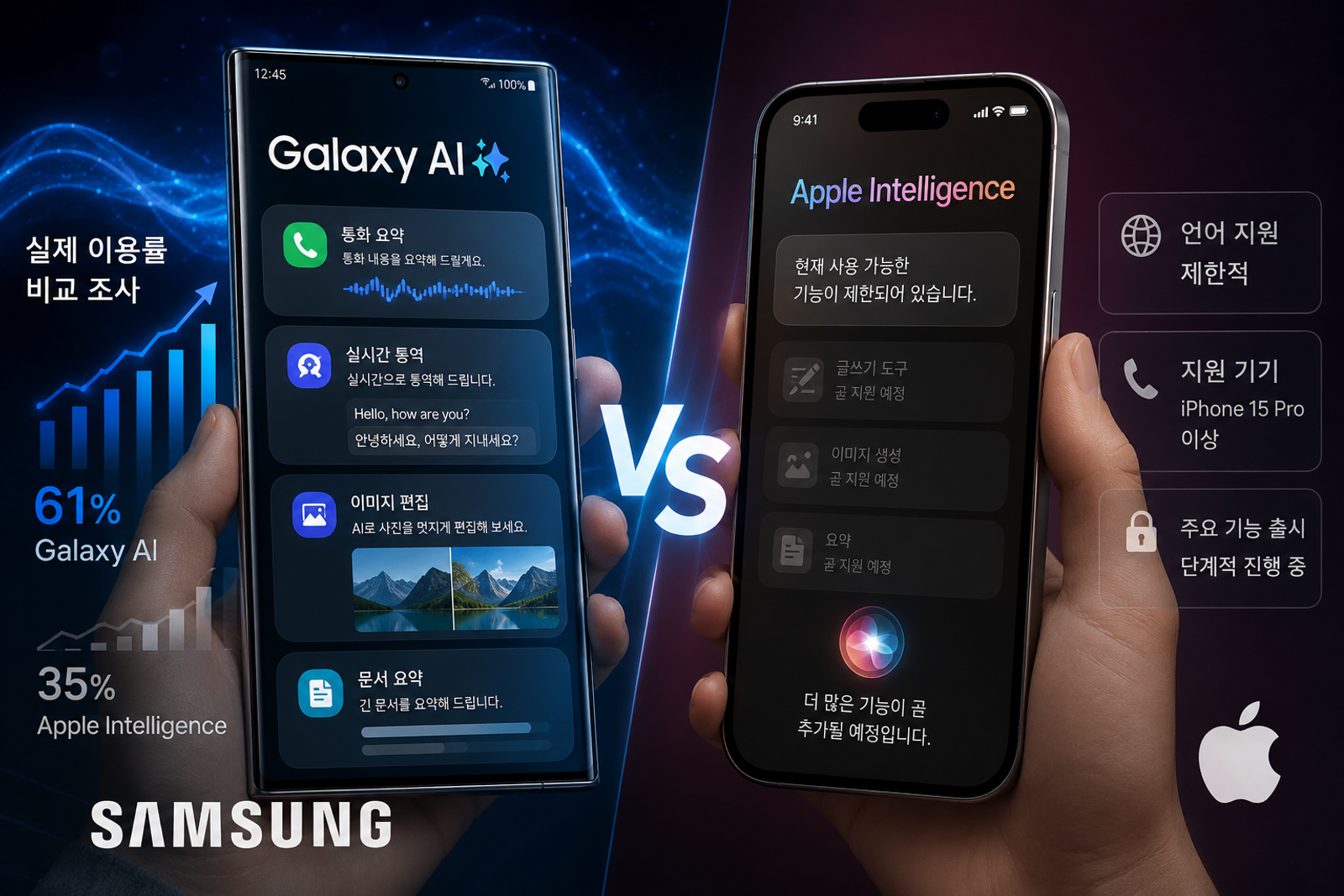
Samsung's Galaxy AI is being used more actively than Apple Intelligence, according to market research and industry analysis — a striking result given that Samsung was long considered the underdog in the race to embed artificial intelligence into smartphones.
Galaxy AI pulls ahead in practice
Galaxy AI has achieved high engagement rates by weaving AI features into everyday smartphone use: call summarisation, real-time interpretation, image editing, and document summaries have all resonated with users. Apple Intelligence, despite its full launch with the iOS 18 update, has struggled to match that accessibility. Limited language support and hardware compatibility constraints have left many users unable to — or uninterested in — using it.
Samsung introduced Galaxy AI alongside the Galaxy S24 series in early 2024, adopting a hybrid approach that combines on-device and cloud-based AI processing. Features such as live call interpretation, Chat Assist, and Circle to Search spread quickly by word of mouth. The subsequent Galaxy S25 series deepened Samsung's partnership with Google, significantly expanding functionality built on Google's Gemini models.
Apple Intelligence: promise versus reality
Apple announced Apple Intelligence at its Worldwide Developers Conference in 2024, declaring it would reshape the AI landscape. Yet the initial roll-out was hampered by delays to multilingual support — Korean, in particular, was deprioritised for an extended period. This widened the usage gap with Samsung across the Asia-Pacific region.
Hardware restrictions compounded the problem. Apple Intelligence's core features are limited to the iPhone 15 Pro and newer models, curbing mass adoption. Samsung, by contrast, extended Galaxy AI's key features to older flagship devices via software updates, broadening the pool of eligible users considerably.
First-mover advantage and divergent ecosystem strategies
Analysts trace Samsung's lead to two factors: an earlier start and features that users can tangibly feel. Samsung brought AI capabilities to commercial devices roughly a year ahead of Apple, and moved swiftly to absorb the latest advances in generative AI through partnerships with Google and Microsoft.
Apple, meanwhile, has held to a closed ecosystem philosophy, prioritising internal coherence. Its emphasis on privacy and on-device processing is well regarded in principle, but the trade-off is slower feature releases and narrower compatibility. "Apple's approach is better suited to building long-term trust," says one mobile AI researcher in Silicon Valley, "but it is structurally disadvantaged in a near-term usage competition."
China, Europe, and Korea: a consistent pattern
In China, domestic brands such as Huawei and Xiaomi lead in AI functionality, but Galaxy AI is reported to have achieved the highest AI feature activation rate among premium foreign smartphones. In Europe, Galaxy AI's real-time translation and summarisation tools have been praised as well suited to a multilingual environment, earning higher satisfaction scores than Apple Intelligence.
The contrast is sharpest in South Korea. Galaxy AI, with full Korean-language support, has established itself among local users as AI that is actually useful. Apple Intelligence's Korean-language service, by comparison, remains limited.
Samsung's challenge: converting usage into loyalty
Higher usage rates do not automatically translate into market dominance. The industry's view is that Samsung's medium- and long-term competitiveness will hinge on whether it can leverage its usage data to sharpen personalisation, and whether it can integrate Galaxy AI coherently across its broader ecosystem — home appliances, wearables, and PCs. Feature breadth alone is not enough; consistency of user experience is what matters.
Apple is not standing still. Planned updates include a ChatGPT integration via its partnership with OpenAI, a comprehensive overhaul of Siri, and expanded multilingual support. These developments could narrow the gap in the second half of the year.
Outlook: the real battleground lies beyond usage metrics
Competition in smartphone AI is evolving from a specification contest into a fight over how deeply each platform can embed itself into users' daily routines. For Samsung, which has seized the early lead, the priority should now shift from adding features to refining the quality of the overall AI experience. Apple, conversely, faces mounting pressure to translate its trust-based AI strategy into the kind of active engagement that usage data currently shows it is lacking.
The contest for mobile AI supremacy is expected to intensify from 2026 onwards. Whichever company first captures users' ingrained habits is likely to determine the shape of the smartphone market for years to come.