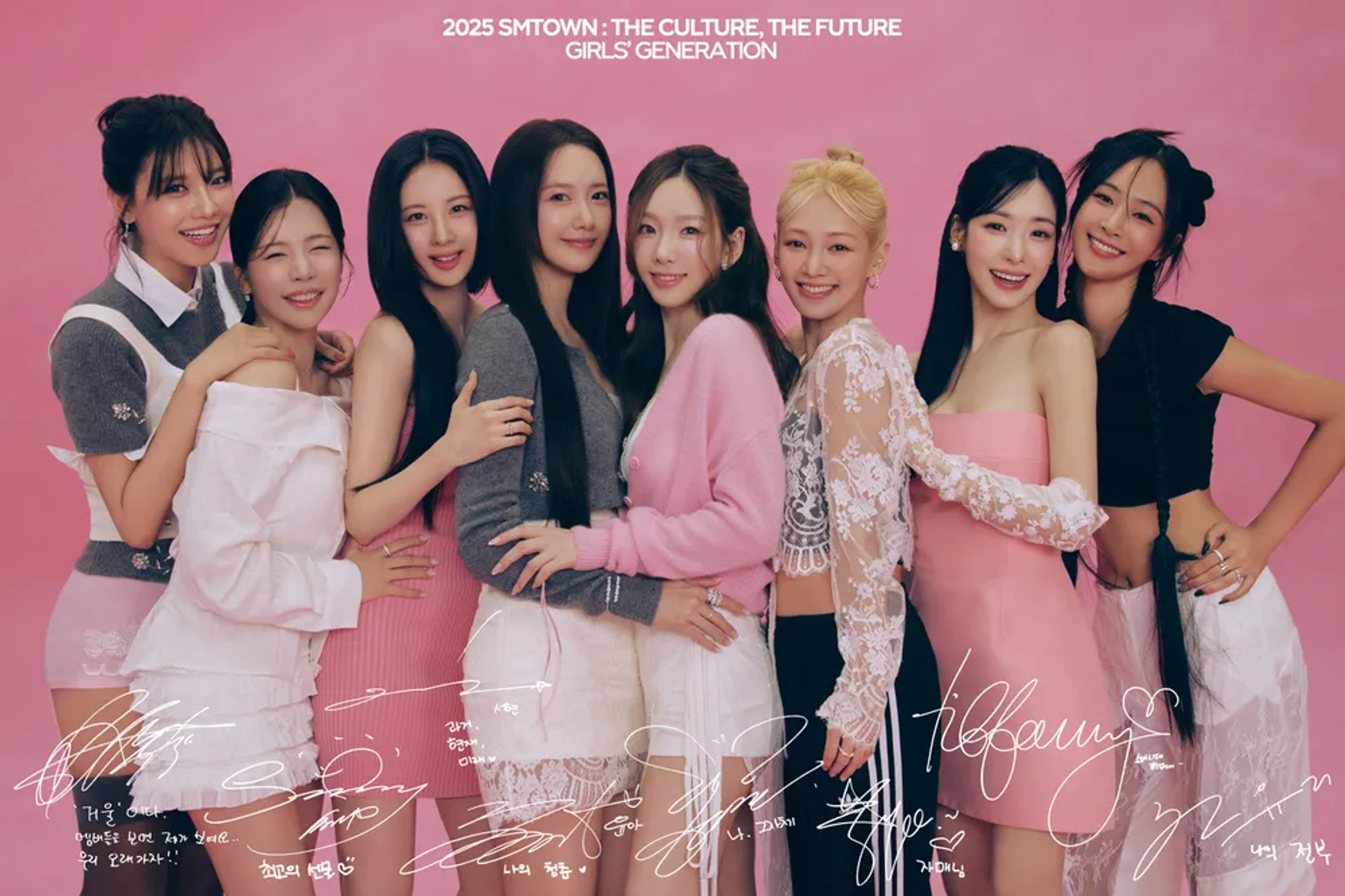
Girls' Generation is an eight-member South Korean girl group managed by SM Entertainment, one of the country's dominant talent agencies. The group debuted on 5th August 2007 with the single "Into the New World". Originally a nine-piece act, it became an eight-member group in 2014 following the departure of Jessica Jung. The remaining members are Taeyeon, Sunny, Tiffany, Hyoyeon, Yuri, Sooyoung, Yoona, and Seohyun. The group's name encapsulates an early ambition: that an era would come in which girls would conquer the Asian pop landscape. Their fanbase goes by the name SONE, the Korean word for "wish".
Rise to prominence
From 2008, a year after their debut, Girls' Generation scored a succession of defining hits — "Into the New World" (re-released), "Genie", and "Gee" — that earned them the unofficial title of South Korea's definitive girl group. What sets them apart from most of their peers, however, is not the music alone but a structural innovation: the expiry of individual members' exclusive contracts with SM Entertainment has never automatically meant the dissolution of the group itself.
In 2022, celebrating their 15th anniversary, Girls' Generation released their seventh studio album as a complete eight-member lineup, even though several members — including Sooyoung, Seohyun, Tiffany, and Sunny — had by then already parted ways with SM. In an industry where a member's departure from a label typically signals the contraction or outright end of group activity, Girls' Generation has spent nearly two decades operating on a different principle: separating individual exclusive contracts from collective group activity. The group has further diversified its model through sub-units — first "Girls' Generation-Oh!GG", and most recently "HyoRiSoo" — allowing the brand to remain commercially active even between full-group comebacks.
Latest development
On 31st August, member Yuri (Kwon Yuri) ended her 19-year exclusive contract with SM Entertainment. The agency confirmed in an official statement that, following in-depth discussions, both parties had "mutually agreed to conclude their 19-year partnership as of 31st August", while stressing that "although the exclusive contract has ended, she will continue to participate in Girls' Generation activities as a member going forward." With Yuri's exit, only three of the eight members — Yoona, Taeyeon, and Hyoyeon — remain signed directly to SM.
The timing carried a certain symmetry. On the very same day that Yuri's contract expired, the new three-member sub-unit HyoRiSoo — comprising Hyoyeon, Yuri, and Sooyoung — released a digital single, "Skibidi". A new release landed on the day a contract closed. The unit, reportedly spearheaded by Hyoyeon, had already generated considerable public interest when its formation was announced. SM has separately indicated that the full eight-member group is targeting a comeback in 2027 to mark the group's 20th anniversary.
The road ahead
Girls' Generation's trajectory poses a fundamental question for the K-pop industry: for how long can a group's brand sustain commercial value when its members are scattered across different agencies, each with their own separate careers and contractual obligations? The group's ability to maintain both full-lineup activity and sub-unit releases — even with a majority of members no longer signed to SM — is increasingly cited alongside Mamamoo, another act whose members are split across three separate agencies yet continue to perform together, as evidence of what might be called decentralised sustainability in K-pop.
For SM, the stakes are significant in their own right. As the cost of launching new idol groups has risen sharply, the label has come to rely on the concert revenues, album sales, and merchandise income generated by veteran acts with deep, loyal fanbases — the kind of intellectual property that Girls' Generation represents. The complication is that with only three members still under direct contract, the administrative and financial cost of co-ordinating with the individual agencies of the other five members will grow with each future project. Whether the promised 20th-anniversary comeback can be assembled smoothly — navigating what is now a considerably more complex web of competing interests — will be the most instructive test of the group's famous resilience.