Company Overview
GS Co., Ltd. is the holding company of the GS Group, one of South Korea's ten largest conglomerates (chaebol), with major subsidiaries spanning energy, retail and construction — among them GS Caltex, GS Retail, and GS Engineering & Construction. Listed on the KOSPI, South Korea's main stock exchange, GS operates as a typical industrial holding company, deriving the bulk of its income from dividends paid up by subsidiaries and from brand-royalty fees charged to group affiliates.
Because its core businesses — oil refining, retail distribution and construction — are all cyclical, the group's earnings swing sharply through the economic cycle. That volatility, compounded by the structural discount that markets routinely apply to opaque holding companies, has kept GS's price-to-book ratio (PBR) pinned in a range of 0.3 to 0.4 times for years.
The backdrop changed in 2024, when the Korea Exchange and financial regulators launched the "Value-Up Programme" — a government initiative designed to close the chronic gap between Korean equities and their book values, modelled loosely on similar reforms in Japan. Major group holding companies, including Samsung and Hyundai Motor, moved quickly to file voluntary disclosure plans. GS was conspicuously slow to follow. When it finally submitted its Value-Up disclosure in September 2025, commentators noted that all ten of South Korea's largest conglomerates had at last joined the programme. GS subsequently announced share cancellations and higher dividends, and formally adopted a medium-term target of reaching a PBR of 1.0 times. Investors are now watching to see whether a potential oil-refining upcycle at GS Caltex, combined with a bolder shareholder-returns policy, could trigger a genuine re-rating of the stock.
Business Mix and Financial Performance
The three pillars
GS's earnings rest on three main business segments.
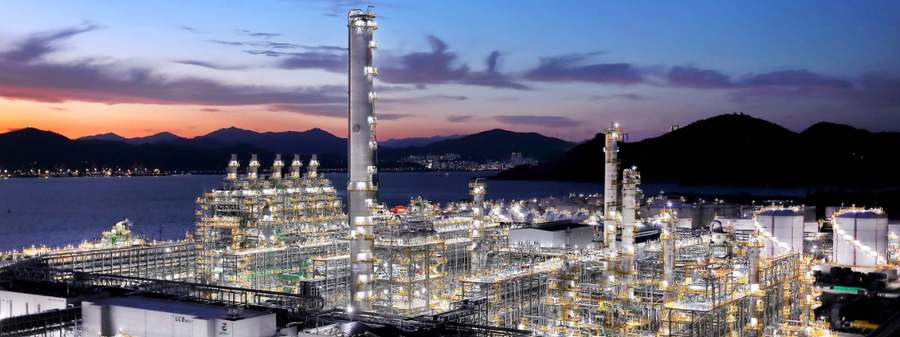
The energy segment, anchored by GS Caltex, is the dominant profit driver. Returns here fluctuate sharply with international crude prices and refining margins, the spread between the cost of crude oil and the selling price of refined products.
The retail segment, led by GS Retail, encompasses the GS25 convenience-store chain, the GS The Fresh supermarket network, and a home-shopping business. This segment generates relatively stable cash flows, providing a useful buffer when energy earnings disappoint.
The construction and infrastructure segment, centred on GS E&C, covers housing and industrial plant projects. Rising construction costs and losses on overseas contracts have weighed heavily on this division since 2023.
Earnings record
As a holding company, GS's consolidated operating profit is essentially a weighted average of its subsidiaries' fortunes, with GS Caltex's refining margin acting as the swing factor.
Year | Consolidated operating profit (est.) | Dividend per share | Share cancellations | Year-end PBR
2021 | ~₩2 trillion | ₩2,500 | None | ~0.35×
2022 | ~₩3 trillion | ₩3,000 | None | ~0.32×
2023 | ~₩1 trillion | ₩2,500 | None | ~0.30×
2024 | ~₩1.5 trillion | ₩2,800 | Partial | ~0.32×
2025 | Improving | Raised | Conducted | ~0.38×
2026 (H1) | Refining boom expected | Raised further | ₩1.8bn cancelled | Rising
*Figures are based on company filings and market estimates; some items may differ from final reported results.*
The GS Caltex volatility problem
The energy division exemplifies the earnings swings that have long frustrated investors. After Russia's invasion of Ukraine in 2022 sent refining margins to record highs, GS Caltex posted its strongest-ever profits. A year later, as margins normalised and inventory write-downs bit, earnings collapsed. By 2026 expectations of a fresh refining upcycle were building again, raising hopes that GS's capacity to return cash to shareholders could expand significantly.
The GS E&C overhang
GS Engineering & Construction provisioned hundreds of billions of won against cost overruns on domestic housing projects and losses on overseas plant contracts in 2023 and 2024. In March 2026, risks associated with a project in the United Arab Emirates resurfaced, casting a shadow over the subsidiary's medium-term value-creation plans. For the holding company, a construction division in difficulty constrains the pool of dividends available to be passed up the chain.
The Value-Up Timeline
September 2025 — GS joins the programme last
On 3 September 2025, GS submitted its Value-Up voluntary disclosure, completing the set: all ten of South Korea's largest conglomerates had now signed up. Leading financial newspapers described GS as "catching the last train." The disclosure set out two headline commitments — improving PBR over the medium term and progressively raising the proportion of earnings returned to shareholders — but stopped short of specifying numerical targets, prompting some analysts to call for a more detailed follow-up.
September 2025 — Market reads broader significance
The day after GS's disclosure, market commentary focused on the symbolic significance of full participation by the top ten groups. Analysts argued that co-ordinated buybacks and higher dividends across the country's largest listed holding companies could act as a catalyst to lift KOSPI valuations more broadly and help the index break out of the narrow range in which it had traded for years.
July 2025 — Shareholder-return intent reaffirmed
A report published on 30 July 2025 noted that GS had reaffirmed its intention to combine share cancellations with rising dividends, and that the group's actions were being cited as a positive example in broader discussions about taking the KOSPI to the 5,000 level.
February 2026 — GS E&C strengthens its own payout policy
On 12 February 2026, GS Engineering & Construction announced a revamped shareholder-return policy weighted towards higher dividends, with share cancellations also under consideration. The move was read as a signal that the group's commitment to the Value-Up agenda extended beyond the holding company itself.
March 2026 — Construction sector dividend surge; UAE risk resurfaces
In early March 2026, revisions to South Korea's Commercial Act tightened directors' obligations towards shareholders, prompting a wave of dividend increases and buyback announcements across the construction industry. GS E&C joined the rush. However, on 20 March 2026 analysts warned that unresolved losses on the UAE project could drain the resources needed to sustain those commitments, injecting fresh uncertainty into the subsidiary's value-creation roadmap.
May 2026 — GS cancels ₩1.8 billion of its own shares
On 8 May 2026, GS Co. announced the cancellation of ₩1.8 billion worth of treasury shares. By reducing the number of shares outstanding, a cancellation mechanically raises book value per share and moves the PBR closer to the company's stated target. The market's reaction was measured: observers noted that the symbolic statement of intent — that GS intends to keep cancelling shares — mattered more than the absolute size of this initial tranche.
May 2026 — Analysts weigh PBR re-rating prospects
On 29 May 2026 a detailed analysis examined whether GS could genuinely achieve a PBR of 1.0 times. The conclusion was cautious: sustained share cancellations, greater corporate-governance transparency, and a recovery in subsidiary earnings would all need to materialise simultaneously before a durable re-rating became possible.
June 2026 — Refining upcycle hopes lift the investment case
Reporting on 3 June 2026 highlighted rising expectations of a new refining upcycle centred on GS Caltex. The scenario envisaged a virtuous circle: stronger refining earnings would boost dividends flowing to the holding company, which could in turn fund larger payouts to GS shareholders.
Challenges
Closing the holding-company discount structurally. GS's shares are estimated to trade at a discount of more than 50% to the sum-of-the-parts value of its subsidiaries. Most analysts argue that share buybacks and dividends alone cannot close a gap of that magnitude. Meaningful progress would also require improved transparency in how the holding company interacts with subsidiaries, rationalisation of intra-group transactions, and a more genuinely independent board.
Managing GS E&C's overseas exposure. Further losses on the UAE contract or other foreign plant projects would not only impair the construction subsidiary's ability to return cash to its own shareholders; they would also undermine confidence in the group-wide Value-Up strategy.
Reducing dependence on refining. GS Caltex's profits dominate the group's consolidated earnings, meaning that any decline in refining margins translates almost immediately into a reduced dividend capacity at holding-company level. Diversifying away from refining and petrochemicals is a long-term strategic priority, but progress has been slow.
Scaling up shareholder returns. The ₩1.8 billion share cancellation announced in May 2026 was welcomed as a first step, but for a holding company with a market capitalisation running into the trillions of won, it is a modest gesture. Investors are calling for explicit annual targets for buybacks and payout ratios, and for consistent delivery against those targets over time.
Assessment
GS's Value-Up journey can be summarised as a late start followed by methodical execution. Being the last of the top-ten groups to file a disclosure is a genuine weakness, and the initial disclosure's lack of hard numerical commitments drew criticism. Nevertheless, the subsequent sequence — GS E&C's strengthened dividend policy, the holding company's share cancellation, and the formal adoption of a PBR target — has gradually rebuilt a degree of market confidence.
The most powerful potential catalyst remains GS Caltex. A sustained refining upcycle would dramatically expand the holding company's financial firepower and could provide the real-world trigger for the re-rating that management and investors alike are hoping for. Whether that prospect is realised depends heavily on global energy markets, factors well beyond GS's control.
What is within GS's control is building a systematic, predictable shareholder-return programme. Until investors can rely on a clear annual schedule of buybacks and dividend increases — rather than ad hoc announcements — the holding-company discount is unlikely to compress to the degree that management's PBR target implies.
Controversies and Limitations
Doubts about sincerity. The fact that GS was last among its peers to participate has fuelled scepticism that the decision was driven more by regulatory pressure and peer-group conformity than by genuine strategic conviction. The relatively vague language in the initial disclosure, with directional commitments rather than specific targets, has not dispelled that scepticism entirely. GS's position, as reported, is that the cyclical nature of refining and construction makes hard multi-year targets impractical.
The small scale of the share cancellation. Measured against the group's overall market capitalisation, the ₩1.8 billion cancellation is, as some analysts have noted, closer to a statement of principle than a meaningful capital-allocation decision. Unless the scale of cancellations grows materially and consistently, the stock-price impact is likely to remain limited.
Contagion from GS E&C. Losses in the construction subsidiary do not stay neatly contained. They reduce the subsidiary's own capacity to reward shareholders and, at the holding-company level, raise questions about the reliability of the group's broader Value-Up commitments. The success of a holding-company value strategy depends heavily on the financial health of its constituent parts — a structural vulnerability that GS shares with most Korean conglomerates.
The structural limits of the holding-company model. Korea's chaebol holding structures are burdened by well-documented governance weaknesses: complex cross-shareholdings, limited visibility into subsidiary financials, and boards whose independence is more formal than real. These problems cannot be resolved simply by paying larger dividends or cancelling more shares. As activist investors and institutional shareholders grow more assertive in pushing for governance reform, GS may find that its current approach is judged as addressing symptoms rather than causes.
Retail growth stagnation. GS Retail faces a maturing domestic convenience-store market and intensifying competition from e-commerce. If the retail segment loses momentum at the same time as energy and construction earnings remain volatile, the medium-term case for reliable and growing dividends from the holding company becomes harder to make.
Summary Data
Year | Dividend per share (est.) | Share cancellations | Consolidated operating profit (est.) | Year-end PBR
2021 | ₩2,500 | None | ~₩2 trillion | 0.35×
2022 | ₩3,000 | None | ~₩3 trillion | 0.32×
2023 | ₩2,500 | None | ~₩1 trillion | 0.30×
2024 | ₩2,800 | Partial | ~₩1.5 trillion | 0.32×
2025 | Raised | Conducted | Improving | ~0.38×
2026 (H1) | Raised further | ₩1.8bn cancelled | Refining boom expected | Rising
*All figures are drawn from company filings and market estimates and are subject to revision. PBR figures are market estimates; operating profit figures are consolidated estimates.*