Company Overview
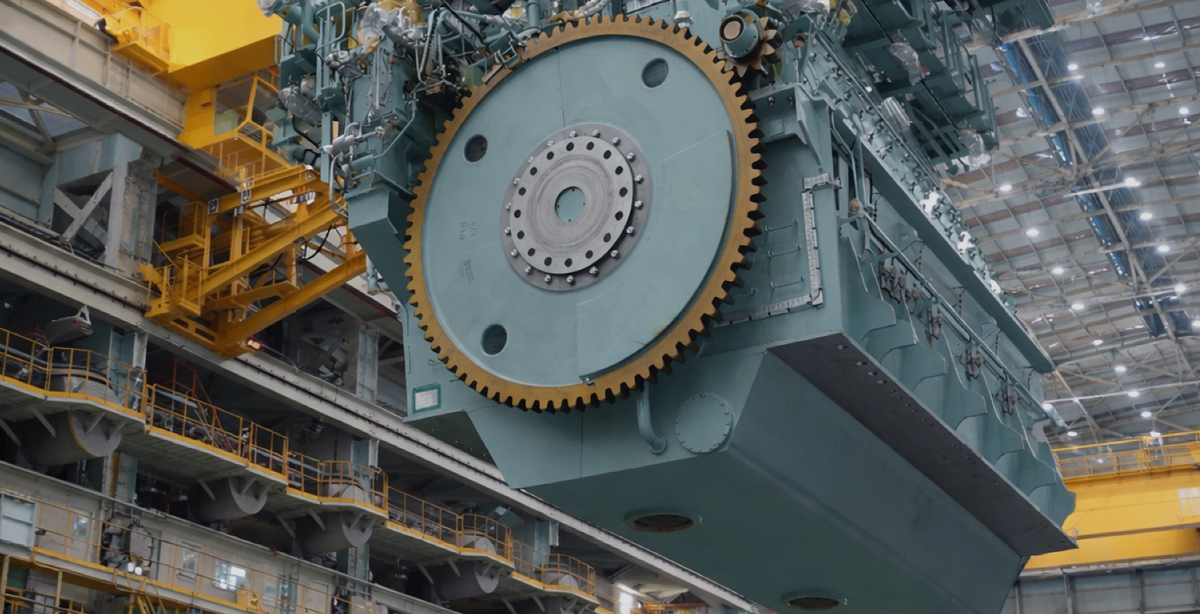
Hanwha Engine is South Korea's leading specialist manufacturer of medium- and low-speed marine diesel engines, including dual-fuel engines capable of running on LNG or methanol. The company's trajectory changed decisively in 2023, when Hanwha Group completed its acquisition of Daewoo Shipbuilding & Marine Engineering — now renamed Hanwha Ocean — drawing Hanwha Engine into the conglomerate's integrated defence and shipbuilding supply chain. Since then, vertical integration with Hanwha Ocean has accelerated both order intake and revenue growth.
Listed on the KOSPI (South Korea's main stock exchange), Hanwha Engine had long been regarded as a cyclical play, its fortunes rising and falling with the broader shipbuilding industry. But as the sector entered what analysts describe as a supercycle in 2024–25, the company's medium-speed engine business gathered momentum. Now, as synergies with Hanwha Ocean begin to materialise in earnest, discussions around shareholder returns and corporate governance reform are also intensifying. In the context of South Korea's national "Value-Up" programme — a government-backed initiative to close the persistent valuation gap between Korean equities and their global peers — Hanwha Engine has emerged as a closely watched case study in whether low price-to-book (PBR) industrial companies can credibly reinvent themselves.
Business Model and Financial Performance
*Core business*
Hanwha Engine's principal products are medium- and low-speed marine diesel engines and dual-fuel engines for LNG and methanol-powered vessels. It holds a dominant domestic position in the medium-speed segment and is a structural beneficiary of the surge in orders for LNG carriers and container ships, which has driven explosive demand for dual-fuel engines. An internal supply arrangement — whereby Hanwha Engine provides engines directly to vessels built by Hanwha Ocean — gives the company unusual visibility over its order book and a degree of revenue stability that pure-market competitors lack.
In May 2026, Hanwha Engine signed a marine engine supply contract with Hanwha Ocean worth 354.2 billion won (approximately $260m), one of the largest single contracts in the company's history and tangible evidence that the vertical integration strategy is delivering commercial results.
*Financial track record*
The company's finances have improved markedly over the past four years, albeit from a low base.
In 2021, revenue was approximately 580 billion won, with operating profit of around 10 billion won and an operating margin of roughly 1% — the nadir of a prolonged industry downturn. By 2022, as new orders began to recover, revenue rose to around 650 billion won and the margin edged up to approximately 3%, though cost pressures persisted.
The inflection came in 2023, when Hanwha Engine was formally absorbed into the Hanwha Group ecosystem. Revenue reached roughly 800 billion won and the operating margin climbed to around 6%, as order volumes surged. In 2024, buoyed by the shipbuilding supercycle and expanding deliveries of dual-fuel engines, revenue crossed the one-trillion-won threshold for the first time, with operating profit estimated at between 90 billion and 100 billion won and margins of 8–9%.
For 2025, analysts estimate revenue of approximately 1.2 trillion won and operating profit in the range of 120–140 billion won, implying an operating margin of around 10% — a structural step-change rather than a cyclical blip.
*(Note: Some figures are based on brokerage estimates and press reports and may differ from audited results.)*
In early 2026, Meritz Securities initiated a buy recommendation on Hanwha Engine with an upgraded price target, describing the situation as one of "structurally rising profitability despite near-term top-line consolidation." The market concurred: the company's shares hit a 52-week high in April 2026.
*Medium-speed engines: a structural growth story*
Industry sources indicate that Hanwha Engine's order backlog in the medium-speed segment is building rapidly, supported by Hanwha Ocean's expanding shipbuilding programme. Demand for dual-fuel medium-speed engines has surged alongside the growth of LNG- and methanol-propelled vessels, and the company's facilities are reported to be operating at close to full capacity.
Value-Up Milestones
*2023 — Integration and the beginning of governance reform*
Hanwha Group's takeover of what is now Hanwha Ocean transformed Hanwha Engine from an independent listed company into a captive engine supplier within a large conglomerate's supply chain. Investors began asking how Hanwha Group's capital allocation decisions would affect minority shareholders — and the seeds of the value-up debate were sown.
*2024 — Earnings surge and rising shareholder pressure*
As profits improved sharply, minority shareholders and institutional investors began pushing for higher dividends and share buybacks. Their cause was reinforced by the Korea Exchange's formal Value-Up programme, which applied pressure across low-PBR sectors including shipbuilding components. Hanwha Engine was not immune to these demands.
*2025 — Governance overhaul gathers pace*
From 2025, the company accelerated efforts to reform its board and internal controls. According to a governance report published in May 2026, the company pursued a "two-track" strategy of simultaneous earnings recovery and governance improvement. Key measures included diversifying the composition of independent directors and strengthening the role of the ESG committee.
*May 2026 — The 354.2-billion-won supply contract*
The engine supply agreement signed with Hanwha Ocean in May 2026 was received positively by investors, not only for its scale but because a stable, long-term internal order stream provides the cash-generation capacity that would underpin future dividend payments.
*May 2026 — Governance report published*
The formal publication of a governance report in late May 2026 confirmed that Hanwha Engine was pursuing board independence and improved internal audit mechanisms alongside its operational recovery. However, the report stopped short of disclosing specific dividend targets or share buyback commitments — an omission that did not go unnoticed.
*April–June 2026 — Share price reaches new highs*
The 52-week high recorded in April 2026 reflected not only improved earnings expectations but also an indirect premium attached to Hanwha Group's broader expansion in defence and shipbuilding — including its move to acquire a stake in Korea Aerospace Industries (KAI). Multiple brokerages revised their price targets upward during this period.
Challenges and Assessment
*Outstanding challenges*
Three tasks stand between Hanwha Engine and a convincing value-up story.
First, it must publish a concrete shareholder return policy. To date, the company has not disclosed a dividend payout ratio target or a share buyback and cancellation schedule. With earnings now on a structurally improving trajectory, investors are demanding a medium-term roadmap, not vague intentions.
Second, it must manage the risks arising from its dependence on Hanwha Ocean. Vertical integration is a double-edged arrangement: it provides order visibility but exposes Hanwha Engine to the strategic decisions of a single dominant customer. If Hanwha Ocean were to adjust its procurement strategy or pursue in-house engine production, Hanwha Engine's revenue and margins could deteriorate rapidly. Diversifying its customer base beyond the parent group is a long-term imperative.
Third, the company must achieve PBR normalisation. The shipbuilding components sector as a whole remains trapped in sub-book valuations. Hanwha Engine needs a credible plan to raise its return on equity and sustain a PBR above one times — levels that most industrial companies in developed markets would consider a baseline, not an aspiration.
*Overall assessment*
The conditions for a value-up are more favourable at Hanwha Engine than at many of its peers. The shipbuilding supercycle is generating the earnings needed to fund shareholder returns; Hanwha Group's backing provides long-term strategic support; and vertical integration with Hanwha Ocean offers unusual revenue predictability.
Yet the dominant view in the market is that governance reform and shareholder return policies remain behind where they should be. Words and structural changes to board composition are welcome, but investors want to see numbers — dividend yields, buyback volumes, payout ratios. Until those are forthcoming, Hanwha Engine's value-up story must be classified as a work in progress.
Controversies and Structural Limitations
*The ambiguity of vertical integration*
Since its absorption into the Hanwha Group, concerns have been raised about Hanwha Engine's growing dependence on related-party transactions with Hanwha Ocean. If the parent were to alter its procurement terms or internalise engine production, minority shareholders would have limited recourse. This makes transparent and fair disclosure of intra-group transactions more important than ever.
*Vagueness on shareholder returns*
Hanwha Engine has yet to commit to a dividend payout ratio or announce a timetable for share buybacks and cancellations. This stands in contrast to some peers in the shipbuilding supply chain that have moved to increase dividends or launch buyback programmes as earnings have recovered. If profit growth is not matched by a credible return of capital, the company's credibility as a participant in the Value-Up programme will be questioned.
*The limits of governance reform*
The May 2026 governance report documented steps towards board independence and a more active ESG committee. But sceptics point out that securing genuine board independence within the hierarchical structure of a large Korean conglomerate (chaebol) is structurally difficult. Whether these changes meaningfully constrain management decisions or merely provide the appearance of oversight remains to be seen.
*Cycle dependency*
Perhaps the most fundamental concern is that Hanwha Engine's profit recovery is driven more by a favourable external environment than by any intrinsic improvement in its competitive position. Should the shipbuilding cycle turn, or LNG carrier orders slow, margins could reverse quickly — and with them, the financial capacity to sustain shareholder returns. Long-term value creation requires investment in next-generation engine technologies for methanol and hydrogen propulsion, not merely riding a cyclical wave.
Summary Data
The table below provides a snapshot of Hanwha Engine's financial and governance trajectory. All figures marked as estimates are derived from brokerage research and press reports; confirmed numbers should be verified against the company's annual reports and investor relations disclosures.
Year | Operating profit (bn won) | Dividend status | Share buybacks | Estimated PBR | Key shareholder issue
2021 | ~10 | Minimal dividend (est.) | None | ~0.5x | Industry downturn; limited capacity for returns
2022 | ~20 | Minimal dividend (est.) | None | ~0.6x | Early recovery; marginal dividend improvement
2023 | ~50 | Modest dividend increase (est.) | None | ~0.8x | Hanwha integration; governance restructuring begins
2024 | ~90–100 | Dividend increase debated | No plan disclosed | ~1.0x | Supercycle gains; Value-Up pressure intensifies
2025 | ~120–140 (est.) | Higher dividend anticipated | No plan disclosed | ~1.1x (est.) | Governance reform; shareholder return roadmap absent
2026 H1 | Not disclosed | Undecided | Not disclosed | 52-week high | 354.2bn won contract; governance report published