Company Overview
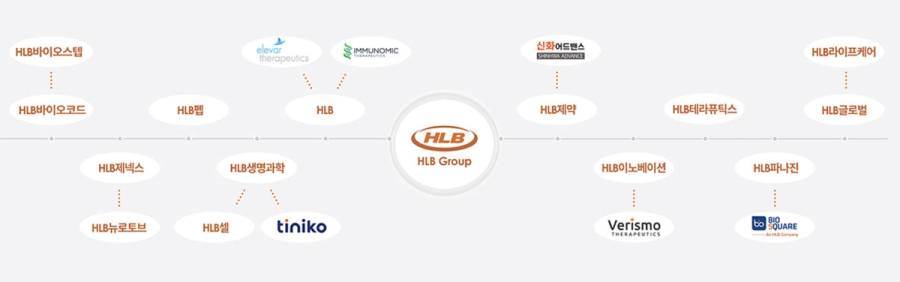
HLB is the de facto holding company of the HLB Group, a biotech and healthcare conglomerate listed on South Korea's KOSDAQ exchange (the technology-heavy junior bourse). Under the leadership of chairman Jin Yang-gon, the group has built its identity around rivoceranib (apatinib), an anti-angiogenic compound licensed from China's Hengrui Medicine and currently in global clinical trials as a treatment for hepatocellular carcinoma (liver cancer). Subsidiaries including HLB Pharma, HLB Global, HLB Genex, and HLB Life Science extend the group's reach into contract research (CRO), functional materials, and broader pharmaceutical development.
HLB regularly ranks among the largest companies by market capitalisation on KOSDAQ. Yet because the group has always prioritised research spending over near-term profitability, the prevailing investment narrative has long been one of pipeline optionality rather than dividend income or book-value discipline. That is now changing—at least in intent. As South Korea's government-backed "Value-Up" programme (a policy initiative modelled partly on Japan's corporate governance reforms, designed to narrow the chronic discount at which Korean equities trade relative to their global peers) gained momentum, HLB and its affiliates began translating aspirational language into concrete, if still modest, actions: share buybacks, cancellations, restricted stock units (RSUs) for executives, and open-market purchases by senior managers.
Business Model and Financial Performance
HLB's commercial activities rest on three pillars. The first and most important is the rivoceranib oncology pipeline, advanced through a licensing arrangement with Hengrui. The second is HLB Pharma's conventional pharmaceutical business, which received a strategic injection of ₩120bn (roughly $90m) in May 2026 to accelerate expansion. The third comprises CRO services and functional materials, operated through HLB Global and HLB Genex.
Because the group remains firmly in investment mode, it has posted operating losses every year for which data are available. Consolidated revenues have none the less grown steadily, rising from approximately ₩230bn in 2021 to an estimated ₩340bn in 2025, as the table below shows.
Year | Revenue (est.) | Operating profit/loss (est.) | Net profit/loss (est.) | Key development
2021 | ₩230bn | −₩40bn | −₩50bn | Rivoceranib trials accelerate
2022 | ₩250bn | −₩35bn | −₩45bn | Global partnerships broadened
2023 | ₩280bn | −₩30bn | −₩38bn | Rising FDA-response costs
2024 | ₩310bn | −₩20bn | −₩28bn | Pipeline value anticipated
2025 | ₩340bn | −₩15bn | −₩20bn | HLB Pharma contributions grow
*Figures are estimates based on regulatory filings and press reports; consolidated scope may affect comparability.*
The loss trajectory is narrowing, but the group has yet to generate a distributable profit—a fact that makes traditional dividend payouts structurally impossible for now.
HLB's share price is acutely sensitive to regulatory newsflow. In June 2026 the stock surged when reports emerged that the United States Food and Drug Administration (FDA) might grant rivoceranib a written-review pathway for liver cancer—a procedural step that would signal expedited consideration. Around the same time it became public that BlackRock had raised its stake in HLB to 6%, lending the company a degree of institutional imprimatur that few Korean biotechs have achieved.
Value-Up Milestones
*January 2025 — Shift to restricted stock units*
HLB Group began replacing conventional stock options with RSUs (restricted stock units), under which employees receive shares outright after completing a defined tenure. Industry coverage grouped HLB alongside Hanmi Pharmaceutical and Daewoong Pharmaceutical as early adopters of the model in Korean pharma. Proponents argue that RSUs align management incentives with long-term shareholder value. Critics note that when treasury shares are used to fund RSU grants rather than being cancelled, the benefit to existing shareholders is diluted—a tension HLB has yet to resolve publicly.
*April 2026 — HLB Genex chief executive buys shares in the open market*
On 21 April 2026, Kim Do-yeon, chief executive of HLB Genex, purchased 15,556 shares in the open market. The company characterised the transaction as an act of "responsible management". While the scale was modest, open-market purchases by sitting executives are read by Korean investors as an internal endorsement of undervaluation—a signal that carried symbolic weight in the context of the broader Value-Up push.
*May 2026 — HLB Pharma deploys ₩120bn in strategic investment*
HLB Pharma announced a ₩120bn strategic investment intended to present shareholders with three distinct future value propositions. Full details of the investment targets and terms were to be disclosed in stages through regulatory filings. Market commentary pointed to CRO capacity, pharmaceutical materials, and global clinical-trial networks as the most likely destinations, consistent with the group's declared ambition to diversify earnings away from a single pipeline.
*May 2026 — Subsidiaries launch independent value-up strategies*
Reporting dated 28 May 2026 indicated that HLB's subsidiaries were formally launching value-up strategies centred on their CRO and materials businesses. The approach signals a deliberate effort to build a group-wide valuation argument that does not rise and fall entirely on rivoceranib's regulatory prospects, with each listed affiliate expected to improve its own price-to-book and return-on-equity metrics independently.
*June 2026 — HLB Global executive boosts controlling family stake above 2.96m shares*
On 22 June 2026, an executive at HLB Global, Kim Gwang-jae, made open-market purchases that pushed total shareholdings of the controlling family above 2.96 million shares. Continuous buying by the founding family during a period of elevated short interest was interpreted by the market as a confidence signal—and a reputational commitment to the company's longer-term prospects.
*June 2026 — FDA written-review report triggers share-price surge; BlackRock raises stake*
On 17 June 2026, coverage of a possible FDA written review of the liver-cancer drug candidate sent HLB shares sharply higher. Though regulatory progress is not itself a shareholder-return measure, it represents the single most important milestone in the group's value-creation story. BlackRock's disclosure of a 6% stake, made public around the same time, reinforced confidence that sophisticated international capital had begun to assign meaningful probability to a positive regulatory outcome.
*June 2026 — Treasury-share cancellation and personal asset pledges join the toolkit*
As treasury-share cancellations and personal financial commitments by executives spread across South Korea's pharmaceutical and biotech sector as crisis-response tools, HLB was reported to be participating in this industry-wide effort. Industry coverage listed HLB among the companies taking "extraordinary measures" to defend shareholder value, suggesting that the group regards the current period as one requiring visible, tangible gestures beyond routine disclosure.
Challenges and Assessment
Four structural challenges stand between HLB and a credible, sustained Value-Up track record.
*Profitability remains elusive.* Inclusion in South Korea's Value-Up index and meaningful improvements in price-to-book or return-on-equity ratios require either the commercial success of rivoceranib or a substantial, durable profit contribution from the CRO and materials businesses. Until distributable earnings materialise, orthodox dividend payments are off the table.
*Group structure invites scrutiny.* With several listed affiliates operating under the HLB umbrella, questions about internal transactions, cross-holdings, and the protection of minority shareholders at each subsidiary will persist. Coherent, group-wide governance disclosures—rather than piecemeal announcements from individual affiliates—are needed to satisfy institutional investors.
*RSUs create ambiguity about who benefits.* Using treasury shares to fund employee compensation, rather than cancelling them, transfers value from shareholders to staff. The group has not yet offered a clear policy framework that reconciles the two objectives.
*Short-selling pressure is structural.* HLB is a persistent fixture among KOSDAQ's most heavily shorted stocks. As long as regulatory uncertainty around rivoceranib remains, institutional hedgers will maintain short positions that can overwhelm positive corporate-action announcements on any given day. Retail investors—a disproportionately large part of KOSDAQ's shareholder base—bear the brunt of the resulting volatility.
In aggregate, HLB's Value-Up response is early-stage but meaningfully multi-dimensional. Rather than relying on a single, headline-grabbing dividend increase, the group is pursuing parallel tracks: open-market buying by insiders, compensation-structure reform, business diversification, and the cultivation of global institutional shareholders. BlackRock's 6% position is the most powerful piece of evidence that this approach is beginning to register with sophisticated external capital.
The caveat is severe. Almost everything depends on rivoceranib. A setback at the FDA—an additional data request, a refusal to file, or an unfavourable advisory-committee vote—could unwind months of carefully constructed shareholder-confidence measures in a single session. The gap between the rhetoric of Value-Up and the reality of binary pipeline risk is HLB's most consequential unresolved problem.
Key Metrics Summary
Year | Operating profit/loss | Dividend | Buyback/cancellation | Estimated PBR | Key event
2021 | −₩40bn | None | Negligible | High (pipeline premium) | Trials accelerate
2022 | −₩35bn | None | Limited | High | Global partnerships
2023 | −₩30bn | None | Limited | High | FDA costs rise
2024 | −₩20bn | None | Small-scale | High | Value-Up debate begins
2025 | −₩15bn | Under review | RSUs introduced alongside | Volatile | RSU transition; affiliate returns begin
2026 H1 | Improving | Undecided | Executive purchases; cancellation discussed | — | BlackRock 6%; FDA written-review report; CRO/materials push
*Dividend and buyback figures are estimates based on public disclosures. PBR is difficult to pin to a specific date given extreme share-price volatility.*