Company Overview
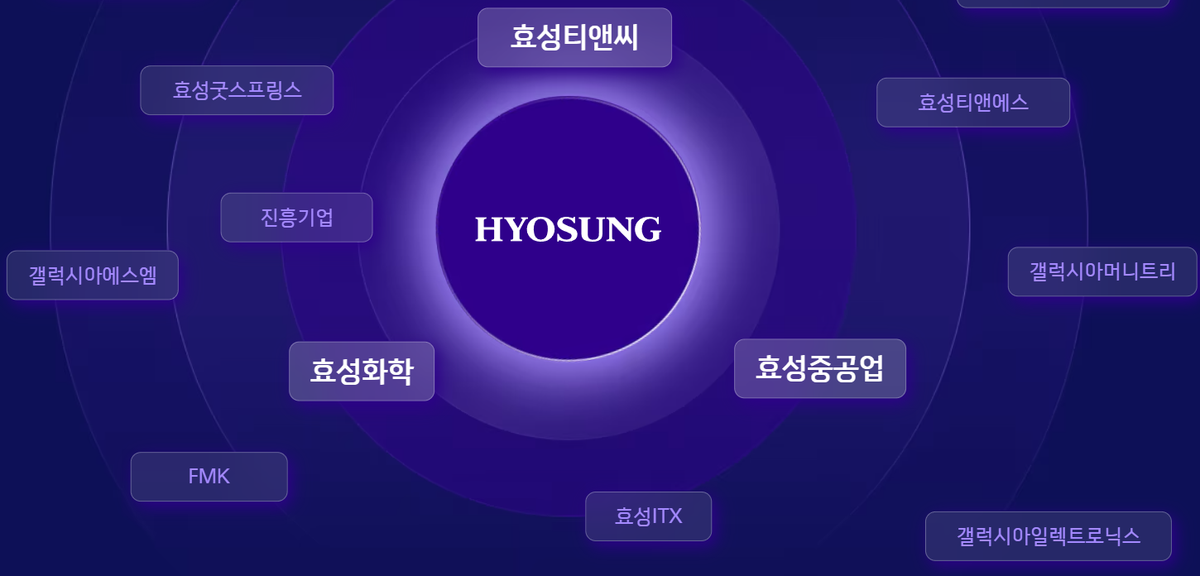
Hyosung Group is one of South Korea's foremost materials and heavy-industry conglomerates, with a diversified portfolio spanning spandex, tyre cord, industrial yarn, power equipment, and chemicals. In 2018 the group restructured into a holding-company model, with the listed parent, Hyosung Corporation, sitting atop four separately listed operating subsidiaries: Hyosung TNC (spandex and nylon), Hyosung Heavy Industries (transformers and construction), Hyosung Advanced Materials (tyre cord and aramid fibre), and Hyosung Chemical (polypropylene and nitrogen trifluoride). Management responsibilities are shared between Chairman Cho Hyun-joon, the third-generation heir, and his brother Cho Hyun-sang, who now leads a separately branded arm, HS Hyosung.
Since South Korea's government launched its "Korea Value-Up" initiative—a programme designed to encourage listed companies to address chronically low price-to-book ratios and improve shareholder returns—Hyosung's constituent companies have faced mounting pressure to respond. Hyosung Heavy Industries was included in the inaugural Korea Value-Up Index in 2024, only to be dropped in the May 2026 rebalancing. The parent holding company, meanwhile, has struggled to shake off controversy over how it uses its treasury shares and whether value ultimately flows to ordinary shareholders. Tracking the group's record on value creation offers a revealing case study in the challenges facing Korea's complex holding-company groups.
Business Foundation and Financial Performance
*Holding-company structure*
As the group's apex entity, Hyosung Corporation earns income primarily through brand royalties, rental income, and dividends received from its four core subsidiaries. Because the holding company's fortunes are directly tied to the operating performance of those subsidiaries, its earnings are inherently cyclical and sensitive to sector conditions.
*Annual performance highlights*
The table below summarises consolidated operating profit, dividends per share, and key subsidiary developments. All figures are on a consolidated basis; some are estimates.
Year | Operating profit (consolidated) | Dividend per share | Key developments
2019 | c. ₩250bn | ₩1,500 | Spandex market buoyant
2020 | c. ₩180bn | ₩1,000 | Covid-19 disruption
2021 | c. ₩520bn | ₩3,000 | Hyosung TNC posts record profit
2022 | c. ₩310bn | ₩2,000 | Spandex market reverses sharply; Hyosung Chemical swings to a loss
2023 | c. ₩160bn | ₩1,500 | Hyosung Chemical posts large operating loss; Hyosung TNC depressed
2024 | c. ₩220bn | ₩2,000 | Hyosung Heavy Industries thrives on power-equipment boom; Hyosung Chemical risks capital impairment
2025 | c. ₩280bn (est.) | ₩2,000 (est.) | Hyosung Heavy Industries exports strong; subsidiary valuations recover
*Diverging fortunes across subsidiaries*
The performance gap between subsidiaries is stark. Hyosung TNC achieved record earnings in 2021 when a global spandex shortage sent margins soaring, only to suffer a sharp reversal in 2022–23 as Chinese producers flooded the market with cheap supply. Hyosung Chemical has become a persistent drag, weighed down by the capital costs of large overseas facilities in Malaysia and Vietnam and chronic weak pricing. Hyosung Heavy Industries has been the group's standout performer in 2024–25, riding a global surge in grid investment and robust demand for transformer exports to the United States. By late 2025 market commentators were noting that a single strong subsidiary was propping up the parent company's share price.
Value-Up Milestones
*2018 — Holding-company conversion: governance reform begins*
Hyosung restructured through a share-based spin-off, separating its businesses into four listed subsidiaries. Management presented the move as a step towards greater transparency and accountability. In practice, however, the process prompted immediate criticism: the group was accused of using treasury shares to consolidate the controlling family's grip, a controversy that has coloured all subsequent shareholder-value discussions.
*2021 — Record profits and a larger dividend*
With Hyosung TNC's bumper year lifting group earnings, Hyosung raised its annual dividend to ₩3,000 per share—three times the prior year's payout. The increase was welcomed but widely characterised as opportunistic rather than the product of a deliberate, long-term shareholder-return policy.
*May 2024 — Treasury-share controversy intensifies*
Investigative reporting on succession planning at the group carried the pointed conclusion that "there is no treasury-share magic here—it is not for shareholders." Analysts argued that instead of cancelling treasury shares to boost per-share value, Hyosung appeared to be retaining them to facilitate controlling-family succession or to reinforce the owners' grip on the business. The episode crystallised a broader market concern about how Korean holding companies deploy their buy-backs.
*2024 — Hyosung Heavy Industries joins the Korea Value-Up Index*
When the Korea Exchange launched its Value-Up Index—designed to highlight companies with strong returns on equity and improving shareholder-return practices—Hyosung Heavy Industries was among the inaugural constituents. It became the most visible emblem of the group's value-enhancement credentials.
*November 2025 — Reappraisal of the parent holding company*
Strong export momentum at Hyosung Heavy Industries and a broader recovery in subsidiary earnings triggered a wave of media commentary about a "transformed, long-undervalued holding company." Expectations that pending amendments to Korea's Commercial Act might narrow the structural discount applied to holding companies contributed to a partial re-rating. BNK Securities subsequently raised its target price for Hyosung Corporation, citing "rising subsidiary valuations and expanding shareholder returns."
*January 2026 — Commercial Act revisions and pressure to cancel treasury shares*
The administration of President Lee Jae-myung launched the third phase of Commercial Act reform, reigniting debate about a potential mandate to cancel treasury shares. Companies carrying large treasury-share positions—Hyosung among them—attracted particular scrutiny. Analysts warned that if compulsory cancellation became law, it would have significant implications for the holding-company structure Hyosung has maintained since 2018.
*March 2026 — BNK Securities raises target price*
BNK Securities upgraded its target for Hyosung Corporation on the grounds of rising subsidiary values and the prospect of greater shareholder returns, pointing specifically to the transformer-export boom at Hyosung Heavy Industries and early signs of recovery at Hyosung TNC.
*April 2026 — HS Hyosung's disappointing value-up record and family governance questions*
Following the operational separation of the Cho brothers, market observers concluded that HS Hyosung—the arm run by the younger brother, Cho Hyun-sang—had fallen short of value-up expectations. Reporting that questioned why assets associated with the elder brother's shareholding appeared to have benefited the younger brother's personal fortune revived pointed criticism about the group's governance and the extent to which internal family arrangements take precedence over the interests of outside shareholders.
*May 2026 — Hyosung Heavy Industries dropped from the Korea Value-Up Index*
The Korea Exchange's scheduled rebalancing of the Value-Up Index removed Hyosung Heavy Industries alongside LS Electric and Hyundai Rotem, while adding SK Square and APR. The market read the exclusion as reflecting both elevated post-rally valuations and doubts about the durability of the company's shareholder-return commitments.
Key Metrics Summary
Year | Dividend per share | Treasury shares | Operating profit (est.) | PBR (Hyosung Corp.)
2019 | ₩1,500 | Held, unchanged | c. ₩250bn | c. 0.4×
2020 | ₩1,000 | Held, unchanged | c. ₩180bn | c. 0.3×
2021 | ₩3,000 | Held, unchanged | c. ₩520bn | c. 0.6×
2022 | ₩2,000 | Held, unchanged | c. ₩310bn | c. 0.4×
2023 | ₩1,500 | Held, unchanged | c. ₩160bn | c. 0.3×
2024 | ₩2,000 | Controversy resurfaces | c. ₩220bn | c. 0.4×
2025 | ₩2,000 (est.) | Cancellation pressure builds | c. ₩280bn | c. 0.5×
*PBR figures are annual-average estimates based on market data and public information.*
Challenges and Assessment
*Outstanding structural challenges*
Four problems stand between Hyosung and credible value-up progress. First, the group must establish transparency over its treasury shares: markets have long suspected that these holdings serve controlling-family interests rather than ordinary shareholders, and a clear, publicly committed cancellation plan is the minimum required to restore confidence. Second, Hyosung Chemical's chronic losses and the risk of capital impairment must be resolved; without that, any group-wide value-up story remains incomplete. Third, dividends need to be anchored to a formal, medium-term shareholder-return policy rather than moving in lockstep with the business cycle. The current pattern—payouts ranging from ₩1,000 to ₩3,000 per share within six years—does little to attract income-oriented investors. Fourth, the separation of the Cho brothers' business empires requires demonstrable proof that resource allocation and governance serve all shareholders equitably, not just the controlling family.
*Overall assessment*
The consensus view is that Hyosung has achieved the formal architecture of governance reform—the holding-company conversion, the separate listings—while failing to earn the market's full trust on substance. The inclusion of Hyosung Heavy Industries in the Value-Up Index was a genuine recognition of progress, but the subsequent removal illustrates the difficulty of sustaining such credentials. Selective broker optimism about shareholder-return prospects (most notably from BNK Securities) is real, but the dominant market view is that it is too early to conclude whether recent improvements reflect structural change or merely a favourable business cycle. Should Commercial Act reforms make treasury-share cancellation obligatory, Hyosung could be compelled to take the kind of decisive action it has so far avoided—and that external pressure, rather than voluntary commitment, may ultimately prove to be the catalyst the group's minority shareholders have been waiting for.
Controversies and Structural Constraints
*The "treasury-share magic" controversy*
The 2024 reporting that gave rise to the phrase "there is no treasury-share magic" cut to the heart of Hyosung's value-up limitations. The allegation—that treasury shares accumulated during the holding-company conversion were used to entrench the owners rather than to enhance value per share through cancellation—has never been fully put to rest. Using treasury shares for share-swap transactions or executive compensation dilutes, rather than concentrates, value for ordinary shareholders.
*Moral hazard within the controlling family*
The April 2026 reporting on the flow of value between the two brothers' corporate spheres raised the spectre of internal conflicts of interest that ordinary shareholders cannot easily monitor or challenge. The concern is that when a founding family divides its business empire, the terms of that division may be governed by intra-family bargaining rather than by any obligation to outside investors. For external shareholders, the opacity of such arrangements constitutes a fundamental governance risk.
*Hyosung Chemical as a systemic risk*
A subsidiary that is chronically loss-making and at risk of capital impairment is not merely a drag on group earnings; it is a potential claim on the resources that would otherwise be returned to shareholders. If the holding company is eventually obliged to recapitalise Hyosung Chemical, the dividends and buy-backs that investors in the parent company are counting on could be diverted to prop up an underperforming unit—a transfer of value from the profitable parts of the group to the weakest.
*The significance of the index exclusion*
Being dropped from the Korea Value-Up Index is more than an administrative reclassification. It signals that the market—through the index methodology—is not yet convinced that Hyosung Heavy Industries has institutionalised its shareholder-return improvements. A share-price surge that has lifted valuations beyond the index's admission criteria is, at one level, a sign of success; but if it is not accompanied by qualitative improvements in governance and payout policy, it can also expose the limits of what has been achieved.
*The structural holding-company discount*
Hyosung Corporation's shares trade at a persistent discount to the sum-of-the-parts value of its listed subsidiaries—a common affliction for Korean holding companies (known in market parlance as the "holdco discount"). The discount reflects a combination of complex ownership structures, earnings volatility across subsidiaries, and owner-related governance risk. Without external catalysts—whether regulatory compulsion or a voluntary commitment to cancel treasury shares and raise payouts—there is little in the group's recent track record to suggest the discount will narrow of its own accord.