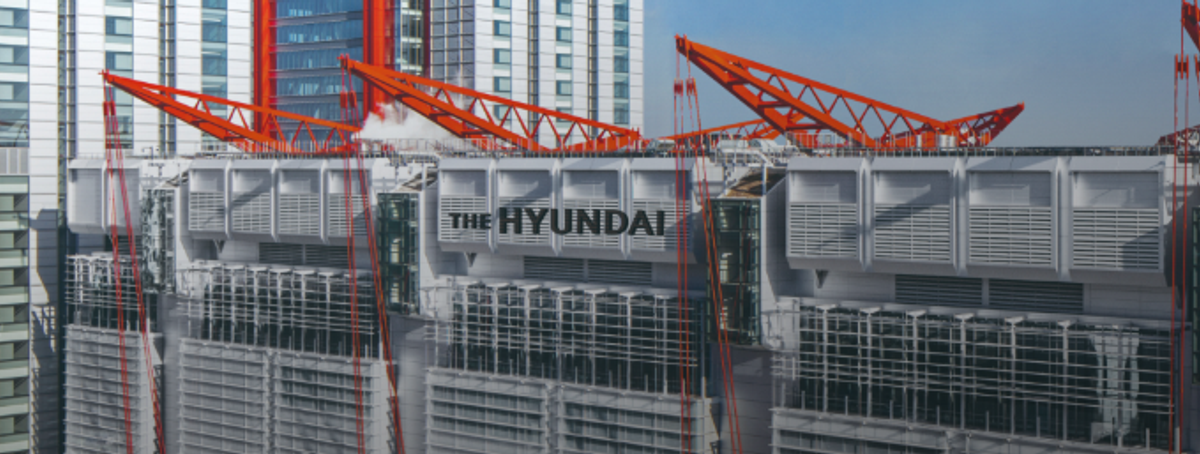
Company Overview
Hyundai Department Store is the de facto holding company and flagship listed entity of the Hyundai Department Store Group—one of South Korea's "Big Three" department-store operators, alongside Lotte and Shinsegae. It runs premium stores in Seoul and the wider capital region, as well as a network of Hyundai Premium Outlets and Hyundai City Outlets across the country. The wider group spans home shopping, food services, furniture and lifestyle products through subsidiaries including Hyundai Home Shopping, Hyundai Green Food, Hyundai Livart, and Zinus.
For all its breadth, the company has long been synonymous with undervaluation. A convoluted ownership structure, meagre dividend yields, and a string of profit disappointments following the acquisition of American mattress maker Zinus conspired to pin the stock's price-to-book ratio (PBR) near 0.3 times for years. When the South Korean government launched its "Korea Value-Up" programme in 2023–24—explicitly designed to tackle the persistent discount at which Korean equities trade relative to global peers—Hyundai Department Store Group signalled its intention to use the initiative as a catalyst for governance reform and more generous shareholder returns. The decisive moment came in February 2026, when the group announced it would cancel its entire treasury-share holding across 13 listed subsidiaries, a move worth ₩350bn that reverberated well beyond the retail sector.
Business Performance
*Department Stores and Duty-Free: A Two-Track Model*
The group's core earnings engine is its department-store division. Anchored by high-footfall premium locations—Pangyo, Apgujeong, and the COEX Trade Centre—the stores have sustained margins by leaning into high-value categories such as luxury goods, fashion, and premium food. The duty-free arm, operating at Incheon Airport, Dongdaemun, and the Trade Centre, recovered after the pandemic but has been hampered by the slower-than-expected return of Chinese tour-group shoppers, leaving profitability in that division below pre-pandemic levels.
*The Zinus Problem*
The group's most significant drag has been Zinus, a US-listed mattress-in-a-box brand acquired in 2022 for roughly ₩1tn. The timing proved painful: a sharp rise in global interest rates deflated America's housing market and hammered demand for home-furnishing products. Zinus's losses weighed heavily on consolidated earnings, deepened investor scepticism, and accelerated the de-rating of the parent stock. By 2025–26, the business appeared to have bottomed out and was showing tentative signs of recovery.
*Financial Snapshot*
The table below summarises estimated operating-profit trends (standalone basis) alongside the principal developments in each year.
Year | Est. Operating Profit | Key Developments
2021 | ₩310bn | Luxury boom; low pandemic base
2022 | ₩340bn | Zinus acquisition completed
2023 | ₩260bn | Zinus losses bite; duty-free weak
2024 | ₩240bn | High rates; subdued consumer spending
2025 | ₩280bn | Department-store rebound; Zinus stabilising
H1 2026 | Recovery evident | Department stores and duty-free both improving
*Figures are based on publicly reported data and broker estimates; some may not be finalised.*
The Value-Up Journey
*2024: Rhetoric Without Action*
When the Korea Exchange and financial regulators formally launched the Value-Up programme, retailers trading below book value—Hyundai Department Store conspicuously among them, at a PBR of just 0.3 times—were flagged as prime candidates for re-rating. The group acknowledged it was studying options for governance improvement and enhanced returns, but produced no concrete measures. The market's verdict was that it had failed to meet rising expectations.
*2025: Governance Restructuring Begins*
The group took a more substantive step by establishing Hyundai GF Holdings as a cleaner apex holding company, with the stated aim of rationalising the group's ownership layers. The move was widely interpreted as an attempt to address the "multiple-listing discount"—the tendency of investors to assign lower combined valuations to groups with many separately listed subsidiaries—and to make the group's overall worth more legible to outside investors.
*February 2026: The Big Bang*
On 11 February 2026, the group delivered what the market deemed a genuinely transformative commitment. All 13 of its listed subsidiaries would cancel 100% of their treasury shares—a combined ₩350bn—leaving not a single share in any company's own hands. The announcement simultaneously addressed the group's overlapping-listing problem: Hyundai Home Shopping was to be taken fully private and folded into the parent, eliminating a long-standing source of structural complexity. Brokerages including Kiwoom Securities responded immediately, raising their target prices for Hyundai Department Store by 13%. The consensus view was that this was a categorically different order of commitment from the incremental gestures that had preceded it.
*March 2026: Industry-Wide Contagion*
The announcement had a galvanising effect on the broader retail sector. By March 2026, Lotte and Shinsegae had both unveiled their own treasury-share cancellation and dividend-increase plans—a dynamic that analysts dubbed "Value-Up 2.0." Parallel legislative discussions about strengthening boards' authority to cancel treasury shares added further momentum. Hyundai Department Store had, by this point, established itself as the sector's standard-bearer.
*March 2026: Execution Timeline Confirmed*
On 31 March 2026, the group publicly committed to completing the full ₩350bn cancellation by the end of the first half of the year. Providing a concrete deadline, rather than leaving the pledge open-ended, was seen as an important step in building market credibility.
*June 2026: Earnings Recovery Comes Into View*
By mid-2026, both the department-store and duty-free divisions were recovering in tandem, and analysts began describing a turnaround as imminent rather than merely possible. With the Zinus drag gradually diminishing, a virtuous cycle appeared to be forming in which improving earnings and stronger shareholder returns reinforced each other.
Key Metrics
Year | Est. DPS (₩) | Buyback/Cancellation | Est. Operating Profit | PBR
2021 | ~2,000 | Negligible | ₩310bn | ~0.45x
2022 | ~2,000 | Modest | ₩340bn | ~0.35x
2023 | ~2,000 | Modest | ₩260bn | ~0.30x
2024 | ~2,000 | Modest | ₩240bn | ~0.28x
2025 | ~2,200 | Under review | ₩280bn | ~0.32x
2026 | Under discussion | ₩350bn full cancellation | Recovering | Re-rating in progress
*DPS and operating profit are based on published reports and broker estimates. PBR figures are point-in-time estimates for the relevant year.*
Challenges Ahead
For the momentum to be sustained, four structural issues demand resolution.
First, Zinus must demonstrate a durable recovery. The pace at which the US mattress market absorbs pent-up demand and the pace at which Zinus restores its margins will be the single most important variable in the group's valuation trajectory. A disappointment there could swiftly reverse the goodwill generated by the share cancellation.
Second, shareholder-return policy needs to be institutionalised. A one-off cancellation of treasury shares, however large, is not a substitute for a clearly stated, medium-term dividend payout target and total shareholder return (TSR) commitment backed by formal documentation. Some institutional investors have already pressed for greater predictability.
Third, the duty-free business must return to profit. If the recovery in Chinese visitor numbers continues to lag expectations, the division will remain a drag on consolidated results.
Fourth, governance transparency must keep improving. Taking Hyundai Home Shopping private eliminates one source of structural opacity, but minority shareholders' rights across the remaining group companies require ongoing attention.
Assessment
The market's overall verdict on the group's value-up efforts is positive. The ₩350bn treasury-share cancellation earns high marks not only for its scale but for the clarity of its message: no subsidiary will retain a single share of its own stock. Brokerages have interpreted this as the trigger for a fundamental re-rating of the company, adjusting their target prices upwards accordingly.
Sceptics, however, caution that buybacks and cancellations are ultimately cosmetic if the underlying business is not growing. What matters, in the end, is the structural health of the department-store and duty-free franchises and the long-term cash flows they generate. The share cancellation enhances the per-share value of those cash flows, but it does not create them. Whether the current earnings recovery proves durable—rather than a temporary bounce from a depressed base—will be the true test of whether the Value-Up programme has achieved anything lasting.

Controversies and Limitations
*Was the Cancellation Truly Voluntary?*
Some market participants have noted that the treasury-share cancellation was structurally linked to the decision to take Hyundai Home Shopping private—raising the question of whether the shares would have been cancelled regardless, as a mechanical consequence of the corporate restructuring rather than a genuine act of shareholder largesse. The two announcements were so intertwined that disentangling altruism from necessity is difficult.
*Dividend Policy Remains Vague*
Hyundai Department Store has historically offered one of the lower dividend yields among major Korean retailers. The failure to pair the cancellation announcement with an explicit medium-term payout target is a conspicuous gap. Several institutional investors are understood to be pressing the company to set and publish a clear dividend policy.
*The Zinus Acquisition: A Cloud That Lingers*
Spending roughly ₩1tn on an acquisition that rapidly turned into a significant loss raises legitimate questions about the quality of the group's capital-allocation judgement. Investors wary of future M&A ambitions will be asking whether management has drawn the right lessons. Until Zinus is demonstrably back on its feet, that scepticism is unlikely to fully dissipate.
*Minority Shareholder Treatment*
The delisting of Hyundai Home Shopping attracted scrutiny over whether minority shareholders received adequate compensation. Asset managers including VIP Asset Management accumulated stakes, signalling concern about the terms on offer. This episode has not been fully resolved in the market's mind, and remains a modest but persistent blemish on the group's shareholder-friendly credentials.