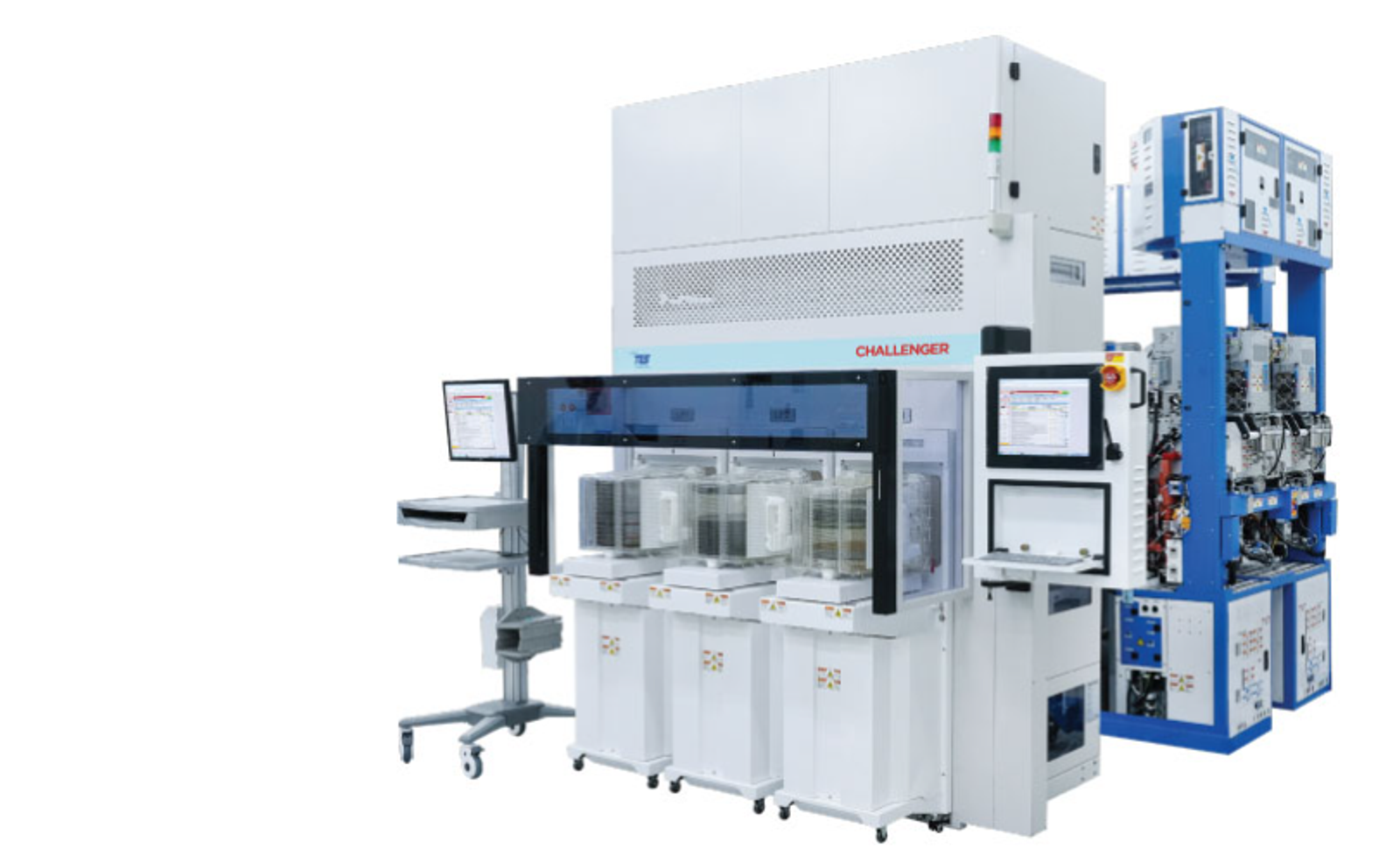
IBK Investment Securities initiated coverage of TES (KOSPI: 095610), a front-end semiconductor equipment manufacturer, on 10th September, assigning a buy recommendation and a target price of ₩210,000. Based on the closing price of ₩154,300 on 9th September, the target implies upside of approximately 36%.
Multiple growth drivers converging
IBK analysts argue that TES has entered a phase in which several growth catalysts are firing simultaneously: the relentless stacking of NAND flash memory layers, and expanding demand for both conventional DRAM and high-bandwidth memory (HBM). Crucially, they contend that three discount factors that have historically weighed on the company's valuation—concerns over shrinking DRAM-related revenues, a narrow customer base, and a limited equipment portfolio—are now being resolved in tandem.
TES's core products are its ACL (amorphous carbon layer) deposition equipment, used as a hardmask underlayer to prevent pattern collapse during etching, and its BSD (backside deposition) equipment, which forms a support layer on the reverse of a wafer to reduce warping and improve yields. Both are indispensable in NAND manufacturing. With the industry already mass-producing NAND chips at over 300 layers and publishing roadmaps extending beyond 1,000 layers, demand for these tools is structurally assured, IBK argues.
Financials on a steep upward trajectory
TES's revenues are expected to rise 46% from ₩240bn in 2024 to ₩351.1bn in 2025. IBK projects revenues of ₩475.5bn and operating profit of ₩107.2bn in 2026, with the operating margin improving from 15.8% in 2024 to 20.2% by 2026. The brokerage forecasts further revenue growth to ₩570.3bn in 2027 and ₩727.0bn in 2028.
Order backlog hits record highs
Perhaps the most striking data point is the surge in the order backlog. Over the past decade, TES's previous quarterly record stood at ₩86.9bn, set in the first quarter of 2021. By the second quarter of 2026, the backlog had reached ₩206.9bn—an all-time high that surpasses the prior record by more than ₩120bn in a single bound. For semiconductor materials and equipment companies, order backlogs tend to move in close lockstep with share prices, making this surge a credible leading indicator for TES's stock.
A qualitative shift in the business mix
Until 2024, TES was heavily reliant on NAND investment cycles at domestic memory chipmakers and on a narrow range of products. That is changing. In 2024, DRAM-related revenues exceeded half of total sales for the first time, a balance IBK expects to persist over the medium to long term. New fab investments by SK Hynix (the M15X facility) and Samsung Electronics (the P4 fab) have driven this shift. Further capex cycles are anticipated from Samsung's P5 plant in Pyeongtaek and SK Hynix's Y1 facility in Yongin from 2027 onwards.
Expanding equipment qualifications
TES is also broadening the range of processes and customers for which its tools are qualified. Its BSD equipment completed qualification for SK Hynix's DRAM and HBM lines in the first half of 2026. Its TETRA thin-film insulating-layer deposition tool has cleared qualification for Samsung Electronics' DRAM processes. IBK expects BSD equipment to be adopted for HBM 4-nanometre base-die production at Samsung's foundry division as well. A new tool, the HD-ACL, is expected to complete qualification for DRAM 1d-generation processes between the second half of 2026 and the first half of 2027.
International diversification on the horizon
The customer base, hitherto concentrated on Samsung and SK Hynix, is beginning to widen. CXMT (Changxin Memory Technologies), a Chinese DRAM manufacturer, has been expanding capacity following a recent listing, and IBK forecasts that China-derived revenues will reach roughly 10% of TES's total sales in 2026. Demonstration tests are also under way with memory chipmakers in the United States and Japan.
Valuation methodology
The ₩210,000 target price is derived by applying a target multiple of 37.0x to IBK's 12-month forward earnings-per-share estimate of ₩5,555. That multiple represents a 30% discount to the average 2026 consensus price-to-earnings ratio of 52.8x applied to four comparable Korean front-end equipment peers—Wonik IPS, PSK, VM, and Eugene Technology—reflecting TES's relative concentration in plasma-enhanced chemical vapour deposition (PECVD) technology.
Risks worth monitoring
That discount encapsulates the key risks investors should weigh. TES's growth story is anchored to the mega-trend of ever-taller memory stacks in NAND, DRAM, and HBM, but its portfolio remains heavily centred on PECVD processes, which limits its reach into adjacent advanced-process technologies such as atomic layer deposition (ALD). Should certification schedules for its newer tools—BSD, HD-ACL, and TETRA—slip, or mass-production adoption prove slower than expected, growth momentum could falter.
Customer concentration remains a concern. Despite the push into China and nascent engagement with American and Japanese chipmakers, TES is still heavily dependent on Samsung Electronics and SK Hynix. A synchronised slowdown in investment cycles at both customers would amplify earnings volatility. Prospective investors should also note that the current share price already reflects a 12-month absolute return of approximately 398% from end-2024 levels, leaving limited margin for disappointment.
Key statistics
As of 9th September, TES had a market capitalisation of approximately ₩2.987 trillion. Its 52-week high was ₩217,500 and its low ₩31,000—an exceptionally wide trading range. Foreign investors hold around 10.5% of the shares, while the largest shareholder group, comprising founder Ju Sung-il and eight related parties, controls 29.46%.