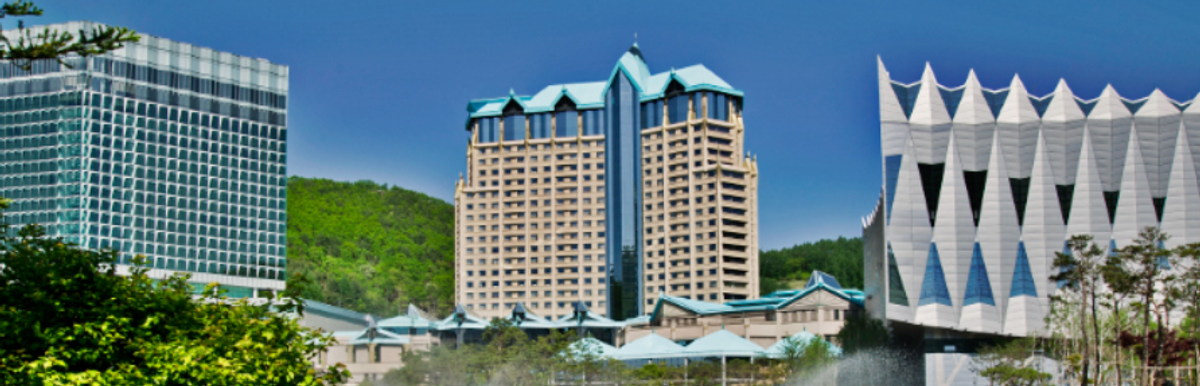
Company Overview
Kangwon Land was established in 1998 to revitalise the economy of a depressed coal-mining region in Gangwon Province, in the country's mountainous interior. It remains the sole casino in South Korea legally permitted to admit Korean nationals — a privilege enshrined in special legislation governing the redevelopment of former mining areas. Headquartered in Gohan-eup, Jeongseon County, the company operates a sprawling integrated resort at High1 Resort that includes a casino, hotels, ski slopes, and golf courses; casino revenues account for more than 70% of total sales. Listed on the KOSPI, South Korea's main stock exchange, it is classified as a mid-cap dividend stock.
The state and Gangwon Province hold controlling stakes, giving Kangwon Land the character of a public-sector entity — a quality that has historically made it cautious about returning cash to shareholders and slow to modernise its governance. That is now changing. Since 2023, when Seoul's broader market "value-up" programme gained momentum, the company has pursued a three-pronged strategy: higher dividends, share buybacks and cancellations, and improved corporate governance. Two consecutive years of total shareholder return (TSR) ratios above 60% have begun to alter market perceptions.
Business Fundamentals and Financial Performance
*A legal moat with a double edge*
Kangwon Land's statutory monopoly is its greatest competitive advantage: no rival can legally offer Korean residents a domestic casino experience. Yet the same legal framework that excludes competitors also exposes the company to regulatory risk. A change in government policy — tightening entry restrictions, altering tax treatment, or permitting new integrated resorts — could undermine the business at a stroke.
*Financial track record*
Year | Revenue (KRW bn) | Operating profit (KRW bn) | Net profit (KRW bn) | Key developments
2019 | 1,572.3 | 521.4 | 389.1 | Pre-pandemic peak
2020 | 685.4 | -35.8 | -38.7 | COVID-19 closures
2021 | 831.2 | 120.3 | 96.3 | Phased reopening
2022 | 1,244.1 | 387.6 | 298.7 | Rapid post-pandemic recovery
2023 | 1,510.8 | 502.3 | 381.2 | Returns to pre-COVID levels
2024 | 1,465.0 | 471.0 | 356.0 | Renovation impact begins
2025e | 1,420.0 | 440.0 | 330.0 | Full-scale renovation, weak Q2
*2025 figures are broker consensus estimates.*
*Renovation and medium-term strategy*
From 2025, Kangwon Land began an extensive refurbishment of its ageing casino facilities. Euijin Investment Securities maintained a target price of KRW 22,000 as of May 2026, describing the programme as "investment in the future". In the near term, reduced gaming floor capacity is weighing on revenues. The prevailing analytical view, however, is that modernised facilities will attract higher visitor volumes and allow the company to diversify income beyond the casino floor.
The Value-Up Journey: A Chronology
*Second half of 2023 — Shareholder return policy formalised*
Kangwon Land published a medium-term shareholder return roadmap with an explicit target: total annual distributions (dividends plus buybacks and cancellations) of approximately KRW 100bn. For a company with quasi-public status, attaching a concrete number to a return commitment was seen as a meaningful signal. From this point the company began to feature regularly among putative beneficiaries of the government's value-up initiative.
*2024 — TSR ratio hits 60% for the first time*
By combining dividends with share repurchases, the company achieved a TSR ratio of 60% in 2024 — a high watermark for the domestic casino and leisure sector, and unusual for an entity with public-sector characteristics. The dividend yield settled around 5%, establishing the stock's credentials as a defensive income holding.
*July 2025 — Dividend appeal highlighted; cancellation hopes rise*
Hana Securities published a report in July 2025 emphasising Kangwon Land's "relatively high dividend attractiveness" and drawing attention to the possibility of share cancellations. Even though second-quarter results came in slightly below expectations — a consequence of renovation-related disruption — a 5% dividend yield was maintained, underpinning the stock's defensive qualities. The report was notable for suggesting that the company might progress beyond mere buybacks to actual share cancellations, amplifying the real economic benefit to shareholders.
*January 2026 — Governance reform officially announced*
In January 2026, the company formally committed to a corporate governance overhaul, with particular emphasis on strengthening board independence and improving internal controls. Brokers noted that a confluence of recovering earnings momentum and governance reform was creating conditions for a meaningful rerating.
*February 2026 — Additional KRW 40bn buyback; dividend confirmed at KRW 950 per share*
The company announced a further KRW 40bn share repurchase and confirmed a cash dividend of KRW 950 per share, bringing the TSR ratio for 2025 to 62.6% — a second consecutive year above 60%. The market interpreted this as evidence that the shareholder return roadmap was being executed rather than merely proclaimed.
*May 2026 — Heavy renovation investment alongside record-level returns*
Broker reports in May 2026 drew positive attention to Kangwon Land's ability to sustain record-high shareholder distributions while simultaneously funding a large-scale capital programme. Euijin maintained its KRW 22,000 target, recommending accumulation at current depressed prices and pointing to the prospect of combined earnings recovery and continued returns once the renovation is complete.
*June 2026 — Market consensus: patience will be rewarded*
By June 2026, multiple brokers were characterising Kangwon Land as a company that can deliver both post-renovation growth and durable shareholder returns — one that is absorbing short-term pain whilst preserving its dividend. This dual quality was identified as the central investment thesis.
Challenges
Kangwon Land faces four substantive challenges on its value-up journey.
Defending earnings during renovation. Restricted gaming floor capacity inevitably reduces near-term revenue. A prolonged construction period could erode the profit base from which distributions are funded.
Converting buybacks into cancellations. The company has consistently repurchased shares, but the timing and extent of cancellations remain uncertain. Until repurchased shares are cancelled, the full economic benefit to remaining shareholders is not realised.
Translating governance pledges into practice. The company has a long history of politically connected appointments to senior positions, and questions about genuine board independence are structural rather than incidental. The January 2026 reform announcement was a necessary step, but durable change will take time to verify.
Managing policy risk. The entire business model rests on a statutory monopoly granted by the government. Regulatory developments — including discussions about permitting integrated resort casinos for Korean nationals elsewhere, or tightening entry restrictions — represent an irreducible source of risk that no shareholder return policy can offset. Diversification of income beyond the casino, particularly through the resort's non-gaming assets, remains a work in progress.
Assessment
Among South Korea's listed quasi-public companies, Kangwon Land's value-up trajectory stands out. Achieving a TSR ratio of more than 60% in two consecutive years is more than a statistical milestone: it signals a genuine shift in management's orientation towards shareholder value — a shift that is particularly striking for an entity with public-sector DNA.
The consensus view in the broking community is that the stock remains undervalued. It currently trades at a price-to-book ratio of roughly 0.8 to 0.9 times. If earnings normalise following the renovation and governance improvements take hold simultaneously, the rerating potential is considered substantial. Counterbalancing this is the persistent discount that markets apply to companies whose fortunes depend heavily on government policy — a discount that structural arguments alone cannot remove.
Controversies and Structural Limitations
*Governance: a recurring problem*
Since its founding, Kangwon Land has been repeatedly criticised for filling senior positions with political appointees rather than sector professionals. This pattern structurally compromises the board independence that credible governance reform demands. Scepticism about whether the January 2026 initiative will produce lasting change is therefore reasonable and widespread.
*Sustainability of the payout ratio*
A TSR ratio above 60% is impressive, but its durability through a period of heavy capital expenditure is legitimately open to question. Casino operating profits are directly tied to visitor numbers and betting volumes; if construction restricts the gaming floor for longer than anticipated, the earnings base supporting the distribution policy will weaken. Some analysts worry that maintaining current payout levels could amount to distributing cash rather than growing it.
*Policy dependency*
Kangwon Land's monopoly is entirely a creation of statute, not of competitive advantage in any conventional sense. Government decisions on integrated resort development, domestic casino regulation, or the legal framework governing the company's designated region could materially alter its business at any time. This is a vulnerability that shareholder return policies cannot address.
*Limited foreign investor presence*
Trading in Kangwon Land is dominated by domestic investors. Foreign ownership is low, which limits the potential for global institutional capital to catalyse a rerating. This is one reason why the process of price discovery may be slower than the underlying fundamentals might otherwise justify.
Key Statistics Summary
Year | DPS (KRW) | Buyback size | TSR ratio | Operating profit (KRW bn) | P/B (x)
2019 | 1,050 | Not disclosed | ~40% | 521.4 | ~1.0
2020 | 0 | — | 0% | -35.8 | ~0.7
2021 | 400 | — | ~25% | 120.3 | ~0.8
2022 | 750 | Partial | ~45% | 387.6 | ~0.9
2023 | 900 | Executed | ~55% | 502.3 | ~0.9
2024 | 950 | KRW 40bn+ | 60%+ | 471.0 | ~0.85
2025e | 950 | KRW 40bn add'l | 62.6% | 440.0e | 0.8–0.9
*P/B ratios are year-end estimates; some figures are based on broker projections.*
Summary: Kangwon Land achieved a TSR ratio of more than 60% in both 2024 and 2025, the highest sustained shareholder return among South Korea's listed quasi-public companies. It is maintaining a roadmap of KRW 950 per share in dividends and approximately KRW 40bn per year in buybacks while simultaneously funding a substantial renovation programme. A dividend yield of around 5% provides downside protection; the completion of the renovation and the consequent earnings recovery represent the core upside case.