
Company Overview
Kolon TissueGene (KOSDAQ: 950160) is the biotech and pharmaceutical arm of Kolon Group, one of South Korea's mid-sized conglomerates. Its business is built almost entirely around a single asset: Invossa (TG-C), a cell and gene therapy for osteoarthritis. Founded in 1999, the company has conducted its pivotal clinical work through its American subsidiary, TissueGene, and has long been regarded on the KOSDAQ exchange as a high-risk, high-promise name in the biotech sector.
As a research-and-development company with virtually no commercial revenue, Kolon TissueGene has little use for the conventional tools of shareholder returns—dividends or share buybacks. Yet as South Korea's broader "Value-Up" programme gathers momentum, and policymakers push the KOSDAQ index towards the symbolic 1,100-point mark, the governance and capital-raising practices of clinical-stage biotechs have come under sharper scrutiny. A 60bn-won (approximately $44m) rights issue completed in March 2026 has thrown into relief the tension between enhancing corporate value and protecting minority shareholders—a tension that sits at the heart of the Value-Up debate.
Business and Financial Performance
*Business Structure*
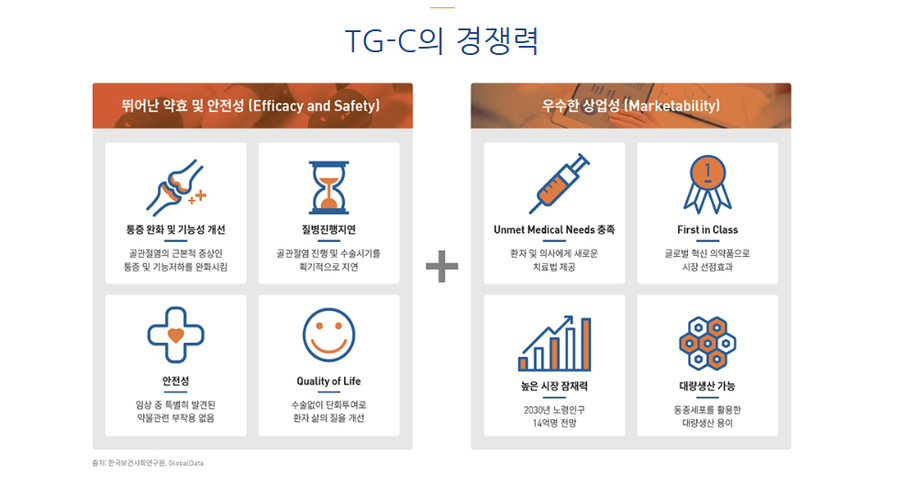
Kolon TissueGene's pipeline is anchored by Invossa, which received approval from South Korea's Ministry of Food and Drug Safety in 2017, only to have that approval revoked in 2019 following a controversy over the cellular composition of the product. The company has since been running a Phase 3 clinical trial in the United States—known as the HERO Study—under the oversight of the Food and Drug Administration (FDA). Global regulatory approval remains the company's central strategic objective and the primary source of its potential value.
The company generates no meaningful revenue. Recurring research and development expenditure produces persistent operating losses, and capital is raised almost exclusively through equity issuances, a structure that continually raises the spectre of dilution for existing shareholders.
*Annual Financial Summary*
The table below summarises the company's financial position over recent years. Precise figures should be verified against filings on South Korea's electronic disclosure system (DART); the estimates below are based on publicly available reports and industry assessments.
Year | Operating Profit/(Loss) | Net Profit/(Loss) | Key Capital Event | Notes
2020 | Large loss (est. ~60bn won) | Loss | — | Post-revocation clinical restructuring
2021 | Loss | Loss | — | FDA clinical re-engagement
2022 | Loss | Loss | — | HERO Study under way
2023 | Loss | Loss | Rights issue | Funding for clinical programme
2024 | Loss | Loss | — | Phase 3 ongoing
2025 | Loss | Loss | — | Global data accumulation
2026 | Loss (est.) | Loss (est.) | 60bn-won rights issue | Proceeds received March 2026
Value-Up: Key Developments
*March 2026 — 60bn-won Rights Issue: Capital Raised, Shareholders Diluted*
In March 2026, Kolon TissueGene completed a 60bn-won rights issue, the proceeds of which are earmarked for the HERO Study and general operating costs. The transaction follows a well-worn template for clinical-stage biotechs: raise equity to fund trials in the absence of product revenue. For existing minority shareholders, however, it represents an unavoidable dilution of their stakes.
The irony is pointed. South Korea's Value-Up programme is designed to improve capital efficiency and boost shareholder returns; fresh equity issuance does the opposite in the short term. The company's implicit counter-argument—that a successful clinical outcome would ultimately be the greatest form of value creation for shareholders—is reasonable in theory, though it asks investors to accept certain near-term pain in exchange for uncertain long-term gain.
*February 2026 — Kolon Group Succession and Governance Questions*
In February 2026, media attention focused on the unresolved question of succession within Kolon Group. The path to the group's vice-chairman, Lee Kyu-ho, consolidating control of the conglomerate was described as far from straightforward. Analysts noted that until the group's ownership structure is clarified, the strategic direction of subsidiaries such as Kolon TissueGene—and their capacity for independent value-enhancing decisions—would remain subject to uncertainty. The Value-Up framework relies on companies voluntarily drawing up and disclosing plans to improve corporate value; that process is harder to execute within a chaebol (family-controlled conglomerate) whose succession is still in flux.
*December 2025 — Value-Up Momentum Meets Biotech Reality*
In December 2025, the South Korean government reaffirmed its ambition to lift the KOSDAQ to 1,100 points, partly on the expectation that the biotech and healthcare sector would provide some of the upward thrust. That expectation highlighted a structural problem: clinical-stage companies like Kolon TissueGene fall largely outside the reach of Value-Up disclosure requirements. The programme's headline metrics—return on equity, price-to-book ratio, dividend pay-out ratio—are either deeply negative or simply incalculable for companies with no revenue. KOSDAQ biotechs, as a result, are likely to remain on the periphery of the policy's benefits.
*May–June 2026 — Foreign Selling Pressure and Market Instability*
As of late May 2026, Kolon TissueGene ranked among the KOSDAQ stocks most heavily sold by foreign investors. The selling coincided with broader global market turbulence—including volatility triggered by concerns around the American chipmaker Broadcom—which prompted international funds to reduce exposure to high-risk KOSDAQ names. The episode underlines a structural vulnerability: in the absence of any shareholder return programme, the stock's price is unusually sensitive to shifts in foreign investor sentiment.
Challenges and Assessment
*Key Challenges*
The most fundamental challenge facing Kolon TissueGene within the Value-Up framework is establishing a revenue-generating business. Until FDA approval is secured, stable profits—the prerequisite for any conventional shareholder return—are not a realistic prospect. The specific tasks ahead are as follows.
First, the successful completion of the HERO Study and the subsequent FDA approval application. Without this, any discussion of Value-Up is academic.
Second, rebuilding shareholder confidence after repeated equity dilution. Even if rights issues are operationally necessary, the company should explore ways to diversify its funding—technology transfers, licensing agreements, or strategic partnerships—so that the burden of financing clinical trials does not fall so heavily on existing shareholders.
Third, resolution of Kolon Group's governance structure. The uncertainty surrounding Lee Kyu-ho's succession will continue to cast a shadow over the long-term strategic direction of the group's subsidiaries, including Kolon TissueGene.
Fourth, engagement with the Value-Up disclosure process. Even if traditional financial metrics are not meaningful in the company's current state, a voluntarily published roadmap—framed around clinical milestones and the path to commercialisation—would represent a credible effort to communicate value to investors on terms that are actually relevant.
*Overall Assessment*
Kolon TissueGene is not the natural beneficiary of a shareholder-value campaign designed with profitable, dividend-paying companies in mind. Dividends are out of the question; share buybacks are a distant aspiration. But the absence of conventional shareholder returns does not, in itself, signal indifference to corporate value. The more persuasive argument is that Value-Up, for a biotech at this stage of development, must travel a different road: greater transparency in the clinical process, clearer communication about the value of the underlying technology, and more trustworthy governance.
The March 2026 rights issue is emblematic of where this company currently stands—survival and clinical continuity take precedence over capital efficiency. The market's ultimate verdict will be shaped by the global commercial prospects for Invossa. Between now and that verdict, the quality of the company's governance and investor communication will determine how much trust it can retain.
Controversies and Structural Constraints
*The Long Shadow of the Invossa Revocation*
No examination of Kolon TissueGene can ignore the events of 2019, when South Korea's drug regulator revoked Invossa's domestic approval after questions arose about the cellular composition of the product. The affair went beyond a clinical setback: it raised serious questions about the timeliness and transparency of the company's disclosures to regulators and investors, and it inflicted direct financial losses on minority shareholders. It remains the single episode most at odds with the Value-Up programme's stated goal of restoring trust between companies and their shareholders.
*Repeated Rights Issues and Dilution*
With no revenue to fund its clinical programme, Kolon TissueGene has relied persistently on equity issuances. The 60bn-won raise completed in March 2026 continues this pattern. Rights issues typically dilute existing shareholders and exert downward pressure on the share price in the near term—an outcome that cuts directly against the capital-efficiency objectives of the Value-Up programme.
*Clinical-Stage Biotechs in the Policy Blind Spot*
South Korea's Value-Up programme is calibrated around financial ratios—ROE, price-to-book, dividend yield—that are either negative or meaningless for companies without revenue. Kolon TissueGene's price-to-book ratio is distorted beyond conventional interpretation, because its market capitalisation is driven by clinical expectations rather than net asset value; its return on equity is persistently negative. The result is that KOSDAQ biotechs as a group are likely to have low participation rates in Value-Up disclosures, and to see limited benefit from the policy's incentive structures.
*Foreign Investor Outflows*
The appearance of Kolon TissueGene on the list of stocks most sold by foreign investors in May 2026 reflects a broader pattern: global capital is withdrawing from companies that combine high clinical risk with an absence of shareholder returns. Attracting foreign investment is one of the explicit objectives of the Value-Up programme; on this measure, Kolon TissueGene is moving in the wrong direction.
*Limits on Subsidiary Independence Within the Group*
So long as Kolon Group's succession and governance arrangements remain unresolved, Kolon TissueGene's freedom to make independent decisions—on capital allocation, clinical priorities, or external partnerships—is constrained. For a company that needs to act with the agility of a pure-play biotech, the ties that bind it to a chaebol in mid-transition represent a meaningful operational and strategic risk.
Summary Data
Year | Dividend (per share) | Share Buyback/Cancellation | Operating Profit/(Loss) | Price-to-Book (est.) | Key Capital Event
2020 | None | None | Large loss | N/A | Post-revocation fallout
2021 | None | None | Loss | N/A | FDA clinical discussions
2022 | None | None | Loss | N/A | HERO Study progressing
2023 | None | None | Loss | N/A | Rights issue
2024 | None | None | Loss | N/A | Phase 3 ongoing
2025 | None | None | Loss | N/A | Clinical data accumulation
2026 | None | None | Loss (est.) | N/A | 60bn-won rights issue completed
*Note: Kolon TissueGene has no history of dividends or share buybacks. Price-to-book ratios are subject to extreme volatility given their dependence on clinical expectations, and are not meaningful in the conventional sense. Detailed operating and net profit figures should be verified against filings on South Korea's DART disclosure system.*