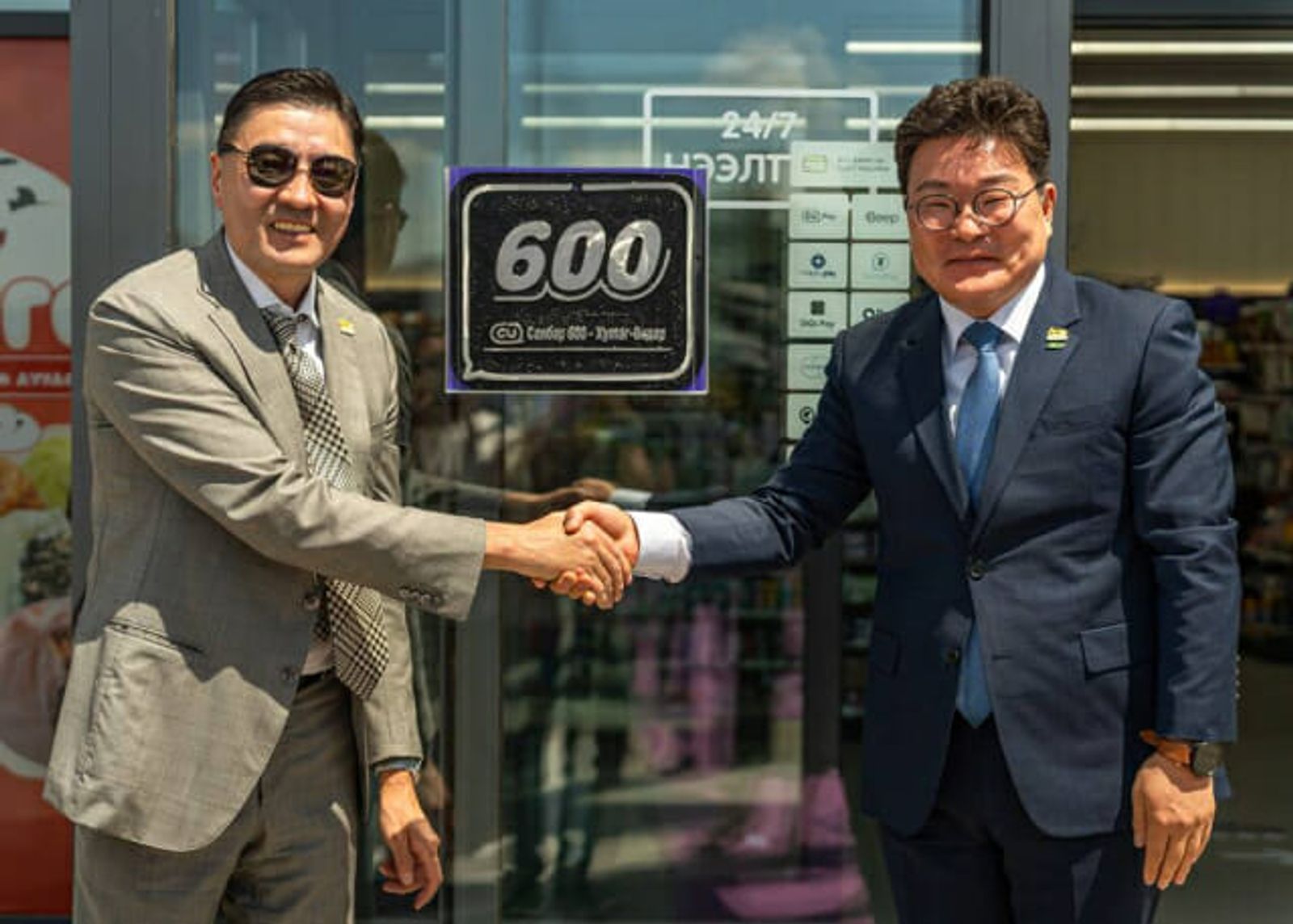
CU, the convenience store brand operated by BGF Retail, has surpassed 600 outlets in Mongolia — a milestone reached just seven years after the company signed a master franchise agreement with local partner Central Express in 2018. At an average pace of roughly 85 new stores per year, the expansion ranks among the fastest ever achieved by a Korean convenience store brand in a single overseas market.
From retail desert to fertile ground
Mongolia is a small country of 3.4m people, but more than half of them — around 1.7m — are concentrated in the capital, Ulaanbaatar. That extreme urban density naturally satisfies the "density economics" that underpin any successful convenience store business. Equally important, Mongolia's GDP per capita has grown steadily since the 2010s, reaching an estimated $5,400 in 2023 (World Bank figures), giving rise to a middle class with the appetite and means to spend on ready-made food, beverages, and everyday goods.
According to data from the Korea International Trade Association (KITA), Mongolia's retail distribution market has grown at an annual rate of 8–10% since 2015, undergoing a structural shift away from traditional markets towards modern convenience stores and supermarkets. CU moved early enough to secure a first-mover advantage at this inflection point.
K-food drives consumer loyalty
One of the most important engines of CU's success in Mongolia has been the demand for Korean food, amplified by the broader Korean Wave. Mongolian consumers who had vicariously experienced Korean convenience store culture through K-dramas and YouTube arrived at CU stores already looking for tteokbokki (spicy rice cakes), triangle rice balls, and instant noodle cups. This familiarity translated directly into high rates of repeat custom. According to internal figures released by CU, ready-to-eat food now accounts for more than 30% of sales in its Mongolian stores — approaching the average seen at outlets in South Korea itself.
Localisation has played an equally important role. CU Mongolia maintains a direct import line of Korean products while also selling traditional Mongolian street food such as khuushuur (fried dumplings) — a so-called "glocal" approach. Retail industry analysts credit this balance as decisive in building consumer trust. "It is neither full Koreanisation nor full localisation," says one specialist. "The winning formula is preserving the Korean brand identity while adapting to local tastes."
The structural logic of master franchising
CU's international expansion relies not on direct investment but on the master franchise (MF) model, in which the parent company provides the brand, operating systems, and product development, while the local partner handles store operations, staffing, and logistics. The arrangement reduces entry risk while generating a steady stream of royalty income.
Lee Jeong-sil, a professor at Kyung Hee University's College of Hotel and Tourism Management, argues that the model is particularly well-suited to markets such as those in South-East and Central Asia, where restrictions on foreign direct investment are common. "The MF model lets you leverage the local partner's networks and regulatory expertise," he says, while cautioning that brand quality control and the risk of capability gaps between franchisor and franchisee require constant monitoring.
Competition and macro risks
The picture is not uniformly rosy. The competitive environment in Mongolia is intensifying. Seven-Eleven has already entered the market, and retail capital from Russia and China is eyeing the local sector. There is also a structural macro risk: Mongolia's economy is heavily dependent on exports of mineral resources such as copper and coal, meaning that a sustained fall in commodity prices could rapidly dampen consumer spending.
Logistics present a further challenge. As a landlocked country, Mongolia relies on air freight or overland routes through China for imports from South Korea, creating delays and cost pressures. Maintaining the quality of fresh and chilled products remains a structural problem without an easy solution.
A faster pace than Japan's giants
It took Japan's Seven-Eleven decades to build a network of more than 20,000 stores globally after acquiring the American original in 1991. Korean convenience store brands are expanding overseas at a considerably faster clip. Beyond Mongolia, CU currently operates international stores in Malaysia, Kazakhstan, Cambodia, and Kuwait; its total overseas store count is believed to have exceeded 1,000 as of 2025. Rival chain GS25 has also entered Vietnam and Mongolia, intensifying the competition abroad.
Academics who study the retail industry identify three sources of competitive advantage for Korean convenience stores overseas: a rapid product innovation cycle, IT-driven inventory and ordering systems, and specialised expertise in ready-to-eat food. Taken together, these amount to something closer to the export of an entire retail operating system than merely a store format.
Outlook and implications
CU's 600th Mongolian store marks a meaningful proof of concept: the Korean convenience store model can serve as a genuine growth engine in Central and South-East Asian consumer markets, beyond a domestic industry that is approaching saturation at home. The synergy between Korean cultural content and convenience retail — a form of commerce riding on soft power — also aligns neatly with the South Korean government's broader strategy of promoting the Korean Wave as an export asset.
Yet analysts are unanimous that sustaining this growth will require more than adding stores. Localising the supply chain, developing local talent, and strengthening franchisee management systems are seen as prerequisites for durable expansion. The next structural variable to watch in Mongolia's convenience store market will be the accelerating growth of single-person households and ongoing urbanisation. How CU manages the qualitative evolution of its model — as it pushes towards 700 and eventually 1,000 stores — will be the true test of whether the Korean convenience store concept can become a genuinely global retail franchise.