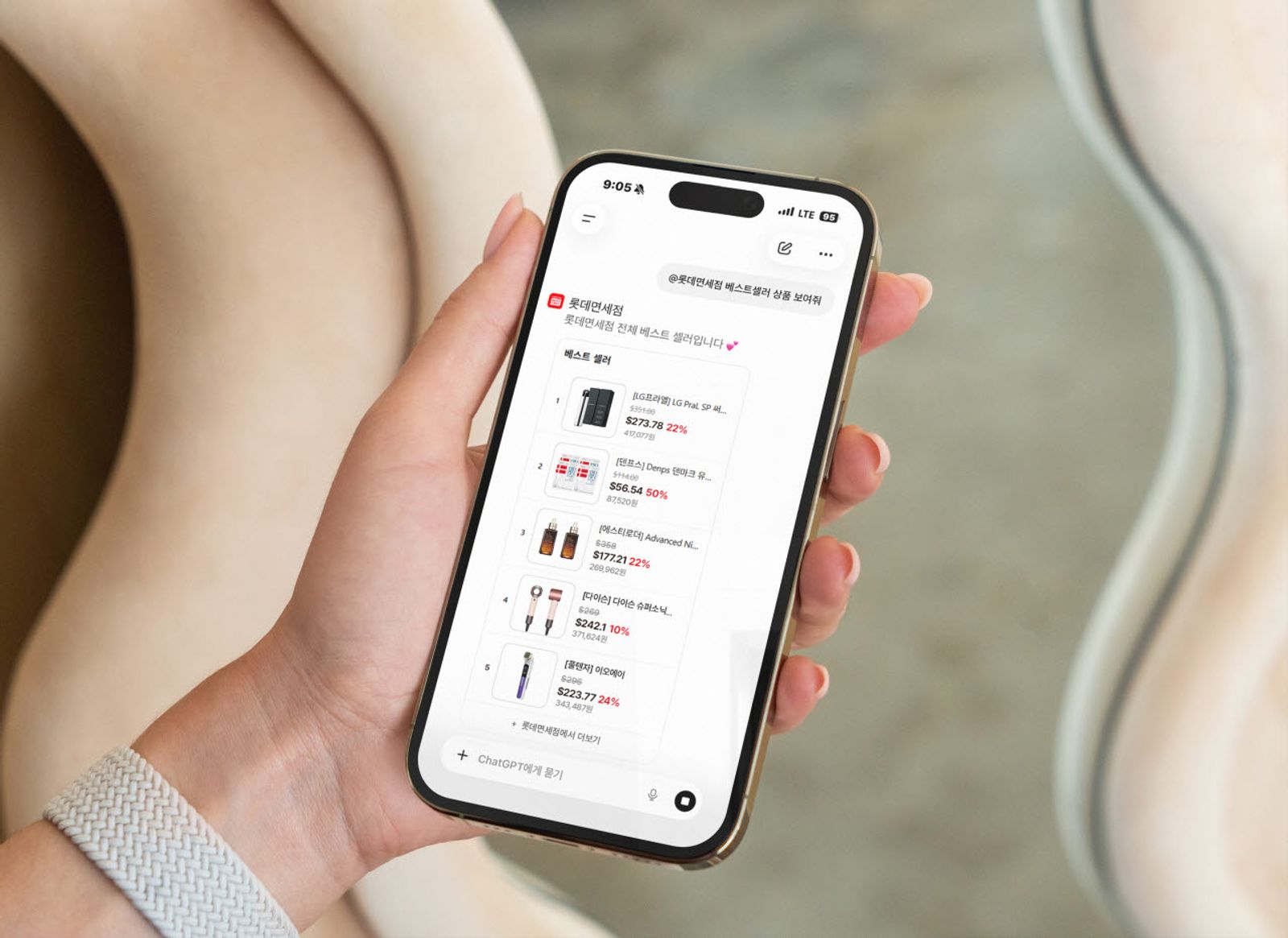
Lotte Duty Free has become the first retailer in South Korea's duty-free sector to launch a ChatGPT-powered shopping service, marking a significant milestone in the country's rapidly intensifying AI commerce competition. The service goes well beyond simple product searches or algorithmic recommendations: a conversational AI intervenes at every stage of the purchase journey. The combination of a highly specialised retail channel — duty-free shopping — with cutting-edge generative AI has drawn attention from across the industry.
An industry in structural trouble turns to AI for answers
Lotte's decision is less a straightforward technology upgrade than a survival strategy born of structural distress. According to the Korea Duty Free Association, the domestic duty-free market generated roughly 24 trillion won (approximately $18bn) in sales in 2019, before the pandemic sent revenues into a sharp decline. Although the sector has since staged a partial recovery, it faces a twin burden: a deliberate reduction in reliance on Chinese daigou traders — professional bulk buyers who resell goods across the border — and falling average transaction values from individual tourists. With the traditional business model built around high-spending tour groups now under strain, hyper-personalised shopping experiences tailored to individual tastes and budgets have emerged as a new source of competitive advantage.
The ChatGPT-based service targets precisely this gap. A customer might type, in plain language, "recommend a whisky as a gift for a man in his forties, budget around 500,000 won" — and the AI will analyse the product database in real time to suggest the most suitable options. Unlike conventional keyword searches, the system grasps context and intent, making genuinely conversational recommendations its core differentiating feature.
A global trend finds its Korean testing ground
AI-assisted shopping is already spreading rapidly on the global stage. Amazon launched its AI shopping assistant, Rufus, in 2024, enabling American customers to search, compare and buy entirely through natural-language queries. In China, Alibaba has integrated its Tongyi Qianwen large language model — developed by Alibaba Cloud — into the Taobao and Tmall platforms, substantially improving the accuracy of personalised recommendations. A 2024 McKinsey & Company report estimated that generative AI could create between $400bn and $660bn in economic value annually across the retail and consumer-goods sector.
In South Korea, Naver has been refining AI-powered shopping recommendations through its Clova platform, while Kakao has been experimenting with combining KakaoShopping and AI. Yet Lotte Duty Free is the first operator in either the duty-free or broader retail sector to integrate OpenAI's ChatGPT directly into a shopping interface. The multimodal capabilities of GPT-4o and its successors — the ability to process images and text simultaneously — are expected to prove particularly valuable in duty-free beauty and fashion categories, enabling recommendations based on product images and visual styling suggestions.
Real promise, real problems
For consumers, the potential of this service is considerable. Duty-free shopping is inherently information-intensive: shoppers must navigate a wide variety of brands, complex allowance regulations, and fluctuating exchange rates, often within tight time constraints before or after a flight. An AI assistant could meaningfully reduce that cognitive load. Research by Deloitte supports the premise: 73% of consumers surveyed said they would welcome AI shopping recommendations that learn from their purchase history and preferences.
Yet legitimate concerns remain. The most significant is the neutrality of recommendations. If the AI is designed — whether explicitly or implicitly — to prioritise high-margin products or items in need of clearance, consumers may be steered towards choices that do not serve their interests without realising it. The Korea Consumer Agency has repeatedly called for urgent action to establish transparency standards for AI recommendation algorithms. There is also the question of data privacy: integrating sensitive personal information — including purchase histories and passport details — with an AI service creates real risks that must be managed carefully.
Experts also flag the risk of AI hallucination. In a duty-free context, this is not a trivial concern. If the AI provides inaccurate information about duty-free allowances, regulated ingredients or items prohibited from import into certain countries, the consequences for consumers could be immediate and material. Building robust verification layers and safeguards into the system's design — specifically for legally or regulatorily sensitive information — is not optional; it is essential.
Rivals under pressure as competition shifts
Lotte's first-mover advantage will apply direct pressure on competitors, including Shilla Duty Free and Shinsegae Duty Free. Competition in the duty-free industry has historically centred on location — airport versus city-centre — and the strength of brand portfolios. AI capability is now emerging as a third competitive dimension. For operators targeting Millennial and Gen Z shoppers, as well as individual foreign tourists, the quality of multilingual conversational AI — in English, Mandarin, Japanese and beyond — could become a decisive factor in customer acquisition.
One industry insider put it plainly: "The first-mover advantage in AI commerce does not show up overnight — the gap widens with every additional layer of data accumulated. If you don't start now, you'll face a technology deficit in two or three years that will be very hard to close." Amazon's own internal data on Rufus appears to bear this out: click-through rates reportedly improved by more than 40% in the eight months following launch, illustrating the compounding returns that learning-based AI systems can generate.
Policy-makers face an unfamiliar challenge
The mainstream arrival of AI commerce also presents regulators with novel questions. South Korea's Fair Trade Commission is discussing voluntary guidelines on algorithmic recommendations by online platforms, but specific rules governing generative AI-based recommendations remain underdeveloped. The European Union's AI Act is advancing discussions on classifying recommendation systems as subject to transparency obligations analogous to those for high-risk AI applications; calls are growing in South Korea for comparable legislative and regulatory foundations.
Lotte Duty Free's adoption of ChatGPT shopping is more than one company's technology experiment. It is a signal that South Korea's retail industry as a whole has arrived at an inflection point in its AI transition. As hyper-personalisation and conversational interfaces become the expected standard in shopping, the central challenge — for industry and regulators alike — is how to pursue technological innovation while simultaneously protecting consumers and ensuring a level competitive playing field. That challenge now sits squarely at the top of the agenda.