What this article covers
How ordinary DRAM is priced, and why it fluctuates with supply and demand; why HBM is traded on entirely different terms; what long-term supply agreements are and why all three major memory producers are adopting them; where pricing power currently resides; and what this shift means for South Korean firms.
The world of ordinary DRAM: prices that rise and fall
The DRAM chips inside smartphones and personal computers are priced much like oil or agricultural commodities—on an open market. Research firms such as TrendForce, a Taiwanese outfit, publish monthly average transaction prices, which move up and down with supply and demand. When supply increases, prices fall; when demand surges, prices spike. In the first quarter of 2026 alone, DRAM prices leapt by 55–60%—a direct consequence of market forces. As AI server demand exploded, memory manufacturers shifted production lines away from conventional DRAM towards HBM, tightening supply of the former and driving up its price.
In this kind of market, nobody locks in a price in advance. A buyer who contracts today accepts today's spot price; one who contracts next month accepts whatever the rate is then. For memory companies, this is the classic fate of a cyclical industry: strong earnings in boom times, steep losses when prices crash.
Why HBM is traded differently
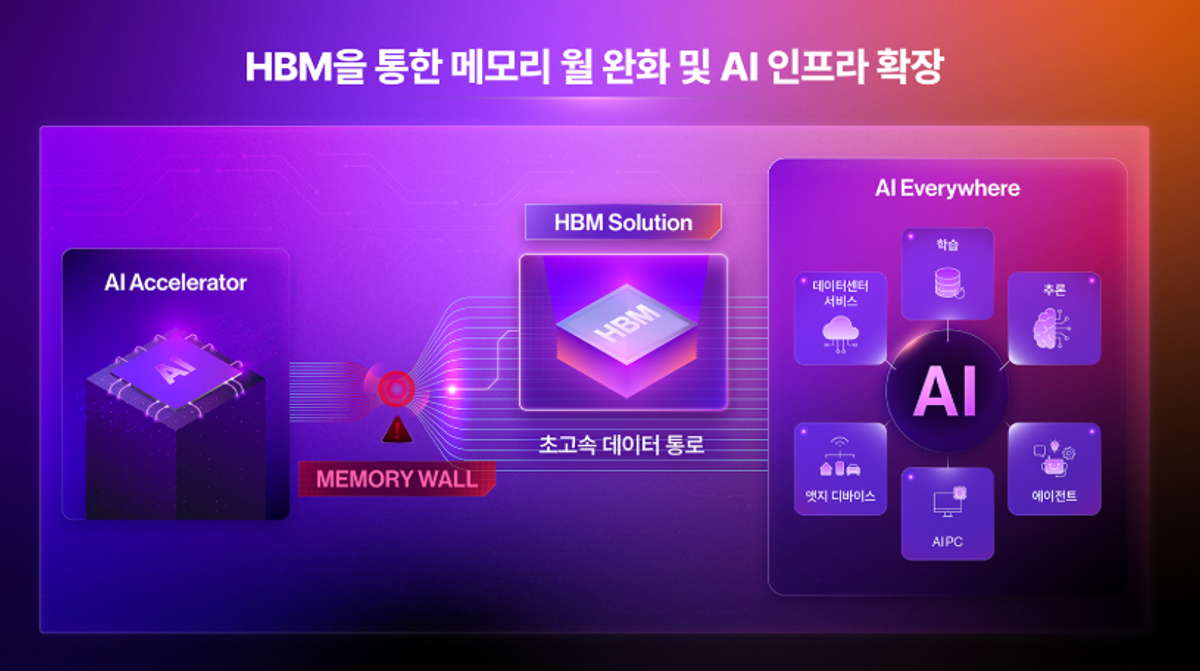
HBM sits outside this market logic, for a fundamental reason: it is not a commodity. Ordinary DRAM is largely interchangeable regardless of manufacturer; HBM, by contrast, is engineered to precise specifications set by individual customers—chiefly makers of AI accelerators such as Nvidia—and there are only three suppliers in the world. The nature of the transaction is altogether different. Conventional DRAM is bought and sold in an open market by a wide range of participants; HBM involves a handful of memory producers negotiating directly, one-to-one, with a handful of big technology customers.
What is more, demand currently exceeds every unit that can be produced. Industry observers note that every HBM chip that can be made is already spoken for. Production slated for 2026 is essentially sold out, and analysts forecast that the DRAM shortage will persist until 2028, with NAND shortages lasting until 2027. In a market where goods are sold before they are even made, the notion of setting a price each day on a spot market becomes meaningless.
A new standard: the long-term supply agreement
This is the context in which long-term supply agreements—commonly known as LTAs—have taken hold. In the past, an LTA was little more than a loose commitment to purchase a certain volume. Today, the concept has been transformed. Duration, confirmed quantities, and price are all fixed in advance.
Samsung Electronics and SK Hynix have effectively abandoned short-term, annual supply contracts this year and moved to agreements spanning three to five years. Until last year, quarterly contracts were still accepted; now the minimum is three years. Micron has gone a step further, introducing what it calls the Supply Capacity Agreement, or SCA—a more developed form of LTA that locks in both volume and price across five years. Micron has already signed 16 SCAs; these alone account for 20% of its DRAM volume and 33% of its NAND volume. Once all SCAs are finalised, more than half of Micron's revenue is expected to flow from them.
The mechanics of these contracts are illuminating. Under Micron's SCA structure, the market price at the time of signing serves as a ceiling; a floor price covering the full contract period is set simultaneously. The customer is guaranteed it will pay no more than the ceiling; the supplier is guaranteed it will receive no less than the floor. Whatever direction prices move, both parties are protected within a defined range.
Who holds pricing power now
What this shift in trading structure ultimately reveals is a rebalancing of power. One market analyst put it bluntly: pricing power has moved entirely to the suppliers. Big technology companies, unwilling to fall behind in the AI race, are forgoing the flexibility to negotiate on price in favour of securing supply.
The numbers bear this out. Fourteen of Micron's 16 SCAs alone guarantee a minimum of $100bn in revenue over their combined terms. The company has also disclosed that the price floors embedded in these contracts are higher than the peak quarterly margins achieved during any previous boom cycle. In other words, the minimum price suppliers are receiving today exceeds the maximum they earned at the top of past upswings.
That said, LTAs are not without moving parts. Minimum-price guarantees in the event of market downturns, upfront advance payments, and other detailed conditions all feature in negotiations, and the precise terms agreed are expected to influence market-share competition among memory producers. Supply capacity also has limits: SK Hynix acknowledged at its most recent earnings presentation that it cannot accommodate every customer's request for a long-term contract. The choice of which customers to partner with, and on what terms, has itself become a competitive weapon.
A shift that is spreading beyond memory
The move to long-term contracts is not confined to memory chips. As shortages in HBM and server DRAM ripple outwards, similar arrangements are appearing in adjacent component markets, including multilayer ceramic capacitors (MLCCs), silicon capacitors, and semiconductor packaging substrates. Samsung Electro-Mechanics, for instance, has signed a two-year silicon capacitor supply contract worth approximately 1.5 trillion won with a major global firm. AI servers require not only semiconductors but also power-stabilisation components and high-performance substrates; if any one of these parts runs short, server production can grind to a halt. Big technology companies and server manufacturers are accordingly beginning to treat key components as assets to be secured over the long term rather than ordered at short notice.
What this means for South Korean companies
The shift towards long-term contracts offers clear advantages to memory producers. The most significant is earnings stability. Historically, these companies were caught in a classic commodity cycle: profits soared when prices rose and collapsed when they fell. As the share of long-term contracts grows, pre-agreed prices and volumes hold even through downturns, creating a floor beneath earnings that prevents them from cratering alongside spot prices.
The investment case is also improved. With future sales already contracted, memory companies can plan capital expenditure with precision rather than engaging in the ruinous capacity races that characterised earlier cycles. The industry expectation is that higher long-term contract penetration will keep margins both higher and more stable than in previous eras.
Samsung has joined this trend. At its first-quarter 2026 earnings briefing, the company confirmed it is pursuing long-term supply agreements for memory products at customers' request, and has already completed contracts with some of them. Industry observers point out that once a supplier secures a place in a customer's HBM supply chain, it tends to retain that position into subsequent product generations. The contracts signed today, in other words, may well determine the competitive landscape when HBM4E and HBM5 arrive.
In summary
The reason HBM and ordinary DRAM are priced so differently comes down to the fundamental nature of each market. Conventional DRAM is a commodity market, open to all buyers and sellers; HBM is a negotiated market in which a small number of suppliers and an equally small number of buyers set multi-year terms in advance. Right now, suppliers hold unusually strong leverage in those negotiations. When goods sell out before they are made, the seller tends to dictate the terms.
Whether this arrangement will remain permanently tilted in suppliers' favour is another matter. Today's long-term contracts were struck during a period of acute shortage; if supply eventually catches up with demand, the balance of negotiating power may shift again. Whether the three-to-five-year agreements now being signed will still look fair to both sides by the time that moment arrives is a question the market will answer over the years ahead.