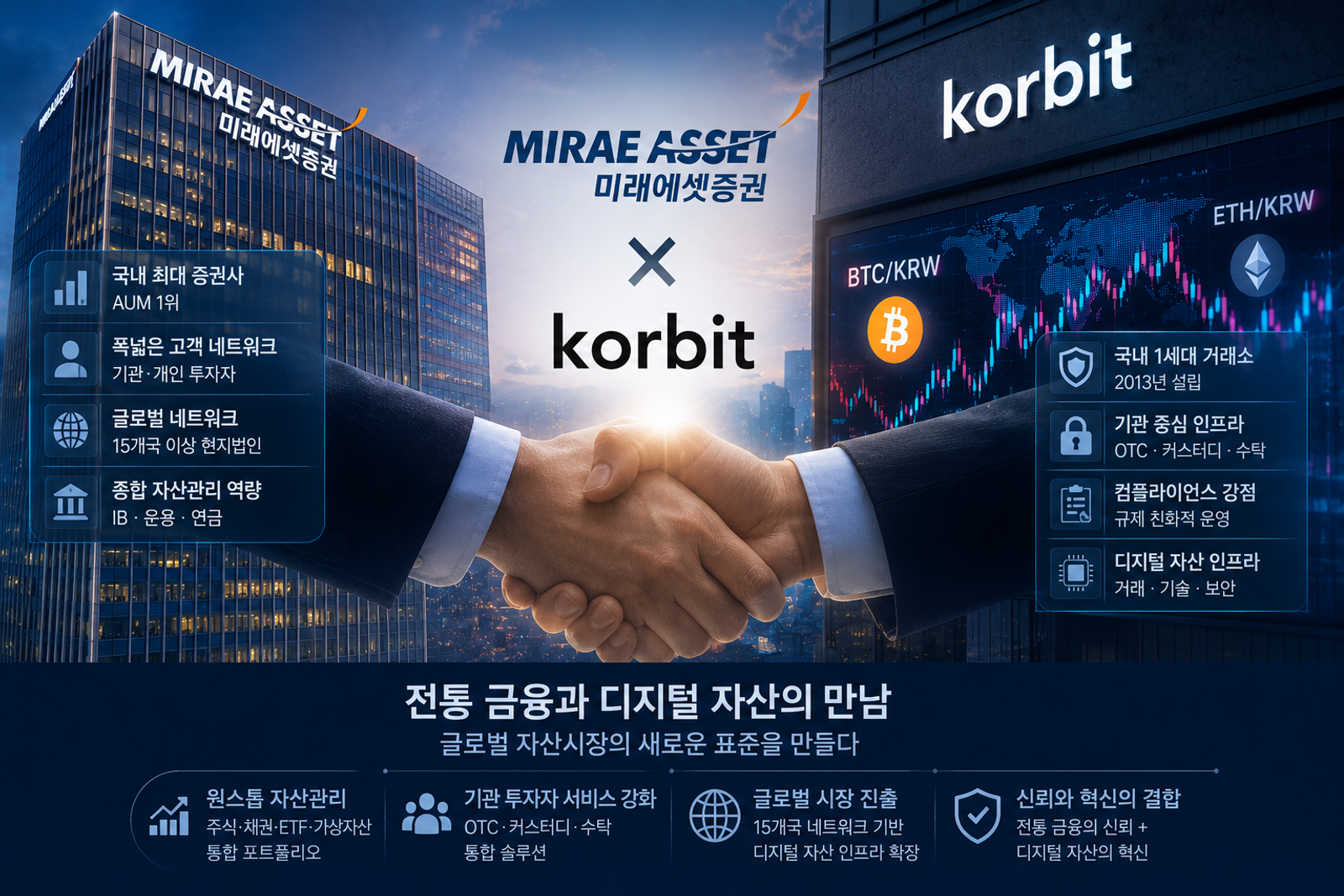
South Korea's competition regulator, the Korea Fair Trade Commission, has approved the merger of Mirae Asset Securities and Korbit, the country's first cryptocurrency exchange. The decision marks a pivotal moment for Korean capital markets, as one of the country's most powerful financial institutions formally enters the digital asset space. Industry observers regard the deal not merely as a corporate acquisition but as a harbinger of a sweeping realignment in global asset management.
Structure and rationale
Mirae Asset Securities is one of South Korea's largest brokerages and ranks among the leading financial groups in the Asia-Pacific region by assets under management. Korbit, founded in 2013, was South Korea's first cryptocurrency exchange and an early pioneer of Bitcoin trading in the country. Under the terms of the deal, Mirae Asset has acquired a controlling stake in Korbit. The competition authority concluded that, because the two firms operate in distinct business segments, the transaction poses little risk to market competition.
Mirae Asset described the move as "a pre-emptive response to the irreversible trend of convergence between traditional capital markets and digital asset markets." Korbit's management expressed equally high hopes, saying that Mirae Asset's global network and retail infrastructure would "dramatically expand" the exchange's growth potential.
A catalyst for market transformation?
The strategic logic of the deal rests on combining two assets: distribution reach and institutional trust. South Korea's virtual-asset market has moved steadily towards regulatory integration since the Virtual Asset User Protection Act came into force in 2024, yet many retail investors still harbour deep reservations about cryptocurrency. Mirae Asset's base of roughly 12 million customers and its nationwide branch network give Korbit access to mainstream financial consumers it could never have reached on its own.
Research from the Korea Capital Market Institute suggests that when an established financial institution acquires a crypto platform, retail investors' confidence in digital assets tends to rise by an average of 23 percentage points—a reflection of the dual effect of investor-protection rules and brand credibility operating in tandem.
Not everyone is convinced, however. A representative of the Korea Fintech Academic Society warned that "if the logic and regulatory framework of traditional finance is transplanted too aggressively onto a blockchain-based platform, the core value of decentralisation that defines cryptocurrency could be undermined." Existing Korbit users have also raised questions about whether the exchange can preserve its operational independence.
International precedents
The deal follows a well-worn path elsewhere. Fidelity Investments built its own digital-asset division, Fidelity Digital Assets, from 2018, providing institutional clients with cryptocurrency custody services. BlackRock's launch of a spot Bitcoin exchange-traded fund in 2024 reshaped the market; the fund surpassed $20 billion in assets under management within its first year. In Europe, Deutsche Bank has obtained a virtual-asset custody licence, as the entry of mainstream financial institutions into the digital-asset space becomes a global norm.
Japan's experience is particularly instructive. SBI Holdings, through its S Coin Platform and SBI Crypto Investment arm, constructed an integrated traditional finance and crypto ecosystem; institutional capital flows into Japan's virtual-asset market subsequently rose to more than three times their 2022 levels. Should the Mirae Asset-Korbit combination follow a similar trajectory, institutional allocation to digital assets in South Korea could increase meaningfully.
Regulatory risk
Regulatory approval does not guarantee commercial success. South Korea's legal framework for virtual assets remains incomplete. A second phase of legislation—targeting stablecoins, decentralised finance (DeFi) and tokenised securities (security token offerings, or STOs)—is under discussion, with implementation targeted for 2025. The shape of those rules could materially alter the business model of the combined entity.
A Financial Supervisory Service official noted that while the involvement of a large financial group such as Mirae Asset would strengthen investor protection, it also raises novel regulatory challenges—particularly around conflicts of interest and the information barriers ("Chinese walls") required between different business lines. Structurally, a brokerage that owns an exchange faces an inherent conflict of interest when a listed company issues blockchain-based tokens through initial or exchange-based token offerings.
Three tests of the new vision
Mirae Asset has spoken of creating "a new global standard for asset markets." Experts broadly agree that realising this ambition will require clearing three hurdles.
First, the fiat-to-crypto on- and off-ramp infrastructure must be upgraded. A seamless platform that links conventional brokerage accounts to digital-asset wallets would represent a genuine leap in user experience. Second, the combined group must build credible institutional custody services: domestic institutional investors cannot commit serious capital to digital assets without secure, regulated custody, and Mirae Asset's financial strength could accelerate that build-out. Third, the pair must develop an integrated platform for trading both tokenised and conventional securities. The combination of Korbit's blockchain expertise and Mirae Asset's securities infrastructure could position the merged entity as a market leader in tokenising illiquid asset classes such as real estate, fine art and private equity.
A senior fellow at the Korea Institute of Finance observed that if the merger delivers genuine synergies, "it would provide South Korea with a concrete foundation to compete with Singapore and Hong Kong in the race to become Asia's digital-asset hub." A cryptocurrency analyst was more measured, noting that "closing the gap with Upbit"—the market leader by domestic trading volume—"will require far more than a capital merger; it demands real service innovation."
An inflection point, not a conclusion
The approval of this merger is a genuine inflection point in South Korean financial history. If the cryptocurrency frenzy of 2017 was consumed by speculative excess, the digital-asset market of the mid-2020s is being recast around three pillars: institutionalisation, regulation, and integration with mainstream finance. The decisive question is whether the trust infrastructure of traditional finance and the technological innovation of the crypto world can combine chemically, rather than merely coexist.
The ultimate significance of this deal will be determined by two factors: what regulatory architecture South Korea's financial authorities choose to erect in the second phase of virtual-asset legislation, and how quickly the merged entity can complete its ecosystem of tokenised securities and institutional services. The moment of approval is not the ending—it is the starting gun.