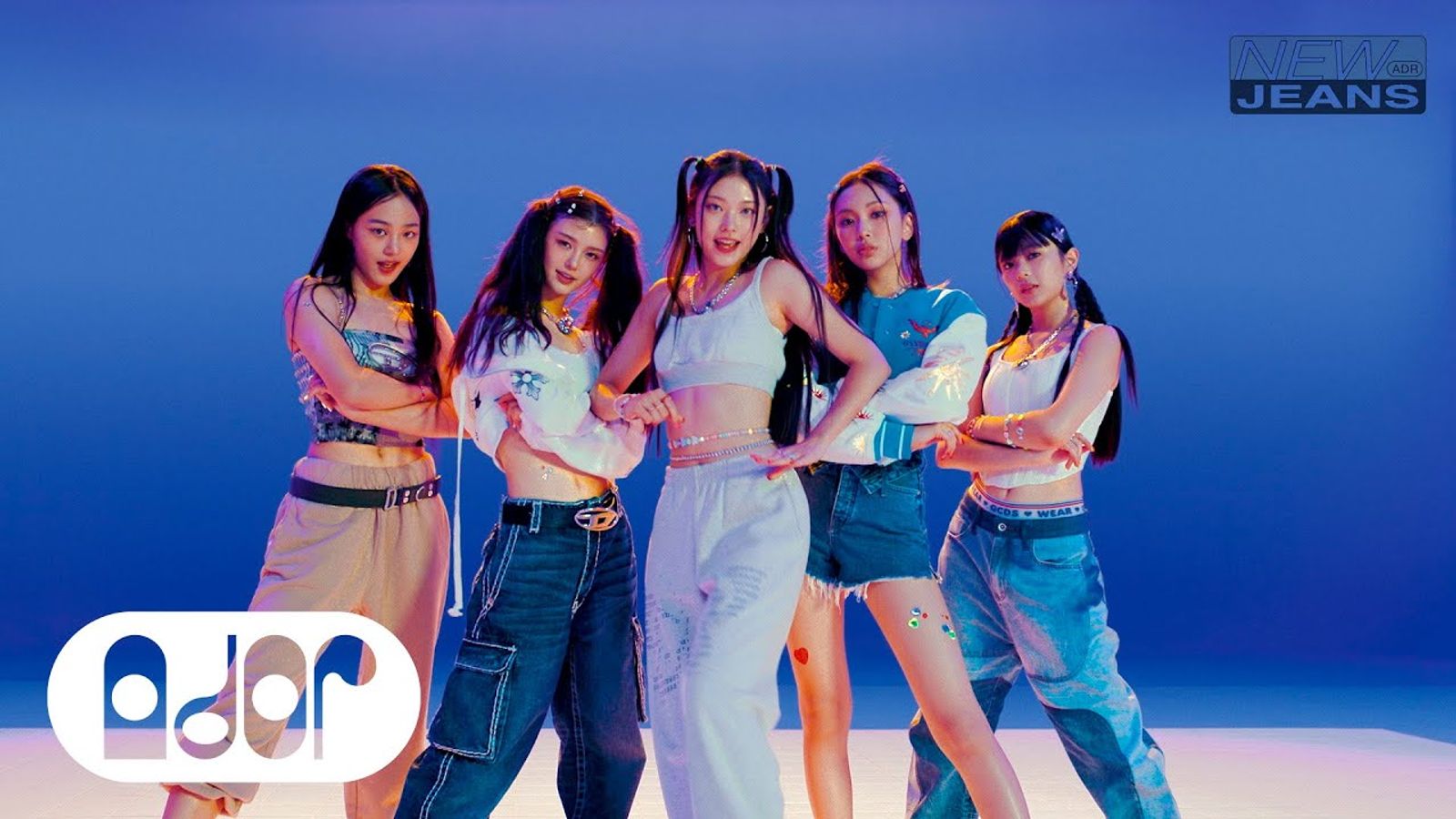
*Editor's note: "One Track" is a series examining trends in the K-pop industry through the lens of a single song. This third instalment looks at "Hype Boy" by NewJeans—a track that has survived for more than three years on the strength of a single internet meme.*
On 1st August 2022, NewJeans made an unusual choice for their debut. Rather than designating a single lead single, the five-member group—Minji, Hanni, Danielle, Haerin, and Hyein—released three tracks simultaneously under the debut EP *New Jeans*: "Attention", "Hype Boy", and "Cookie". The group is signed to ADOR, a label under HYBE, the entertainment conglomerate also home to BTS. The triple-title format was striking enough to draw immediate industry attention. All three songs hit domestic and international charts at once, but in those early days, "Attention" led the charge.
Origins
"Hype Boy" blends moombahton—a genre that fuses reggaeton with electronic dance music—with electropop into something breezy and propulsive. Its release as part of a simultaneous three-track debut was itself a break from K-pop convention, which typically concentrates promotional firepower on a single lead song.
Early advantage: "Attention" takes the lead
The initial numbers favoured "Attention". On the night of 9th August 2022—the day music videos were released—it reached number one on Melon's Top 100 chart, South Korea's dominant music-streaming platform, within hours of going live. That was a first for a debut track since Melon's chart methodology was reformed, and more broadly, the first time an idol group's song had debuted at number one since BLACKPINK's "Whistle" in 2016. On the Billboard Global 200, "Attention" entered at 82nd, ahead of "Hype Boy" at 116th. Several music databases and commentators accordingly identified "Attention" as the more definitive statement of what NewJeans stood for.
The turning point: a meme changes everything
Over time, the picture shifted. "Hype Boy"'s choreography—cool, unhurried, with a particular arm movement that proved irresistible to imitate—spread rapidly across short-form video platforms, including Instagram Reels, YouTube Shorts, and TikTok. A specific phrase derived from the song, roughly translatable as "NewJeans' Hype Boy", became a meme widely enough cited to appear in news articles. The song's cultural footprint extended to unexpected places: professional *League of Legends* player Byun Jeong-hyeon abandoned his existing gaming alias and adopted "Hype" as his new handle, citing the song's name as his reason.
Curiously, "Hype Boy" was slow to register on televised music shows, where weekly chart winners are declared through a combination of streaming, sales, and broadcast performance. It did not claim its first number one on SBS's *Inkigayo*—one of South Korea's flagship music programmes—until 2nd April 2023, fully 35 weeks after the group's debut. It had been lapped on conventional metrics at launch, only to climb to the top on the back of organic, audience-driven momentum.
The long game: streaming tells the final story
The ultimate verdict is written in streaming figures. As of September last year, "Hype Boy" had surpassed 700m streams on Spotify, making it the fourth NewJeans track to cross that threshold. "Attention", by contrast, sits in the 500m range—a strong performance, but well behind. The performance version of the "Hype Boy" music video also became the first NewJeans video to exceed 100m views on YouTube. More than three years after release, the song continues to appear on South Korea's mainstream streaming charts. By most measures, it ranks among the most durable pop songs of the 2020s.
What it means
"Hype Boy" illustrates a distinct model of success in K-pop—and in pop music more broadly. BTS's "Dynamite" was an English-language single engineered for Western radio from the outset. "Gangnam Style" by PSY became a global phenomenon entirely by accident. "Hype Boy" sits somewhere between those poles. It was planned from the start as one of three co-equal debut singles, yet the force that sustained it was neither the label's marketing nor the song's initial chart performance, but a meme that audiences generated and spread themselves.
The lesson is straightforward, if still underappreciated by the industry: a song's commercial lifespan is no longer determined at the moment of release. When listeners become producers—replicating, remixing, and redistributing content across platforms—they can extend a track's relevance long past the promotional window that labels traditionally rely upon. "Hype Boy" did not win the opening sprint. It won the marathon.
*"Another song grabbed the attention first. What endured was the power of the meme."*