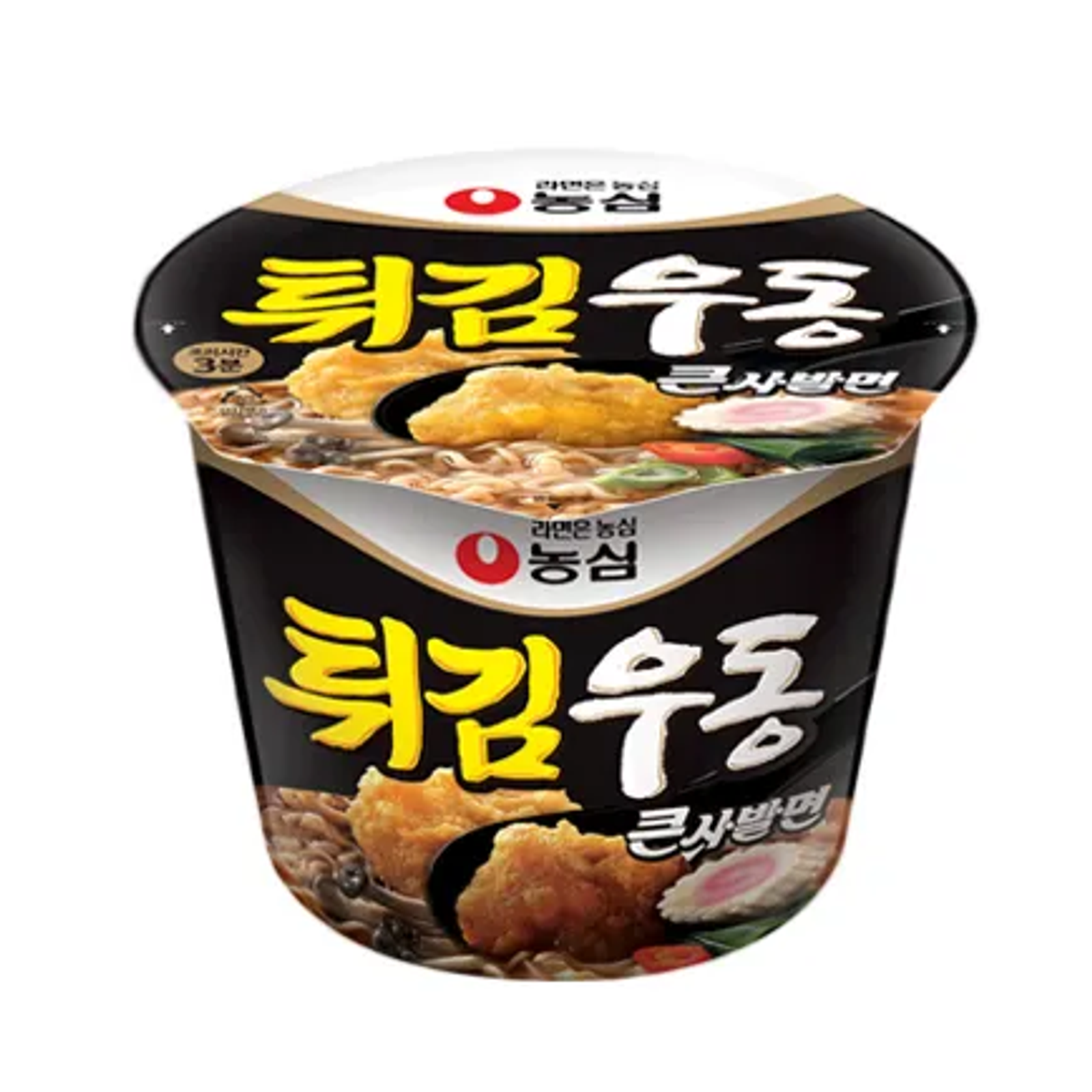
Background
Twigim Udon Big Bowl — a udon-style cup noodle launched by Nongshim on 8th October 1990 — has earned a place alongside Yukgaejang Sabal and Kimchi Sabal in what Korean consumers affectionately call the "holy trinity of cup noodles." In a market where fiercer and fiercer chilli heat has long been the dominant competitive strategy, it stands out as a rare steady seller that has remained mild from the very beginning.
The Story
When Twigim Udon first appeared, its defining proposition was simple and deliberate: a spice-free udon broth. That original identity — a soup entirely without heat — built a loyal following among consumers fatigued by fiery noodles, young children, and those unable to tolerate spicy food. Over the years, a small amount of chilli powder has crept into the recipe, yet the product remains roughly as mild as the gentlest variants of rival Jin Ramen, a benchmark that still defines its character. Sodium content has also been quietly reformed, falling from around 2,000mg to 1,590mg, steadily reinforcing its image as an unfussy, low-irritant noodle.
The toppings, too, set it apart. A tempura-battered dried squid fritter — the twigim of the name — has long been regarded as the product's signature flourish, praised for adding textural contrast to the clean broth. In 2016, an upgraded variant called Big Twigim Udon Big Bowl attempted to supersize the fritter into a large, round centrepiece; the experiment backfired, with many consumers finding the combination of deep-fried noodles and an oversized fritter excessively greasy, and the product was eventually discontinued. A bag noodle version, Twigim Udon Myeon, followed in November 2018. Its broth is notably milder and closer to an authentic udon flavour than the cup incarnation, and it has since cultivated its own dedicated admirers — including fans of a recipe popularised on the Korean variety show "2 Days & 1 Night," in which comedian Kim Jong-min added the full contents of a tinned tuna can, oil included, and stirred in a portion of pre-cooked rice.
Tasting Notes
Twigim Udon's defining quality is softness. The noodles are slightly thicker than average but lean towards comfort rather than chewiness, sliding down smoothly rather than demanding attention. The seasoning packet, which includes furikake (a Japanese-style dried condiment blend), combines with dried vegetable flakes to produce a broth that is restrained yet pleasantly savoury. For those accustomed to bolder noodles, it may register as somewhat plain — but that very plainness is the point. It imposes no burden and suits almost any occasion or appetite.
One persistent criticism is that the broth can taste slightly watery at the prescribed water level; veteran fans advise using a touch less water than the fill line indicates to achieve the right balance of flavour. Another useful tip: the instructions recommend adding the toppings packet at the very end of cooking, but experienced eaters suggest putting the fritter in earlier, allowing it to soften properly rather than remaining partially hard.
Verdict
Twigim Udon has survived 36 years not through spectacle but through consistent, undemanding usefulness. In a marketplace where rivals compete ever more aggressively on heat, it has carved out a narrow but durable position: the mild udon that anyone can eat, at any time, without hesitation. The trade-off is a certain lack of memorability. Those in search of excitement will almost certainly look elsewhere.
★★★☆☆ (3.5/5.0)
In a sentence "It will never set the table alight — but for 36 years it has reliably been there for everyone who never wanted it to."