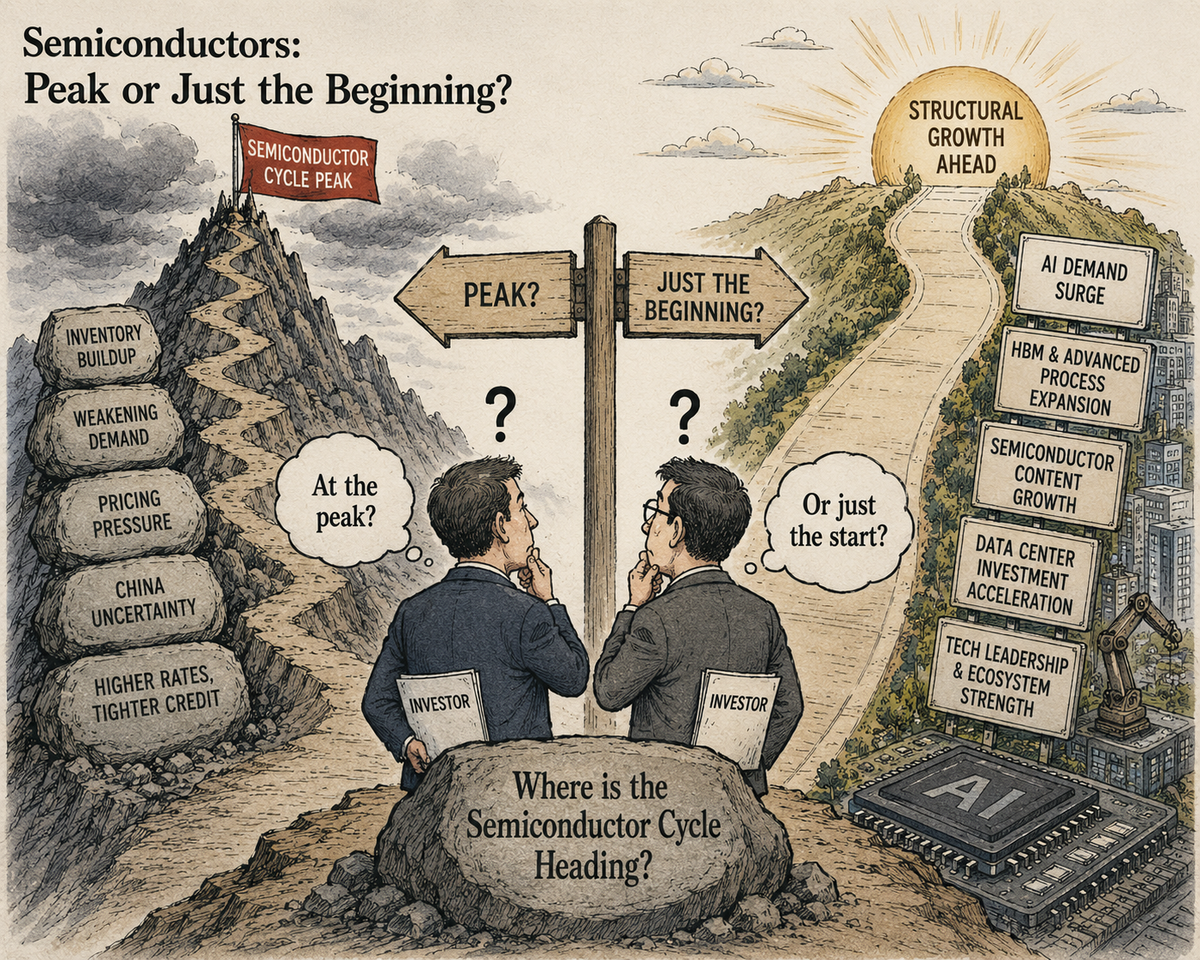
Every so often, a single earnings report shakes an entire industry. This week, that report came from Broadcom. When the chipmaker issued its second-quarter guidance, markets reacted instantly. The Philadelphia Semiconductor Index collapsed 10.26% in a single session. Micron, widely watched as a leading indicator for Samsung Electronics, fell 13.25% the same day. In the financial district of Yeouido, Seoul, debate about a semiconductor supercycle abruptly gave way to talk of a "peak-out"—the point at which a cycle crests and turns.
And yet, curiously, the analysts held their nerve.
Fear versus analysis
Look closely at the Broadcom shock and an important distinction emerges. What rattled markets was not the company's results, which beat expectations. The concern centred on two things: margin pressure, and signs that Google was reducing its dependence on Broadcom by bringing MediaTek on board as a new partner while building up its own in-house chip capabilities. The message seemed to be that big technology companies were moving to escape arrangements in which they had become excessively reliant—and were paying heavily for the privilege.
Korean semiconductor industry insiders read the situation differently, however. Fears that the allocation of SOCAMM2 memory in Nvidia's Vera Rubin servers had been trimmed were interpreted by some as evidence of weakening demand. Insiders pushed back: the cutback reflected a shortage of memory supply, not a diminished need for it. Specifications were redistributed because supply could not keep up, not because appetite had waned. That subtle distinction is precisely what separates the peak-out camp from the supercycle believers.
Heading for a trillion dollars
The most powerful argument for the supercycle case is quantitative. Goldman Sachs forecasts that major hyperscalers will spend $1.1 trillion on AI infrastructure next year—well above the Wall Street consensus of $920 billion. Nomura, at a media briefing in Seoul, described the semiconductor supercycle as being in its early stages. BOCOM International declared that the global memory industry had entered its largest upcycle of the century, with pricing strength expected to persist at least until the first quarter of 2027. Citigroup raised its target price for SK Hynix from 1.7m won to 3.1m won, projecting that HBM4 prices would rise 30% quarter-on-quarter in the fourth quarter of 2026.
These forecasts share a common thread: AI infrastructure investment has only just found its stride. Building data centres takes time. Designing and validating chips takes time. AI servers ordered today will be delivered next year; chips designed next year will reach mass production the year after. What supercycle proponents are watching is not today's share price but the depth of this demand pipeline.
Yet clouds remain
Optimism is not universal, nor entirely warranted. Morningstar has warned that the AI boom is unlikely to fundamentally alter the semiconductor industry's characteristic boom-and-bust cycle. Prices for commodity DRAM have already stalled. The conflict in the Middle East has raised concerns about disruption to helium supply chains—helium being essential for semiconductor fabrication. South Korea sources between 60% and 80% of its helium from Qatar.
Big technology's drive to diversify its supply chains is another wildcard. Just as Google is distancing itself from Broadcom, the major technology platforms are broadly seeking to reduce dependence on any single supplier. For South Korean chipmakers, this shift could prove either an opportunity or a threat.
Not whether, but how much—and for whom
Short-term market panic and underlying industry conditions are different things. Semiconductor shares lurched sharply lower in the aftermath of the Broadcom shock, then recovered partially, producing the sort of whipsaw volatility that makes headlines but obscures fundamentals. Analysts kept their target prices for good reason: Samsung Electronics' first-quarter operating profit surged 756% year-on-year; SK Hynix continued to expand its share of the high-bandwidth memory (HBM) market; Nvidia's Vera Rubin platform moved into full-scale production. None of those facts changed because of one Broadcom guidance statement.
The real question, then, is not whether the cycle has peaked. It is how deep and how long the supercycle will prove to be—and how much of it Samsung and SK Hynix will capture. The answer to that depends on yields for next-generation HBM4E chips, whether Samsung's foundry business can return to profitability, and the depth of each company's partnership with Nvidia.
*What to watch:* Samsung Electronics and SK Hynix are both scheduled to report second-quarter results in July. The share of HBM4 in their sales mix, and the degree to which average selling prices are rising, will serve as the clearest test yet of whether the supercycle is as real as its champions claim.
**Peak-out case** | **Supercycle case**
Arguments | Broadcom margin pressure; stalling commodity DRAM prices; big tech supply diversification | Goldman Sachs $1.1trn AI capex forecast; HBM4 supply shortage; Nvidia Vera Rubin ramp
Key institutions | Morningstar | Goldman Sachs, Nomura, BOCOM International, Citigroup
Implications for Korea | Greater short-term share-price volatility | Target prices for Samsung and SK Hynix maintained or raised
Critical variable | Speed of big tech's in-house chip development | HBM4E yields and depth of foundry partnerships