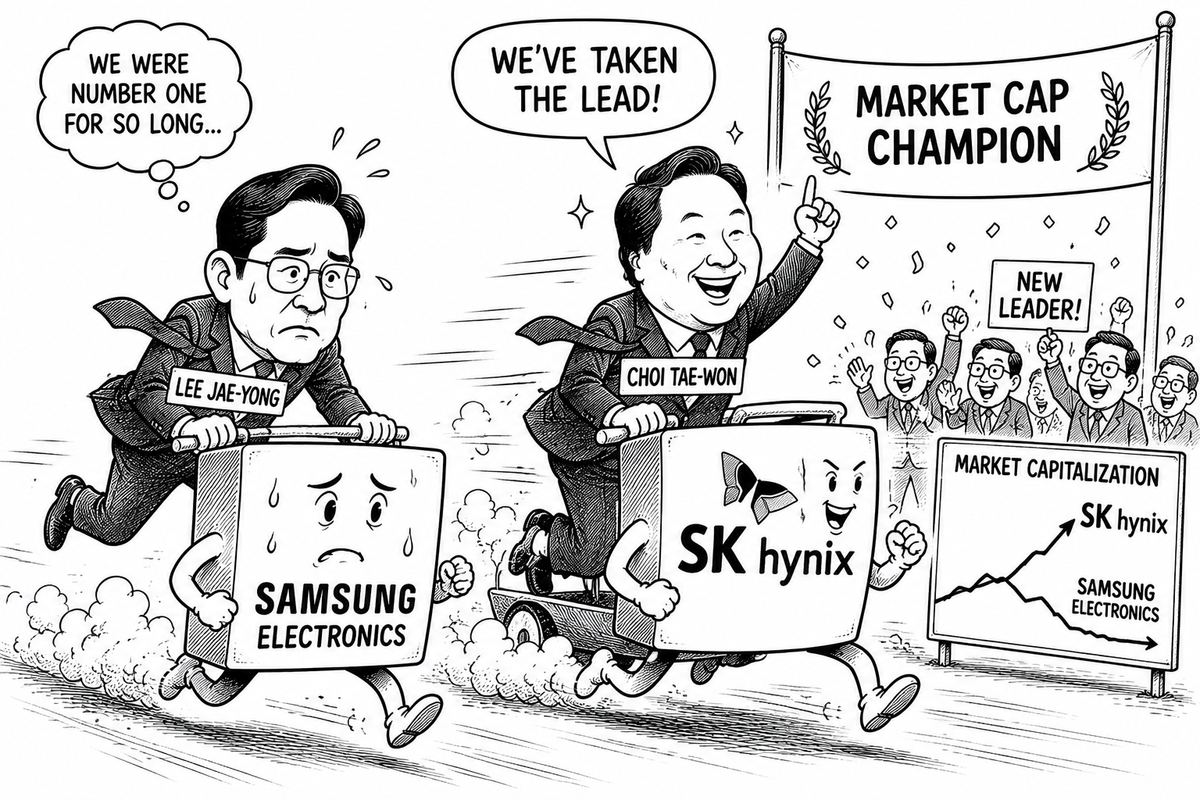
On the afternoon of 22nd June, SK Hynix claimed the top spot on the KOSPI — South Korea's main stock exchange — by market capitalisation, ending a reign by Samsung Electronics that had lasted 26 years and seven months. Markets interpreted the moment as a symbolic transfer of the "memory-chip premium" from one chipmaker to the other. Missing from that narrative, however, was a rather inconvenient figure: in the first quarter of the same year, Samsung's memory division alone recorded revenues of 74.8 trillion won. SK Hynix's revenues — for the entire company — came to 52.6 trillion won. The market capitalisation had flipped; the actual scale of the memory business had not.
A reversal — but of what, exactly?
According to TechM, it was the first time in a year that Samsung's memory division had outpaced SK Hynix on both revenue and operating profit. As recently as the fourth quarter of 2025, Samsung's group-wide operating profit had trailed SK Hynix's. The turnaround in the first quarter of 2026 was explained candidly by Kim Jae-jun, executive vice-president of Samsung's memory division. "HBM [high-bandwidth memory] prices are negotiated annually, while standard DRAM prices are set quarterly — that creates a profitability reversal." As AI-server demand surged, prices for conventional DRAM and NAND flash rose sharply, and Samsung, with its larger memory revenue base, absorbed those gains faster and more fully.
SK Hynix does hold a clear advantage in HBM, the specialised memory chips that sit inside Nvidia's AI accelerators. Counterpoint Research puts SK Hynix's share of the HBM market at between 50% and 61%; Samsung languishes in the low 20s. Yet the permanence of that gap is questionable. Kim himself stated that "given current supply shortfalls, the gap is unlikely to narrow until 2027" — framing it as a question of timing rather than outcome. Samsung has already begun mass shipments of HBM4 and SOCAMM2, the industry's first such deliveries, and expects HBM4 to account for more than half of its total HBM revenues from the third quarter onwards. A first sample shipment of HBM4E is scheduled for the second quarter. The gap is real; so is the timetable for closing it.
A chronic loss-maker turning the corner
The market's persistent discount on Samsung has long centred on its contract chip-manufacturing, or foundry, division — a business that has haemorrhaged trillions of won since 2022 and become the company's most visible weakness. That picture is changing quickly.
The catalyst is a string of high-profile customer wins. Tesla has awarded Samsung a contract worth $16.5 billion (roughly 23 trillion won) to manufacture its AI6 chip. Samsung's foundry will also produce Nvidia's inference-dedicated "Grok3" chip. In June, Nikkei Asia reported that AMD, BYD, Google, Tesla and Nvidia were all in discussions with Samsung about advanced logic-chip production. Google, in particular, is said to be considering Samsung for the I/O chip in its next-generation 10th-generation TPU — a choice driven partly by Samsung's memory expertise, since bridging a TPU to HBM memory demands intimate knowledge of memory architecture. Samsung's strength in memory, in other words, is becoming a calling card for foundry business.
The commercial consequences are tangible. Samsung has pulled forward its target for returning the foundry division to profit: from 2027 to 2026, with some analysts pointing to the third quarter and others the fourth. Either way, the schedule has moved a year ahead of plan. Foundry utilisation has climbed from below 50% in 2025 to around 80% by February 2026. Kim Rok-ho, a researcher at Hana Securities, notes that shipment growth of Nvidia's Grok chip and HBM base dies on Samsung's stabilised 4-nanometre process should underpin a meaningful earnings recovery. He flags residual uncertainties — depreciation charges from the ramp-up of Samsung's Taylor, Texas fab, and the pace of yield improvement on the 2-nanometre process for Tesla — but the direction of travel is unambiguous. A division once written off as a structural drag is now bringing forward its own rehabilitation, and when that rehabilitation arrives, it will add an upside to Samsung's valuation that SK Hynix simply cannot match.
The numbers that do not explain the reversal
This raises an obvious question. If Samsung is not losing in memory and is actually building a recovery story in foundry, what does explain the market-cap flip?
The sequence of events matters. The price-to-earnings (PER) ratio reversal came first, on 14th May; the market-cap reversal followed roughly a month later, on 22nd June. The repricing of multiples preceded, and ultimately drove, the headline change in ranking.
On absolute profits, Samsung retains a commanding lead. Consensus estimates for 2026 put Samsung's net profit at roughly 280 trillion won against SK Hynix's 208 trillion won. First-quarter operating profit was 57.2 trillion won for Samsung versus 37.6 trillion won for SK Hynix. Samsung has never trailed on raw earnings power.
Yet by 14th May, SK Hynix's forward PER — the premium investors are willing to pay for each won of expected earnings — had edged above Samsung's for the first time: 6.79 times versus 6.77 times. The speed of that shift is striking. In February, Samsung's PER stood at 8.08 times and SK Hynix's at 5.28 times — a gap of 2.8 percentage points. By April, Samsung was still ahead at 5.70 times against SK Hynix's 4.66 times. Within three months, that spread had entirely reversed. Over the same period, reported by Maeil Business Newspaper, consensus earnings-per-share estimates for Samsung were revised upward by 102%, outpacing SK Hynix's 79% upgrade. Profits improved more for Samsung, yet the market assigned it a lower multiple. That is not a relationship that fundamentals alone can explain.
One partial explanation lies in operating margins. SK Hynix converted 71.5% of its revenues into operating profit in the first quarter; Samsung managed 42.8%. SK Hynix generates income with greater efficiency, even if in smaller absolute quantities, and that efficiency premium justifiably supports a higher multiple. But operating margins did not swing dramatically within three months in a way that would account for a complete PER reversal. Something else must have been at work.
The role of flows
In the weeks surrounding the reversal, several non-fundamental sources of demand for SK Hynix shares opened simultaneously. Lee Seung-woo, head of research at Eugene Investment & Securities, pointed directly to one of them: SK Hynix's imminent listing of American Depositary Receipts (ADRs) in the United States. ADR listings attract foreign capital that responds to the event itself rather than to quarterly results; if SK Hynix subsequently secures inclusion in global benchmarks such as the Philadelphia Semiconductor Index, passive funds tracking those indices would be compelled to buy the stock regardless of valuation. That prospect alone can move a share price before a single foreign dollar has actually arrived.
On 22nd May, single-stock leveraged exchange-traded funds (ETFs) based on Samsung and SK Hynix began trading. Mirae Asset Securities estimated that up to 5.3 trillion won in fresh capital could flow into these instruments. Leveraged ETFs are structurally momentum-amplifying: as prices rise, their rebalancing mechanics require additional purchases, creating a self-reinforcing feedback loop. A stock that begins rising for any reason becomes harder to stop.
Finally, on 18th May Hana Securities published a note flagging the possibility of a market-cap reversal — what it called a "Cisco warning", a reference to the dot-com era when Cisco briefly became the world's most valuable company before collapsing. The report itself became news, and the narrative of an imminent throne-change attracted further attention and capital.
The convergence of ADR anticipation, leveraged-ETF mechanics and media-driven momentum offers a more complete explanation for the reversal than any shift in competitive standing.
Beyond the market cap
The change at the top of the KOSPI is symbolically significant. It is not, however, evidence that Samsung has lost its edge in memory chips. At the divisional level, Samsung's memory business outperformed SK Hynix on both revenue and operating profit in the first quarter. The HBM gap is real but has a closing timetable. The foundry division — for years a millstone around Samsung's valuation — is attracting Tesla, Google and AMD while pulling its breakeven target forward by a full year; that represents an upside option that SK Hynix does not possess.
What the reversal actually demonstrates is not that SK Hynix has become the superior business, but that the market is currently willing to pay a higher price for it. A meaningful share of the force behind that premium came not from the memory scorecard but from an ADR listing, leveraged-ETF flows and the momentum of a compelling story. Fundamentals and prices do not always move in the same direction — and this episode is a useful reminder of why.
Watch for: the precise quarter in which Samsung's foundry division returns to profit (third or fourth quarter of 2026 are the competing forecasts), and whether SK Hynix's market-cap lead survives the completion of its ADR listing. If the premium fades once the listing event is behind it, that would be the clearest evidence yet that this reversal was, at its core, a phenomenon of flows rather than of fundamentals.
Metric | Samsung Electronics | SK Hynix
Q1 2026 revenue (comparison basis) | Memory division only: 74.8 trillion won | Whole company: 52.6 trillion won
2026 forecast net profit | ~280 trillion won | ~208 trillion won
Q1 2026 operating profit | 57.2 trillion won | 37.6 trillion won
Q1 2026 operating margin | 42.8% | 71.5%
Forward PER (14th May 2026) | 6.77x | 6.79x
HBM market share | ~20% | 50–61%
Foundry break-even target | Q3–Q4 2026 (brought forward) | N/A
Market-cap reversal date | — | 22nd June (approx. one month after PER reversal)
Key factors accelerating reversal | — | ADR listing expectations; leveraged-ETF inflows
*Sources: TechM (1st May 2026), Maeil Business Newspaper (15th May 2026), Seoul Economic Daily, Herald Business, MoneyToday (22nd June 2026), Deal Site, Tech World and other foundry-related reporting (April–June 2026). Reference dates vary by source; verify timing when citing individual figures.*