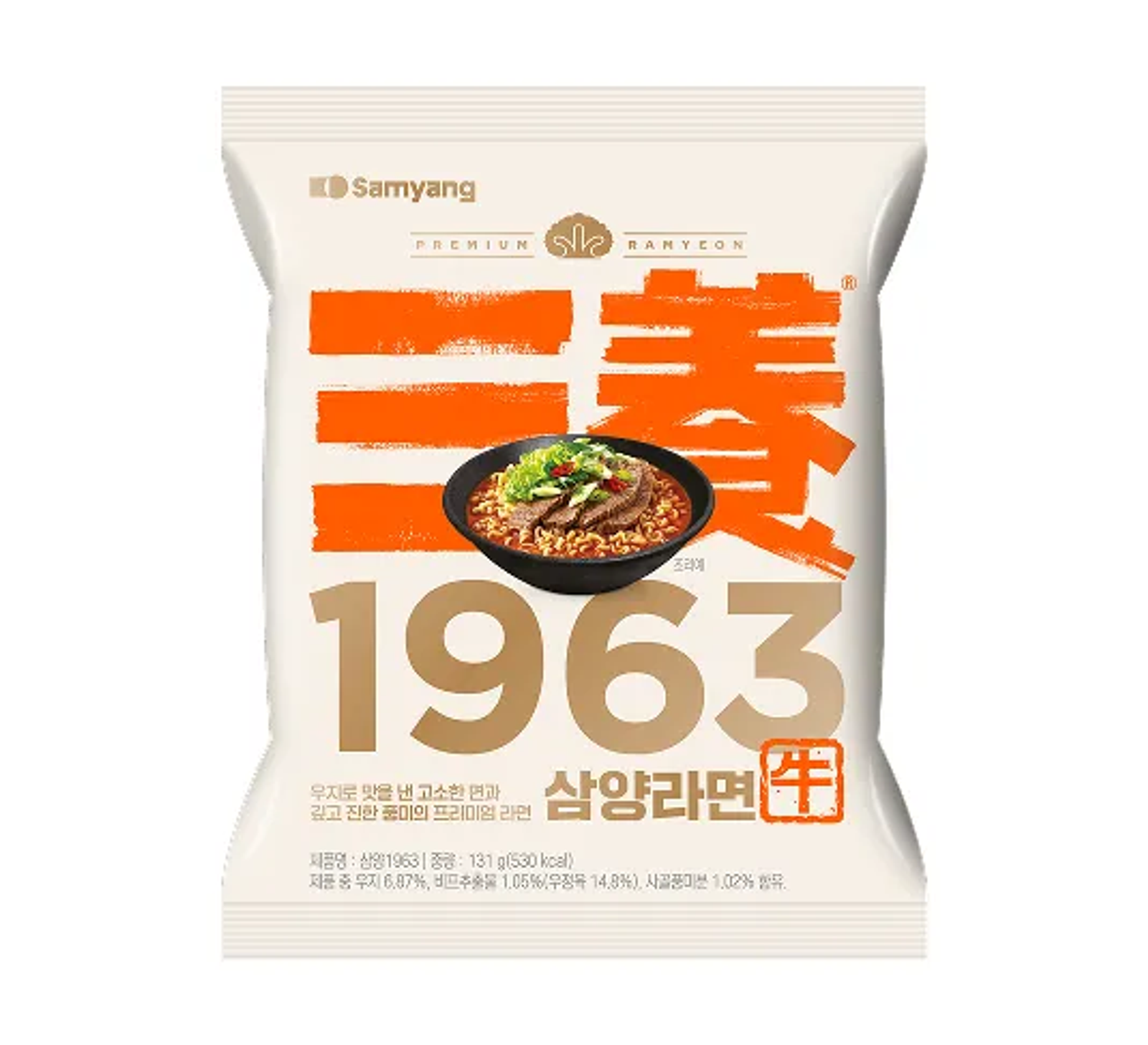
*Editor's note: This is the first instalment of Ramen Wars, a series that goes beyond the packet to examine the stories, histories, and rivalries behind South Korea's most popular instant noodles — along with an honest verdict on each.*
Few food products carry as much history as Samyang 1963. This is not simply a new product launch. It is the comeback of South Korea's original instant noodle, a brand that spent 36 years living under a false accusation.
The story
On 15th September 1963, Jeon Joong-yoon, founder of Samyang Foods, was walking through Namdaemun market in Seoul when he stopped at a troubling sight: people queuing to buy *kkkulkkuli-juk* — a watery gruel made from food scraps and meat offcuts discarded by the American military. He resolved to do something about it.
He quit his job at an insurance company and travelled to Japan, where he knocked on the door of Myojo Foods, a noodle manufacturer. He was turned away. He persisted. Eventually he secured the rights to the instant noodle recipe and brought it home. The result was Samyang Ramen — South Korea's first instant noodle.
The first three years were loss-making. Koreans did not regard the product as proper food. The company survived on bank loans, though it never once missed a payroll. Perseverance paid off. By July 1965 monthly sales surpassed one million servings. "Samyang Ramen" became a byword for instant noodles in Korea — the equivalent of calling a vacuum cleaner a Hoover.
Then came November 1989. An anonymous tip-off arrived at the public prosecutor's office: Samyang was using industrial-grade tallow in its noodles. The press piled in. The phrase "noodles made with industrial oil" swept the country. Sales collapsed. Staff resigned. It was the company's worst crisis in 26 years. The health ministry declared the product safe for human consumption, but the public had already made up its mind. By the time the Supreme Court formally acquitted Samyang in 1997, the damage was irreversible. Market leadership had passed to Nongshim's Shin Ramyun (a rival brand launched in 1986). The original Samyang Ramen faded into history.
Thirty-six years on, Samyang Foods — reinvigorated by the global phenomenon of its Buldak (fire chicken) noodles — launched Samyang 1963 in November 2025. The product revives the beef-tallow recipe that had been at the centre of the scandal: it uses a blend of tallow and palm oil, branded "Golden Blend Oil", with a higher proportion of tallow than the original. The broth is made from beef, bone marrow, and chicken stock, with Korean chilli peppers added for heat. Within one month, seven million packets had sold — equivalent to roughly 80% of the existing Samyang Ramen's monthly volume.
Tasting notes
The broth sets itself apart immediately. Where rivals such as Shin Ramyun or Jin Ramen lead with sharp, aggressive heat, Samyang 1963 opens with the deep, rounded richness of beef bone marrow. The tallow-fried noodles amplify that savoriness. The chilli peppers provide a clean, warming spice rather than raw heat; those seeking an intense chilli punch may find it mild. But this is a broth you will drink to the last drop.
The noodles themselves are thick and pleasingly chewy. At 131g per packet, the portion is generous by instant-noodle standards.
The one reservation is price. At 1,538 won per packet, Samyang 1963 is notably more expensive than standard Samyang Ramen — an inevitable consequence of its premium positioning, though not one that encourages daily consumption.
Verdict
Samyang 1963 is as much narrative as noodle. In a single packet sits the story of a founder who crossed to Japan to rid his country of food-scrap gruel; of a company undone by a false accusation; and of a 36-year wait for vindication. The flavour matches the story — unflashy, unfrenetic, but with real depth.
If Shin Ramyun represents brute strength, Samyang 1963 represents age. And age carries something that its younger rival cannot manufacture.
★★★★☆ (4.0/5.0)
In a line: *"The wrongly accused original has returned. The story hits you before the flavour does."*