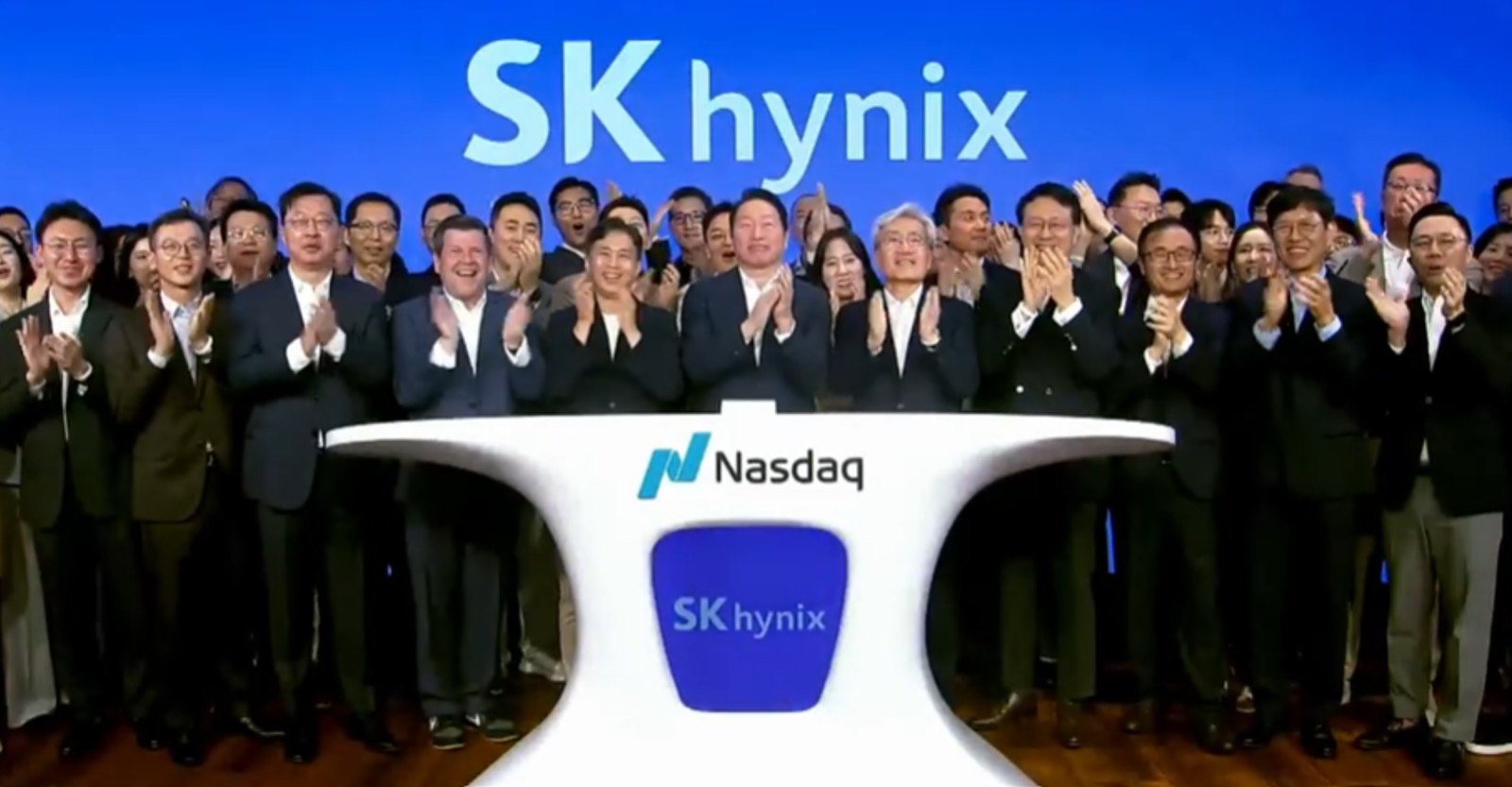
SK Hynix opened trading on the Nasdaq at $170 per share on 11th July 2026, a premium of 14% to its offer price. The significance of that first print extends well beyond a pleasing opening bounce. It was the first real test of how the world's largest technology equity market would value South Korea's leading chipmaker—and of how investors would price its role in the artificial-intelligence semiconductor boom.
Why Nasdaq, and Why Now?
The decision to pursue a dual listing was a carefully calculated strategic move. SK Hynix has emerged as the indispensable backbone of the AI chip supply chain, supplying Nvidia with high-bandwidth memory (HBM) on an exclusive basis. The timing of the listing reflects a clear ambition: to forge direct relationships with global institutional investors at precisely the moment its strategic importance is greatest.
South Korea's domestic stock market has long imposed structural constraints on that ambition. Foreign investor participation is limited, and the country's technology companies have persistently traded at a discount to their global peers—a phenomenon known locally as the "Korea discount." A Nasdaq listing offers a route around that discount while simultaneously opening a direct channel to global capital.
The contrast with Samsung Electronics is instructive. Samsung has no formal American Depositary Receipt (ADR) programme and trades only through an unsponsored arrangement on the over-the-counter market. SK Hynix, by contrast, has secured an official ADR listing on a regulated exchange. That distinction matters: American institutional investors can now hold the stock directly within their portfolios, fundamentally altering the long-term supply-and-demand dynamics for the shares.
The Structural Case for a 14% Premium
The opening premium was no accident. During the book-building process, institutional demand reportedly far exceeded the number of shares available, reflecting a blend of short-term arbitrage and longer-term conviction in the structural growth of the HBM market.
According to TrendForce, a global market research firm, the HBM market surpassed $20bn in 2025 and is forecast to grow at an annualised rate exceeding 40% through to 2027. SK Hynix commands more than 50% of that market. As the hyperscalers ramp their capital expenditure on AI infrastructure, HBM supply capacity has become a primary measure of corporate value in the semiconductor sector.
Nvidia's GPU roadmap—spanning the current Blackwell architecture and the forthcoming Rubin platform—implies exponential growth in HBM demand. Investors are willing to pay a premium for SK Hynix's near-monopoly position within that supply chain.
The Bull Case and the Sceptics
Proponents of the dual listing argue that it will catalyse a meaningful re-rating. Greater liquidity and visibility in American markets should raise the liquidity premium attached to the shares, exerting upward pressure on the South Korean-listed stock as well. Aligning with SEC disclosure requirements and US accounting standards (US GAAP) will also strengthen governance transparency—a longer-term positive for institutional confidence.
The sceptics, however, have legitimate concerns. A dual listing brings dual regulation. SEC disclosure requirements are exacting; class-action litigation risk is real; and the administrative burden of reconciling to US GAAP is not trivial. Several South Korean sell-side analysts have warned that American investors, who tend to react more sharply to semiconductor cycle risk, could amplify the stock's volatility. Micron Technology and Intel have both experienced severe share-price drawdowns during cyclical downturns—a pattern SK Hynix's new investor base may repeat.
The group's ownership structure adds another layer of complexity. SK Hynix sits at the end of a conglomerate chain—SK Telecom holds SK Square, which in turn controls SK Hynix—typical of the chaebol model that governs South Korea's largest industrial groups. How American institutional investors assess that structure could weigh materially on the stock's long-term trajectory.
Precedents from Asia
The dual-listing playbook is well-established among Asian technology companies. TSMC, Taiwan's contract chipmaker, listed ADRs on the New York Stock Exchange in 1997, a move that cemented its status as a global semiconductor leader. SK Hynix has followed a similar path, though with notable differences: it has chosen the Nasdaq over the NYSE, and its offering—at approximately $29bn—is the largest ADR flotation in history, giving it a symbolism all its own.
The cautionary tale is Alibaba, which set a record for the largest IPO ever when it listed in New York in 2014. The subsequent deterioration in US-China relations and a domestic regulatory crackdown drove the stock more than 80% below its offer price. That episode illustrates how geopolitical risk can fundamentally reshape the trajectory of an Asian company listed in America. SK Hynix is not without its own geopolitical exposure: it operates a significant manufacturing facility in Wuxi, China, squarely in the crosshairs of the US-China semiconductor dispute. How investors choose to price that risk will be a critical variable to watch.
Implications for South Korea's Capital Markets
SK Hynix's Nasdaq debut carries broader significance for South Korean financial policy. Eliminating the Korea discount has become an explicit government objective, and the listing of a flagship conglomerate subsidiary on a foreign exchange may encourage other large South Korean groups to diversify their funding channels internationally. Regulators face the challenge of ensuring that this trend does not hollow out the domestic market, even as they acknowledge the competitive logic driving it.
The years 2026 and 2027 represent the pivotal period for SK Hynix's earnings leverage, as mass production of HBM4—the next generation beyond the current HBM3E—comes into view. The company's first earnings report as a Nasdaq-listed entity, and the details of its HBM4 roadmap, will be the decisive factors shaping the stock's direction.
Whether the 14% opening premium proves to be the starting point of a sustained re-rating, or merely the high-water mark of initial enthusiasm before a correction, will ultimately be determined by the fundamentals: technological competitiveness and the ability to convert AI's insatiable appetite for memory into durable profitability.
South Korea's semiconductor industry has established itself as a critical infrastructure supplier for the AI era. Measured against that backdrop, SK Hynix's arrival on the Nasdaq is more than a corporate financing event—it is a marker of how far South Korean technology has travelled, and a signal of how central it intends to remain, in the reshaping of the global technology order.