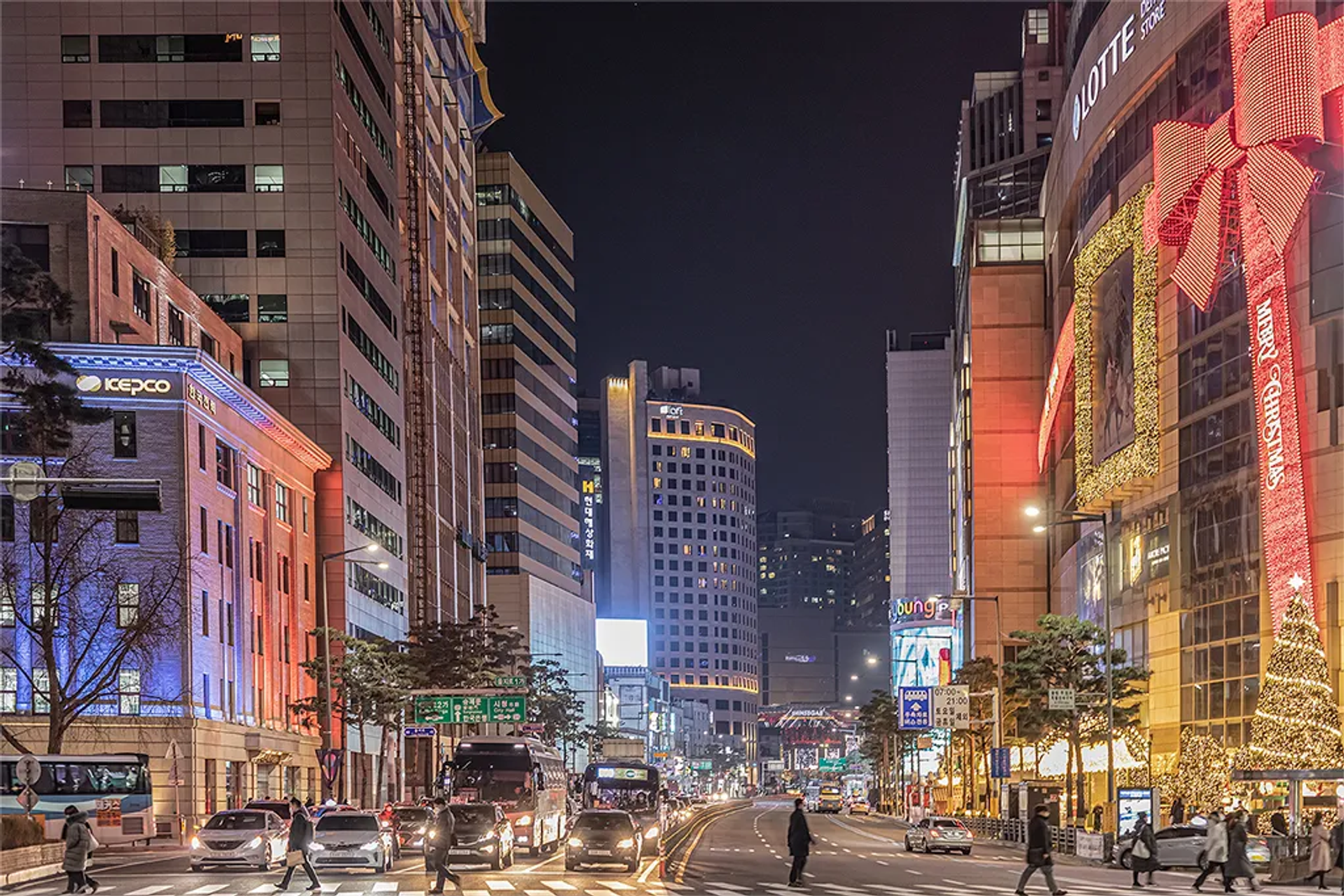
Seoul's Myeongdong district is heating up again. Shinsegae Department Store has ignited competition in the area with a sweeping renovation and an array of experiential offerings, and Lotte Department Store has wasted no time firing back with its own slate of year-end attractions. The result is a retail battle that is entering a new and consequential phase.
Myeongdong earned an inglorious reputation as a street of empty shopfronts after foreign tourist numbers collapsed during the Covid-19 pandemic. But since 2023, visitors from China, Japan and South-East Asia have returned in force, breathing life back into the district. According to the Korea Tourism Organisation, the number of foreign visitors to Myeongdong in 2024 reached 90% of pre-pandemic levels recorded in 2019—and is expected to surpass them this year.
The two retailers are pursuing sharply different strategies to capture this revival. Shinsegae's flagship store has led with what it calls "experience-centred content": large-scale pop-up shops, art installations and collaborations with prominent global brands. These events spread rapidly on social media, drawing in younger Korean consumers as well as foreign tourists. Industry sources say daily visitor numbers on the floors hosting pop-up shops rose by more than 40% compared with normal trading periods.
Lotte's Myeongdong flagship has countered with a push into year-end seasonal programming. It has unveiled large-scale media façades, themed photo zones and pop-up events tied to the Korean Wave—the global spread of Korean popular culture. Lotte is also leaning into its comparative advantages: attracting brands already familiar to Japanese and Chinese visitors, and designing shopping routes that connect seamlessly with duty-free purchasing.
Retail analysts argue that this contest goes beyond a straightforward fight for sales. It amounts to a strategic experiment in what the department store of the future might look like. "The survival strategy for bricks-and-mortar retail ultimately hinges on transforming space into experience," said Seo Yong-gu, a professor of business administration at Sookmyung Women's University. "Whichever side creates more original content—content that brings people back repeatedly—will determine the new balance of power in Myeongdong."
Precedents from abroad suggest such contests can redefine entire retail districts. In Tokyo's Shibuya and Ginza neighbourhoods, a similar battle over experiential content has already become standard practice. Isetan and Matsuya Ginza have successfully repositioned themselves as destination spaces rather than mere shops—drawing on pop-ups and art events to raise the share of foreign visitors to roughly 20% of total revenues.
Yet some observers worry about the downsides of intensifying competition. Rising content costs are squeezing profit margins. A dependence on short-term events raises questions about long-term sustainability. And the influx of capital is accelerating gentrification, pushing out smaller tenants and independent traders. A representative of the Myeongdong Merchants' Association warned of what they called a "black-hole effect", in which the footfall drawn by large department stores fails to spill over into the surrounding side streets and smaller businesses.
The contest between Shinsegae and Lotte will ultimately serve as a critical test of where South Korean offline retail is heading. Whether competition between the two giants revitalises the entire district, or whether the concentration of large-scale capital erodes its commercial diversity, will depend on balanced intervention by policymakers—and on whether the retailers themselves can demonstrate a meaningful sense of social responsibility.