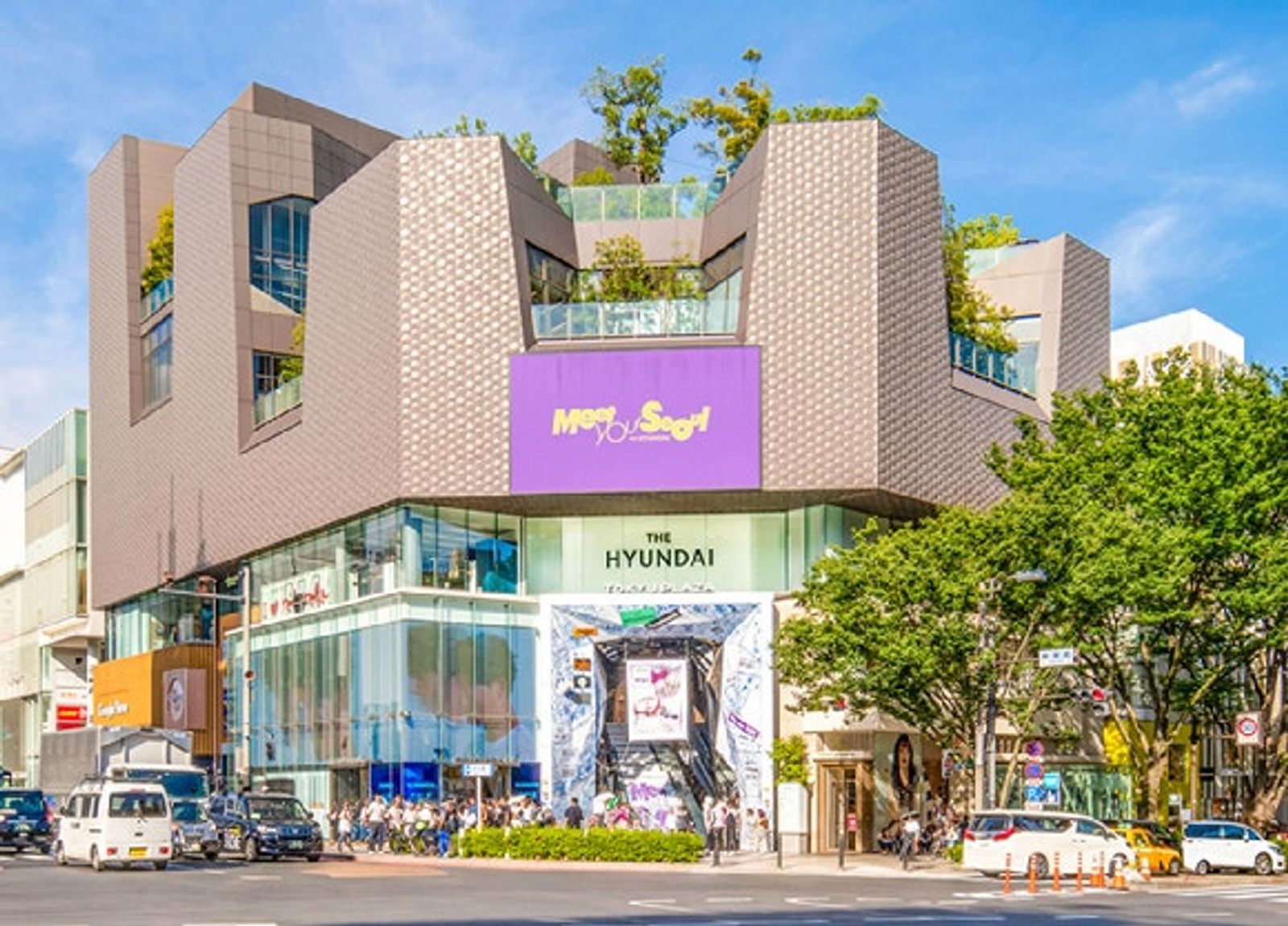
The Hyundai, the premium retail brand of Hyundai Department Store Group, is preparing to plant its first flag abroad — in Tokyo. For a Korean department store to enter one of Japan's prime commercial districts as a standalone operation, rather than through a pop-up or concession arrangement, is virtually unprecedented. The industry is watching closely, treating the venture as a litmus test for Korean retail's global ambitions.
Why Tokyo?
When The Hyundai opened in Yeouido, Seoul, in 2021, it rewrote the rulebook for Korean department stores. Nearly half its floor space was given over to indoor landscaping and cultural venues rather than merchandise — a radical departure from convention. Its strategy of rotating pop-up shops aimed at younger consumers proved immediately lucrative: revenues exceeded 800 billion won (roughly $600m) in its first year alone. After expanding across Seoul and the wider capital region, the group has now chosen Tokyo as its first international destination, and the choice is deliberate.
Tokyo receives more than 15 million foreign tourists a year (pre-pandemic figures), and serves as Asia's pre-eminent centre for luxury and cultural consumption. In recent years, Japanese appetite for Korean fashion, beauty products and food has grown sharply, driven by the sustained popularity of Korean pop culture among younger consumers. According to Japan's Ministry of Economy, Trade and Industry, imports of Korean consumer goods into Japan rose by more than 40% between 2020 and 2024.
Structural pressures at home, opportunity abroad
The Hyundai's overseas push also reflects the structural constraints of the Korean market. According to Statistics Korea, the domestic department store sector has been largely stagnant since 2022, squeezed by the rise of online commerce and a polarisation of consumer spending that has hollowed out mid-market retail. Prime locations for new stores are scarce.
Japan's offline retail market, by contrast, is showing signs of revival. A weak yen has fuelled a surge in tourist spending, lifting sales in Tokyo's key shopping districts — Ginza, Shibuya and Shinjuku among them. The Japan Department Stores Association reported that total department store sales rose roughly 7% in 2023 compared with the previous year, the first positive growth in five years. The Hyundai is betting it can ride that wave as a foreign entrant.
The strategy: space as the product
The Hyundai's distinctive competitive edge lies in treating the physical environment itself as the merchandise. At its Yeouido flagship, a five-storey indoor waterfall and natural-light atrium became a social-media phenomenon, drawing visitors as much for the spectacle as the shopping. The Tokyo store is expected to blend locally inspired spatial design with the Korean pop-up culture that has become the brand's signature.
Retail analysts argue that the strategy's success will hinge on localisation. "Japanese consumers have very high standards for quality and service, and there is a natural scepticism towards foreign brands," said one retail consultant. "To convert affection for Korean culture into actual purchases, The Hyundai will need meticulous curation that weaves together Korean content with local Japanese brands and sensibilities."
Lessons from Korean retail's overseas record
Korean retailers' international track record offers more cautionary tales than success stories. Lotte Mart withdrew most of its Chinese stores in 2017 following a diplomatic dispute over the deployment of a US missile-defence system on Korean soil. E-Mart suffered losses in both China and the United States. In both cases, the common failings were insufficient understanding of local consumer culture and an inability to compete on price.
There are, however, encouraging precedents among global players. Muji, Zara and IKEA have each built cross-border consumer bases by maintaining a consistent brand identity and experiential retail environment regardless of geography. That is the model The Hyundai would do well to emulate.
The cultural groundwork in Japan looks favourable. A 2024 survey by Nikkei Research found that more than 60% of Japanese consumers in their 20s and 30s said they regularly engage with Korean cultural content. Converting that cultural affinity into commercial footfall is the central challenge facing The Hyundai's Tokyo venture.
The risks: currency, regulation and competition
The optimistic case has its counterarguments. A persistently weak yen could erode the profitability of local operations, since costs are denominated in yen while the parent company reports in won. In Tokyo's most sought-after retail districts, where rents are astronomical, years of initial losses are widely regarded as inevitable. Japan's retail regulations, labour laws and the requirements of local partnership structures will all demand careful navigation.
The competitive landscape is formidable. Tokyo is home to department stores with more than a century of heritage — Isetan Shinjuku, Takashimaya, Matsuya Ginza — and they have been refurbishing and expanding their experiential offerings. Analysts advise The Hyundai to pursue a strategy of creating an entirely new retail category rather than competing head-on with these entrenched incumbents.
A pivotal moment for Korean retail
The Tokyo opening is significant beyond the fate of a single store. It represents a genuine test of whether Korean retail can internationalise as a sector, following the trail blazed by K-pop, K-beauty and Korean food. There are growing calls within South Korea for the government to support the overseas expansion of Korean retail brands as an extension of the country's broader soft-power strategy — the argument being that retail spaces can function as platforms and showcases for Korean culture at large.
If The Hyundai succeeds in Tokyo — exporting a new retail culture through the medium of physical space — New York or London could plausibly be next. If it founders on localisation failures or margin pressures, it will join a long list of Korean retailers whose international ambitions became cautionary lessons. The answer is being written, right now, in the heart of Tokyo.