1. Semiconductors
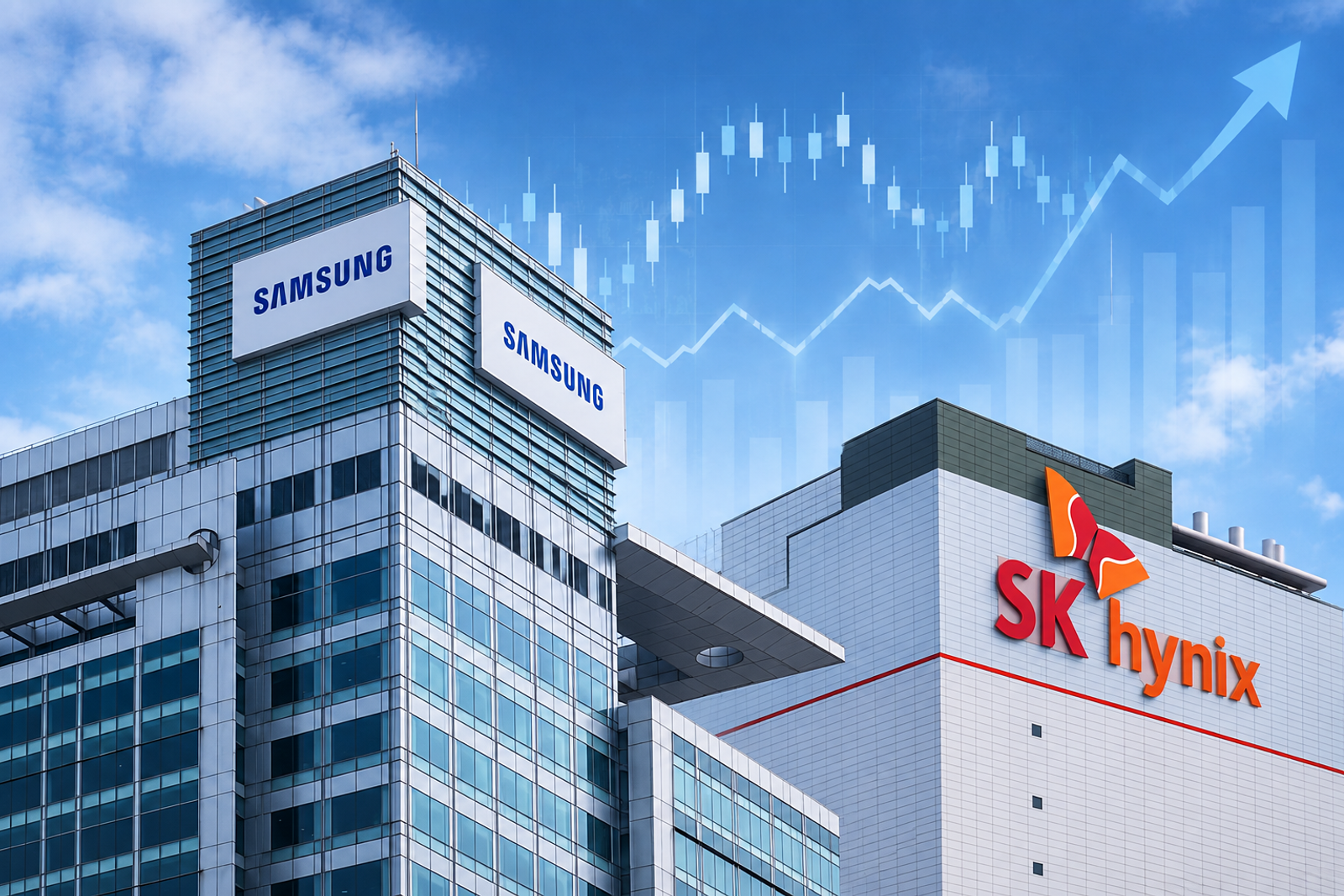
SK Hynix reported third-quarter operating profit of 83.33 trillion won, a 632% year-on-year increase that surpassed market expectations of roughly 76 trillion won. Samsung Electronics followed on the 29th with record quarterly results: revenue of 195.25 trillion won and operating profit of 107.44 trillion won. Its semiconductor (DS) division contributed 106.5 trillion won in operating profit, implying a margin of 72.4%. Shipments of HBM4 memory — destined for Nvidia's Vera Rubin platform — began in earnest during the quarter, and losses in the foundry business narrowed. The mobile and consumer electronics (DX) division, however, posted an operating loss of 800 billion won for the second consecutive quarter, weighed down by higher memory costs.
2. Substrate and Components
Samsung Electro-Mechanics recorded its best-ever quarterly performance, with revenue of 3.76 trillion won (up 30%) and operating profit of 691 billion won (up 165%). Sales of its package solutions — semiconductor substrates used in server CPUs and AI accelerators — surged 58% to 939 billion won. LG Innotek's revenue topped 6 trillion won for the first time, reaching 6.37 trillion won (up 18.6%), but a weaker won-dollar exchange rate squeezed operating profit by 53.4% to 94.8 billion won.
3. Shipbuilding
HD Hyundai, the conglomerate that controls South Korea's largest shipbuilding group, reported third-quarter operating profit of 2.92 trillion won, up 71.5%. Its intermediate shipbuilding holding company, HD Korea Shipbuilding & Offshore Engineering, contributed 1.45 trillion won (up 37.3%). Hanwha Ocean's operating profit rose 67.6% to 485.7 billion won, but came in 10.3% below the market consensus of 541.5 billion won; its naval-vessel division posted an operating loss of 70.6 billion won after booking provisions for anticipated losses on certain hulls. Its order backlog stands at $36.2 billion. Samsung Heavy Industries posted revenue of 3.15 trillion won (up 19.6%) and operating profit of 338.4 billion won (up 42.1%), with a margin of 10.7%. The company has won orders for 20 LNG carriers and two floating liquefied natural gas (FLNG) units this year; its cumulative order intake of $12.4 billion represents 89% of its annual target of $13.9 billion. It is pursuing two further FLNG contracts before year-end — the second Delfin FLNG unit in the United States and the Western LNG project in Canada.
4. Power Equipment
HD Hyundai Electric reported third-quarter revenue of 1.18 trillion won (up 18.5%) and operating profit of 284.5 billion won (up 15.1%), with a margin of 24.1%. Its order backlog at the end of the third quarter reached $8.843 billion, up 4.2% from the previous quarter.
5. Defence
Hanwha Aerospace reported third-quarter revenue of 6.09 trillion won (down 6%) and operating profit of 452 billion won (down 46%). Deliveries of K9 self-propelled howitzers under the second tranche of its Polish contract were concentrated in the fourth quarter, leaving the ground-defence division with operating profit of just 21.7 billion won for the period. Management expects a recovery from the fourth quarter onwards, driven by deliveries of K9 and Chunmoo multiple-rocket-launcher systems to Poland and K9 programmes in Egypt and Australia. The ground-defence order backlog stands at approximately 35 trillion won.
6. Nuclear Power
Doosan Enerbility reported third-quarter operating profit of 261.2 billion won (up 90.6%) and revenue of 4.45 trillion won (up 14.7%). Cumulative orders in the energy division for the first nine months of the year reached 9.999 trillion won, equivalent to 75% of the full-year target of 13.3 trillion won, with gas turbines leading the way; nuclear orders amounted to only 400 billion won. The company plans to secure 1 trillion won in small modular reactor (SMR) orders and additional large-reactor contracts in the fourth quarter to meet its annual goal. Its order backlog at the end of the third quarter stood at 26.58 trillion won.
7. Hotels
Hotel Shilla reported third-quarter operating profit of 55.2 billion won, a 382.4% year-on-year increase. Revenue fell 6.5% to 959 billion won, partly reflecting the company's partial withdrawal from duty-free retail at Incheon Airport. Profitability improved sharply nonetheless, driven by growth in the hotel and leisure division on the back of higher inbound tourist numbers and rising average room rates.
8. Capital Markets
South Korea's Financial Supervisory Service (FSS) and the Korea Financial Investment Association announced on the 28th that securities firms will be barred from offering cash, gift vouchers, or similar incentives linked to clients' trading volumes or frequencies. Promotions tied to high-risk products — including leveraged and inverse exchange-traded funds, and margin-trading accounts — will also be restricted. A draft amendment to industry rules will be published in November, finalised by December, and will take effect on 1st January 2027; firms have agreed to refrain from launching new promotions in the meantime. Separately, the FSS on the 27th summoned chief risk officers from the country's major integrated investment banks to press for tighter management of margin-lending balances.