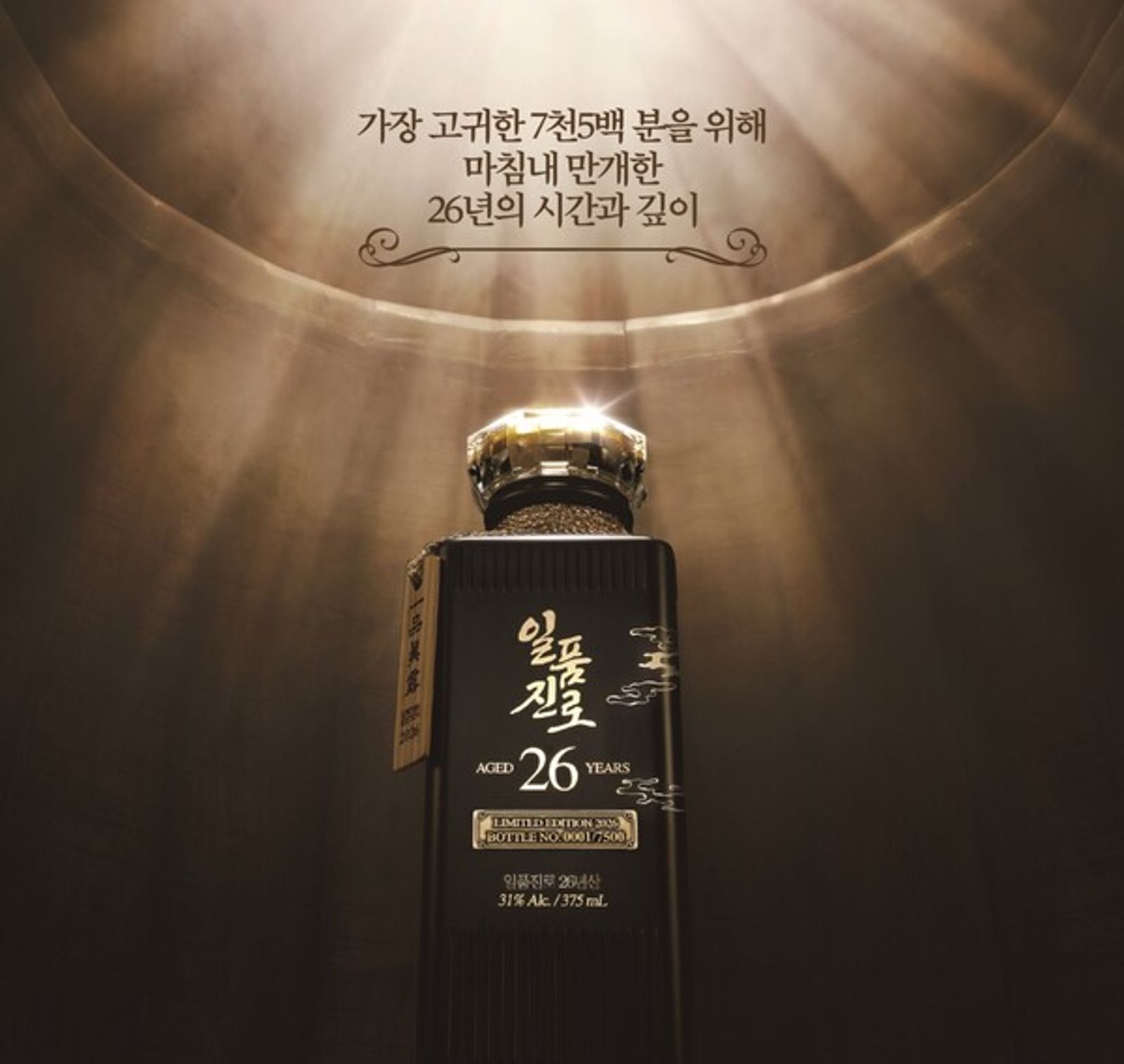
Hite Jinro has thrown down a striking challenge to South Korea's drinks market with the launch of an ultra-premium soju aged for an unprecedented 26 years. The move is far more than a routine product launch. This single bottle represents a calculated strategic bet on restructuring a soju market that has, for years, been going nowhere fast.
From value-for-money to values-led consumption: a seismic shift in soju
For decades, soju has been defined by a stubborn stereotype: cheap, strong, and unrefined. According to the Korea Agro-Fisheries and Food Trade Corporation (aT), the domestic soju market is worth roughly 3 trillion won annually — yet per-capita consumption has been in steady decline since the mid-2010s. Meanwhile, premium categories such as whisky, traditional Korean spirits, and highballs are gaining ground rapidly, driven largely by younger millennial and Gen Z consumers.
Against this backdrop, Hite Jinro's new release is best understood not as product diversification but as an attempt to redefine an entire category. The ambition is to reposition soju as a premium spirit deserving of comparison with the world's finest. As one industry insider put it: "We've seen a clear trend of soju drinkers trading up to whisky or Japanese sake as they get older. There's a real sense of alarm across the industry that soju itself must change if we're to stop that exodus."
The power of 26 years: symbolism as marketing
The age statement does powerful narrative work. In Scotch whisky, 18- and 21-year-old expressions have long served as benchmarks of premium quality, while anything aged 30 years or more occupies the rarefied territory of collectors and the wealthy. By slapping a 26-year age statement on a bottle of soju, Hite Jinro is deliberately transplanting the premium grammar of whisky into its own category.
This is no idle gamble. Research by Drinks International, a British trade publication, found that age-stated whiskies command prices on average more than 40% higher than their non-age-stated equivalents, and also enjoy meaningfully stronger consumer trust. Hite Jinro appears to have concluded that this logic translates readily to soju.
The competitive landscape: Hwayo, Ilpoom Jinro, and the challenge of tradition
Hite Jinro is not entering uncharted territory. Hwayo (known for its 25% and 41% bottlings) has pioneered the premium distilled-soju segment since the mid-2000s, and Hite Jinro itself has previously attempted an upmarket push with its Ilpoom Jinro range. Traditional distilled spirits such as Munbaeju and Leegangju have also been quietly building a presence at the top of the market.
Yet the 26-year-old expression is seen by many as a different proposition altogether. Rather than differentiating on alcohol content or ingredients alone, it places time — and its attendant scarcity — at the very heart of the product's value. "Consumers are no longer simply buying a flavour," says a spirits marketing specialist. "They're buying the story and the experience behind the bottle. The narrative of a 26-year wait is, in itself, a powerful point of distinction."
K-spirits goes global
There is a second, outward-looking dimension to this launch. The global spread of Korean popular culture has stoked growing international interest in Korean food and drink. According to South Korea's customs service, soju exports rose roughly 12% year-on-year in 2023, with the market expanding beyond the traditional strongholds of the United States, Japan, and China into South-East Asia and Europe.
The obstacle, however, is a persistent perception problem: in global markets, mainstream soju is too often dismissed as a cheap Asian drink. Overcoming that stigma requires positioning soju as a premium national spirit in the mould of Japanese sake or China's Moutai. The ultra-premium launch is widely expected to serve as the vanguard of that effort. Industry observers note that Suntory's success in building a globally respected premium identity for Japanese whisky — through expressions such as the Yamazaki 12-year-old — offers a compelling template for Hite Jinro to follow.
The risks: price resistance and the perils of a split identity
Not everyone is convinced. In the minds of most South Korean consumers, soju remains firmly associated with an inexpensive night out. Shifting that perception is a precondition for any premium pricing strategy, and specialists are united in warning that no single product launch can achieve this quickly.
The relationship between an ultra-premium line and the parent brand's existing image is also double-edged. On the one hand, a well-executed prestige product can generate a halo effect that elevates the entire brand. On the other, poor management risks creating an identity crisis — a brand caught awkwardly between mass-market staple and luxury spirit. The question circulating even within the industry is pointed: can the company that sells Chamisul (South Korea's best-selling soju, consumed by millions as an everyday drink) credibly sell a bottle priced at over a million won?
The opening shot in a market transformation?
Ultimately, this venture will serve as a litmus test for the entire Korean soju industry. Success would allow soju to evolve into a mature, two-tier market in which an accessible everyday spirit coexists alongside a genuine premium segment. Failure would consign the premiumisation project to the back-burner for years to come.
What is beyond dispute is that this single bottle has posed a question the market will soon have to answer: can soju become a luxury? A spirit that waited 26 years to be poured will not have to wait much longer to find out.