The three things you need to know
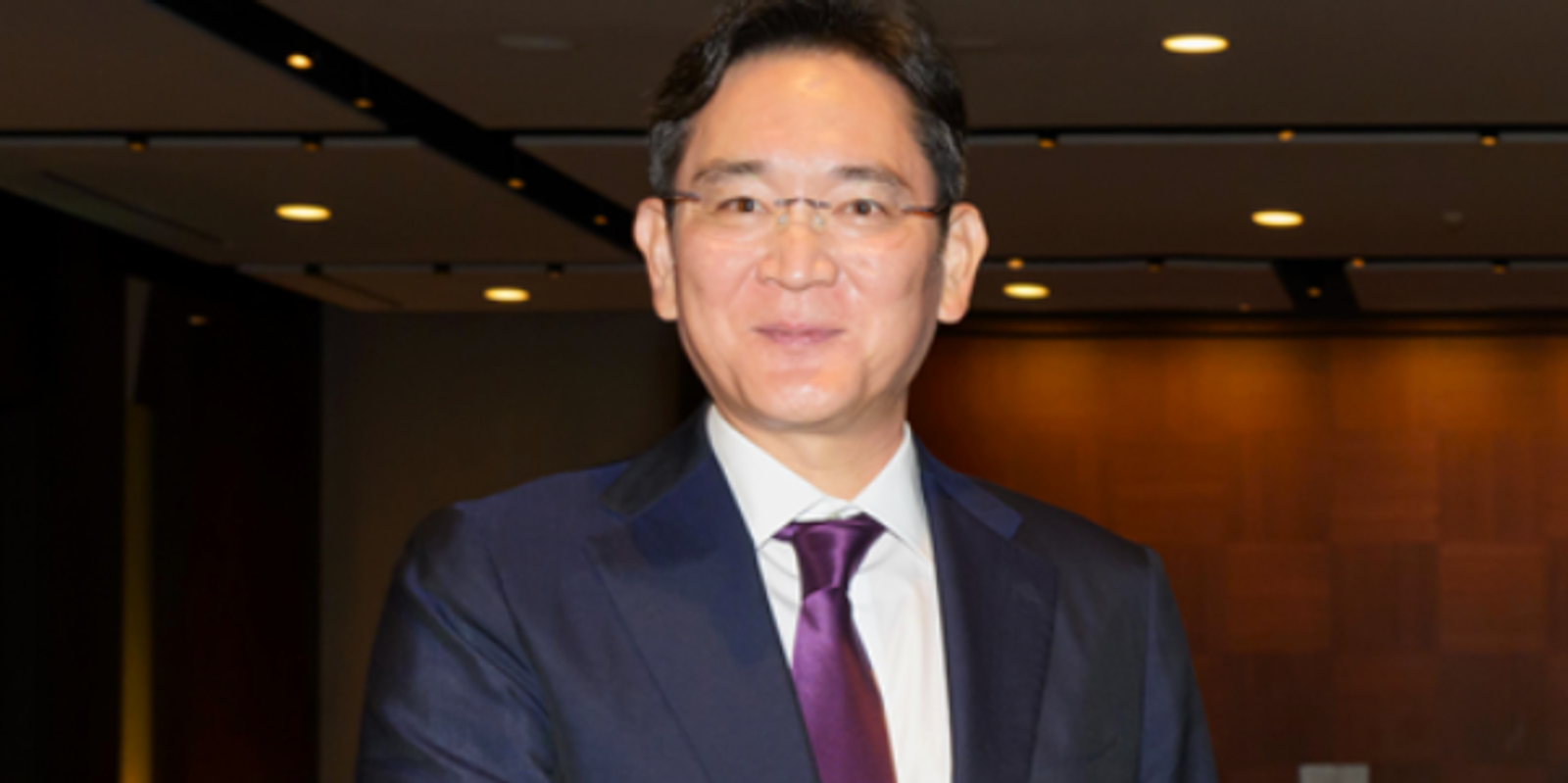
Lee Jae-yong, chairman of Samsung Electronics, has agreed to buy 7,667,100 ordinary shares in Samsung Electronics from his mother, Hong Ra-hee, honorary director of the Leeum Museum of Art, in an off-market transaction worth approximately ₩1.92trn ($1.4bn), and to receive a further 11,158,000 shares as a gift worth roughly ₩2.6trn. His direct shareholding will rise from 1.47% to 1.75% (combining ordinary and preference shares).
Because the transaction is entirely within the family, the combined stake held by the Lee family and related parties remains unchanged, and the group's governance structure is largely unaffected. The market broadly interprets the sale as being driven by Hong's need to repay loans taken out to cover inheritance taxes following the death of her late husband, former chairman Lee Kun-hee.
The deal was struck while the share price was under pressure despite record quarterly earnings, which lends itself to a reading of "strategic accumulation during a period of undervaluation." That said, the transaction was announced as a scheduled event back in September, making it hard to conclude that the timing was deliberately chosen to catch the bottom.
The numbers
On 12 October, Chairman Lee purchased 7,667,100 ordinary shares of Samsung Electronics from Hong in an off-market transaction at ₩250,500 per share, for a total of ₩1.9207trn. On the same day, a gift agreement was signed covering a further 11,158,000 ordinary shares, with the transfer scheduled for 12 November. Using the 13 October closing price of ₩236,000 as a rough guide, those shares are worth approximately ₩2.6trn, though that figure does not represent an actual transaction price.
Together, the two deals cover 18,825,100 shares, or roughly 0.28% of shares outstanding. Lee's shareholding rises from 1.47% before the purchase to 1.58% after it, and will reach 1.75% once the gift is complete. On ordinary shares alone, the figure climbs from 1.8% to just under 2%. Hong's ordinary share stake will fall from 1.12% to 0.93%, though she will still hold 54,153,600 ordinary shares after the transfer.
Two transactions with different characters
The off-market purchase was not a surprise. A regulatory filing on 9 September had already flagged it. At the time, the plan was to buy 7,188,793 shares at ₩269,500 each—the closing price on 8 September—for roughly ₩1.9374trn, with 12 October set as the execution date. Industry observers interpret the deal as Hong liquidating holdings to repay loans incurred during the inheritance-tax settlement that followed Lee Kun-hee's death. The decision to sell directly to her son rather than on the open market is widely explained by the risk that offloading nearly ₩2trn worth of stock would rattle the share price. The precise size of the outstanding loans has not been independently confirmed.
The gift carries its own tax consequences. At the top statutory rate of 50%, a rough calculation puts the gift tax at around ₩1.3trn. The actual liability will be determined by the average share price in the two months surrounding the transfer date, so the final figure may differ. A 20% premium is applied when calculating the taxable value of shares held by controlling shareholders, a surcharge that was factored into estimates of the inheritance tax on Lee Kun-hee's Samsung Electronics stake in 2020. If the same premium applies here, the gift-tax bill could exceed ₩1.5trn—something that will require formal tax confirmation.
The share transfer from Hong to Lee should also be seen in the context of an earlier move: Hong had already gifted her entire stake in Samsung C&T—1,808,577 shares, or 1.06%—to her son (transfer date: 2 January 2026), lifting his holding in the group's de facto holding company from roughly 19.9% to 20.82%. Taken together, the Samsung C&T gift, the off-market Samsung Electronics purchase and the Samsung Electronics gift form a coherent pattern of gradually winding down Hong's personal holdings.
The 1.75% that isn't the whole story: where control really comes from
A 1.75% direct stake sounds modest, but Samsung's governance is built on a chain of cross-holdings rather than raw ownership. According to public filings, Lee is the largest single shareholder in Samsung C&T (20.82%); Samsung C&T holds 19.3% of Samsung Life Insurance and roughly 5.1% of Samsung Electronics; and Samsung Life holds 8.5% of Samsung Electronics. Lee exercises indirect control over Samsung Electronics through this chain, on top of which his direct stake now sits.
Because the transaction is intra-family, the aggregate holding of the controlling family and their related parties stays constant. What changes is the distribution within the family—specifically, the proportion held directly in Lee's own name. A larger personal stake means that dividends and share-price movements affect him more directly.
Strategic accumulation during a period of undervaluation?
There is a plausible market-based argument for reading this as buying into a dip.
| Date | Samsung Electronics share price | Note |
|---|---|---|
| 8 September | ₩269,500 (closing price) | Reference price in the 9 September filing |
| 12 October | ₩250,500 | Off-market transaction price; roughly 7% below the 8 September close |
| 13 October | ₩236,000 (closing price) | Roughly 12% below the 8 September close |
Samsung Electronics posted record quarterly operating profit of ₩107.4trn in the third quarter, yet the share price fell. Foreign investors had been net sellers for nine consecutive trading days as of 8 October, and Goldman Sachs warned of near-term selling pressure tied to semiconductor ETF rebalancing, options expiry and the conclusion of the company's share buy-back programme. Korean brokerages, by contrast, argued that the stock remained cheap at 3.7 times 2027 estimated earnings and 1.7 times book value. As a mechanical consequence of the lower price, Lee ended up with roughly 478,000 more shares (about 6.7% more) than the September plan had envisaged, for the same total outlay.
Even so, the "deliberate timing" narrative is hard to sustain. The schedule and price were set in September; the purchase appears to have been driven by Hong's need to repay a loan rather than by Lee's investment judgment; and the fact that a lower price translated into more shares is a consequence of arithmetic, not evidence of market timing. The lower share price may incidentally reduce the gift-tax bill, since the taxable base is the average price over the two months around the transfer—but that too is not proof of deliberate strategy. The most reasonable interpretation is that a pre-arranged transaction happened to settle during a period of market weakness, produced an arithmetically favourable outcome for Lee, and can be read as a signal of managerial commitment—though none of these effects was necessarily engineered.
Where does the money come from?
The combined outlay—₩1.9207trn for the purchase plus at least ₩1.3trn in gift tax—exceeds ₩3trn in total. The filing does not specify how Lee will fund it. One report suggested he would borrow the money and repay it from rising dividend income. That logic connects directly to Samsung Electronics' shareholder-return programme: the board announced on 21 August that total returns for the year would reach up to ₩110trn, with approximately ₩30trn in cash dividends, including regular quarterly payments, earmarked for the third quarter alone. The per-share amount is to be confirmed at an October board meeting. Based on his September shareholding, one estimate put Lee's third-quarter dividend receipts at around ₩445bn; a larger direct stake means a larger cheque. In effect, dividends that were previously directed at servicing inheritance-tax debt are becoming the vehicle for funding further share accumulation.
How does this compare with Chey Tae-won's ₩4.8bn purchase?
Around the same time, another major conglomerate chairman made his own move. Chey Tae-won, chairman of SK Group, bought 3,620 ordinary shares in SK Hynix on the open market on 30 July—his first-ever personal purchase of the stock—for roughly ₩4.786bn at the day's closing price. The purchase came shortly after SK Hynix shares had fallen more than 50% from their peak and tumbled about 10% following a set of earnings that disappointed investors expecting more aggressive shareholder returns. Some observers noted that the sum was calibrated to fall just below the ₩5bn threshold above which Korean securities rules require a 30-day advance disclosure—making it effectively the largest purchase he could make without prior notice.
| Chey Tae-won | Lee Jae-yong | |
|---|---|---|
| Method | Open-market purchase | Off-market family transaction + gift |
| Scale | ~₩4.8bn | Purchase ~₩1.92trn + gift ~₩2.6trn |
| Nature | First-ever personal purchase | Addition to existing holding |
| Market impact | Creates genuine new demand | No new demand; intra-family transfer |
| Timing | Shortly after 50%-plus fall from peak | During a correction amid record earnings; transaction announced in September |
| Filing | Structured just below the ₩5bn advance-disclosure threshold | Pre-announced 9 September; settled 12 October |
| Stated rationale | Signal of managerial commitment and undervaluation | Estimated loan repayment by Hong + internal family restructuring |
The signalling power of a share purchase depends on its structure, not its size. Chey's ₩4.8bn is modest relative to his wealth, but it was an open-market transaction executed when sentiment was fragile—textbook market signalling. Lee's ₩4.5trn is enormous, but it is an internal family transfer that adds no new buyers to the market and leaves the freely traded float unchanged. As a signal that the stock is undervalued, Chey's purchase is far closer to the orthodox playbook, which reinforces the earlier conclusion that Lee's transaction cannot simply be characterised as a bottom-fishing bet.
That said, ranking the two in terms of "managerial responsibility" is not particularly meaningful. Chey's move carries symbolic weight but involves a trivial sum. Lee's transaction is entangled with the practical realities of taxation and debt repayment. The two deals are different in kind, and applying the same standard to both would be misleading.
What should shareholders make of it?
Interpretations diverge. On the positive side, an owner directly increasing his personal stake brings his interests into closer alignment with those of outside shareholders. In an environment of rising dividends, a larger direct holding means that Lee and ordinary investors are pulling in the same direction. If the loan repayment motive is accurate, some of the overhang associated with pledged shares may diminish.
On the other hand, because this is an intra-family transfer, the direct impact on the share's supply-and-demand dynamics is limited. The fact that the family's aggregate stake is unchanged underlines the point.
What to watch next
12 November gift transfer. Confirmation of the transfer, the accompanying regulatory disclosure and the method of gift-tax payment are all outstanding.
Third-quarter dividend record date. The per-share dividend will be fixed at an October board meeting. Depending on when the record date falls, it will determine whether the shares purchased on 12 October and those to be received on 12 November qualify for the latest distribution.
Hong Ra-hee's remaining stake. She will still hold 54,153,600 ordinary shares after the gift is complete—a substantial position in its own right.
Other family share movements. The positions of Lee Boo-jin, president of Hotel Shilla, and Lee Seo-hyun, president of Samsung C&T, deserve monitoring alongside those of the chairman.
Share price trajectory. Samsung Electronics is generating record profits while foreign investors remain persistent net sellers. Any shift in that dynamic will colour how the market interprets the transactions described above.