The three things to know
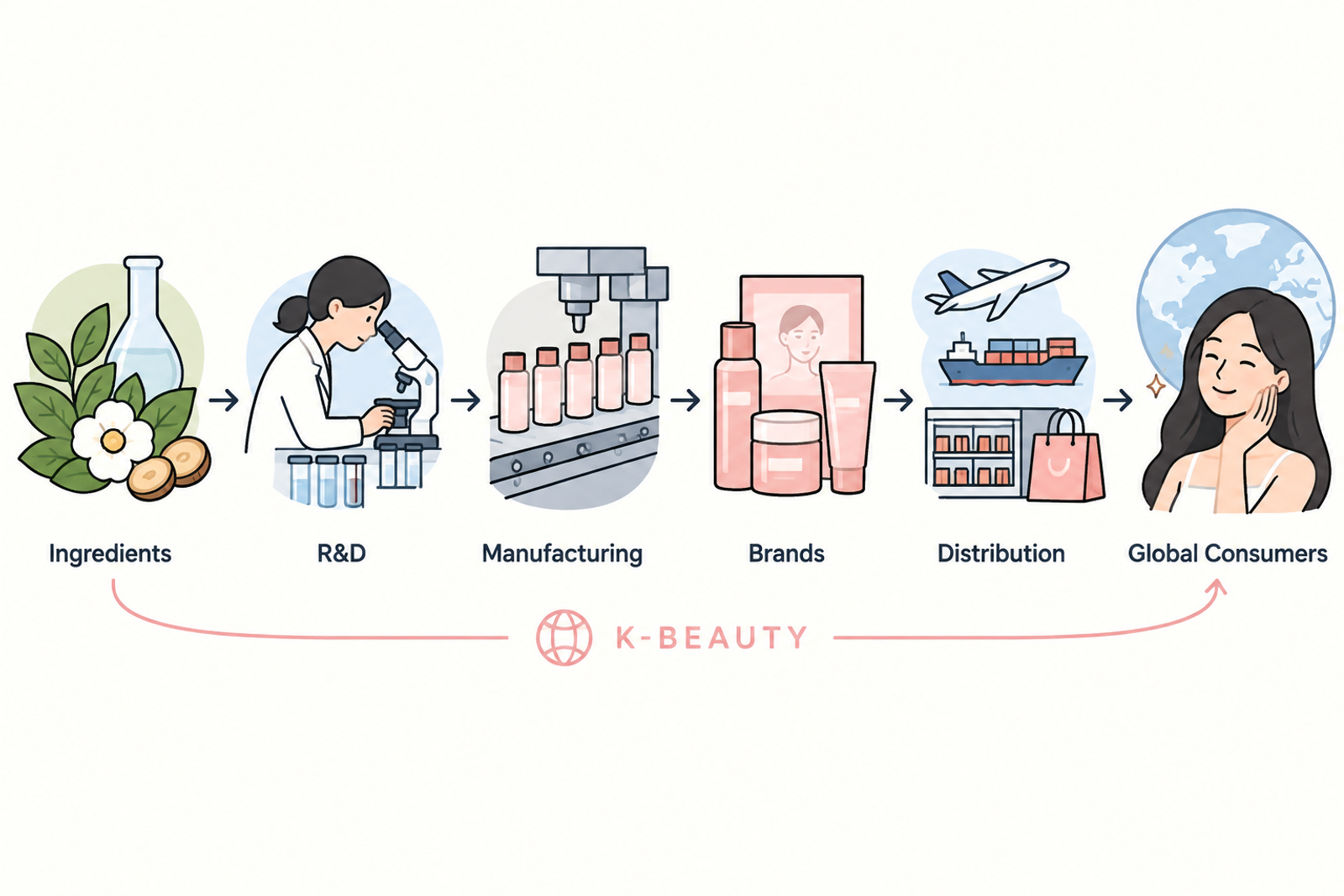
K-beauty's rise is a story about the power of specialisation, not the genius of any one firm. Map the industry onto semiconductors and the structure snaps into focus: brand-only companies such as APR resemble fabless chipmakers like Nvidia; contract developers and manufacturers such as Cosmax play the role of foundries like TSMC; conglomerates such as Amorepacific and LG H&H are the integrated device manufacturers, akin to Samsung Electronics; and ingredient and packaging suppliers correspond to materials and components firms. One important caveat: the semiconductor analogy has no equivalent for the distribution layer, which in K-beauty is critical.
This structure means a cosmetics brand can exist without ever owning a factory. South Korean contract manufacturers (ODMs) can move from brief to shipment in three to six months, far faster than overseas rivals, which typically take six to twenty-four months. As of 2023, South Korea had more than 31,000 registered cosmetics brand licence holders but only around 4,500 manufacturers. In 2025, South Korean cosmetics exports reached a record $11.4 billion, making the country the world's second-largest exporter.
The analogy has its limits, however. Unlike a foundry, which simply fabricates a customer's design, an ODM also develops the formulation. Nor is there a TSMC-style monopolist dominating the sector. The competitive advantage of indie brands lies in marketing, community and channel access, not design patents. Knowing where the map fits and where it does not is what makes it useful. Beyond the map, political risk looms. The THAAD missile-defence dispute of 2017 showed how quickly geopolitics can upend financial performance, and the possibility of further disruption — from cultural sentiment to trade policy — cannot be dismissed.
Why borrow from semiconductors?
K-pop and Korean dramas have made Korean cosmetics familiar to the world. Who actually makes and sells them is less well understood. The numbers set the scene. South Korean cosmetics exports hit $11.4 billion in 2025, a record, according to data cited by the Korea Food and Drug Safety Ministry. That put South Korea second globally behind France ($24.3 billion), and ahead of the United States ($10.8 billion) for the first time. Exports to the United States reached $2.2 billion, overtaking China ($2.0 billion) as South Korea's single largest cosmetics export market. In the first half of 2025, exports were roughly $7 billion, up 27% year on year. America accounted for $1.45 billion (20.7% of the total), China $1.01 billion (14.4%) and Japan $580 million (8.3%).
This growth was not driven by a handful of large conglomerates. It rests on a division of labour in which branding, manufacturing, materials and distribution are handled by distinct specialists. The structure closely resembles South Korea's semiconductor industry — itself world-class — in which fabless designers, foundries, integrated chipmakers and materials firms each occupy a defined role. Readers familiar with semiconductors can use that mental model to map K-beauty at a glance.
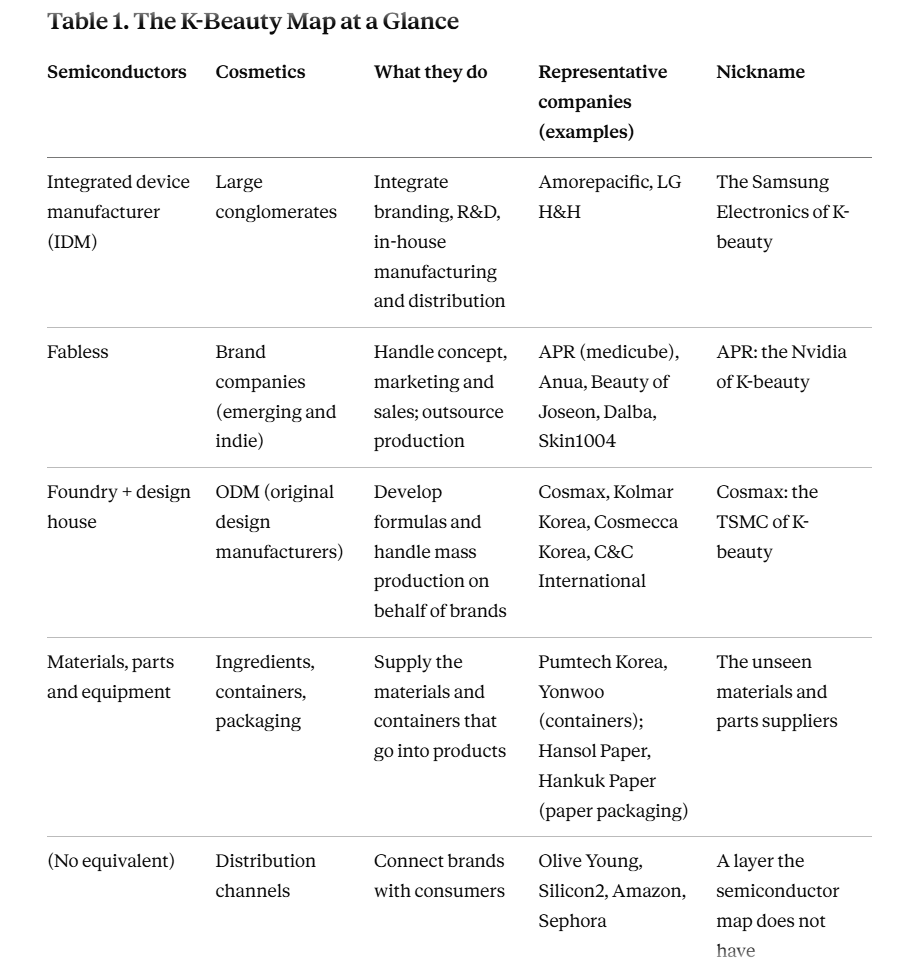
*Note: the one-line nicknames below are analogies to aid comprehension. Where they fit and where they break down is discussed in the "Limits of the analogy" section.*
In three lines:
APR is K-beauty's Nvidia. Rather than running its own factories, it focuses on brand-building, product concept and sales — a fabless model. It has grown faster than almost anyone in the sector, reaching a scale that rivals the traditional giants.
Cosmax is K-beauty's TSMC. It develops and manufactures products on behalf of other brands and is widely regarded as the world's largest cosmetics ODM, with customers that include many of the world's leading beauty companies.
Amorepacific and LG H&H are K-beauty's Samsung Electronics. They own their brands, their research capabilities and their production facilities — fully integrated players.
ODM: factory and laboratory combined
The ODM layer is the most important in the chain. A brand arrives with a concept — "we want something like this" — and the ODM develops the formulation, selects appropriate packaging and handles production. What distinguishes an ODM from a simple contract manufacturer (OEM) is that it brings its own development capability. According to the Korea Economic Daily, South Korean ODMs can go from client brief to finished shipment in roughly three to six months; overseas rivals typically need six to twenty-four months. In the fastest cases, an indie brand can be on shelves within three months of conception.
The two dominant players are Cosmax and Kolmar Korea. Cosmax is said to have overtaken Italy's Intercos to become the world's largest cosmetics ODM in 2015; it reportedly counts around 5,000 client brands, including approximately 1,500 domestic K-beauty labels, and trades with 18 of the global top 20 beauty companies. Kolmar Korea is said to manufacture more than 70% of South Korea's sun-care products. In the second quarter of 2025, both companies reported record quarterly results. Cosmax posted consolidated revenue of 794.9 billion won, up 27.5% year on year, and operating profit of 73.7 billion won, up 21.3%. Kolmar Korea posted consolidated revenue of 861.3 billion won, up 17.9%, and operating profit of 110.3 billion won, up 50.2%. Kolmar Korea's consolidated figures include its pharmaceutical subsidiary HK Inno.N; cosmetics alone contributed 606.4 billion won in revenue. Cosmax's US subsidiary recorded its first-ever quarterly operating profit.
The ODM model's reach extends to global celebrity brands. According to industry reports, Selena Gomez's Rare Beauty sources roughly half of its colour cosmetics from the South Korean factory of C&C International, while Rihanna's Fenty Beauty sells products developed and manufactured by Cosmax's research division. The brand name is on the packaging; a Korean ODM made what is inside.
Data from PwC Samil's industry guidebook shows that between 2015 and 2023, ODM and OEM businesses grew at an average annual revenue rate of 10.2%, the fastest of any layer in the value chain. Large brand companies managed only 2.6%. Manufacturing and development, in other words, have been outgrowing brands for years.
Brand companies: the factory-free players
The fabless equivalent is the indie or emerging brand. As of 2023, South Korea had 31,524 registered cosmetics brand licence holders but only 4,567 manufacturers — far more sellers than makers. Indie brands typically grow through word of mouth on TikTok and Instagram and outsource everything from concept to production to ODMs.
They have grown substantially in scale. According to Cosine Korea's 2024 revenue rankings, 25 small and mid-sized K-beauty brands had crossed the 100 billion won annual revenue threshold. Anua (owned by The Founders) reported 427.8 billion won, up 198.6% year on year, with overseas sales accounting for around 90% of the total. Beauty of Joseon (Goodal Global) reached 330.9 billion won; Skin1004 (Craver Corporation) 318.1 billion won; and d'Alba (d'Alba Global) 309.1 billion won, with around 46% coming from overseas. These are 2024 figures and current revenues may be higher.
The standout in this layer is APR, owner of the Medicube and April Skin brands. In 2025, APR posted consolidated revenue of 1.527 trillion won and operating profit of 365.4 billion won, implying an operating margin of roughly 24% — a significant step above the leading names in the "100 billion club." Roughly 70% of its revenue (1.077 trillion won) came from cosmetics and about 27% (407 billion won) from beauty devices under the Ager brand. Overseas sales now account for more than 80% of total revenue, up sharply from 55% a year earlier. The United States alone generated 565.1 billion won. At this scale, calling APR an indie brand no longer fits; it is better described as a company that started as one and has grown to rival the traditional conglomerates. Its inclusion of beauty devices alongside cosmetics also sets it apart from pure-play brand companies, which means its high margin should not be read as representative of the broader brand layer.
The relationship between brands and ODMs can be deep and long-standing. Cosmétic reports that beauty of Joseon's popular "Malgeunssal Suncream" is the fruit of five years of joint development between Goodal Global and Kolmar Korea; cumulative sales of that sun-care line have surpassed 100 million units. Even so, the competitive moat for indie brands is not proprietary formulations or patents — it is consumer engagement and channel access. When trends shift, rankings can change quickly.
The conglomerates: brand to production under one roof
Amorepacific and LG H&H are the integrated device manufacturer equivalents — multi-brand houses with their own research centres and production facilities. Both were heavily exposed to China and both have been pivoting towards North America. In the second quarter of 2025, Amorepacific posted revenue of 1.176 trillion won, up 17.0%, and operating profit of 117.3 billion won, up 59.3%; Americas revenue came to 210.4 billion won, up 57%, representing roughly 18% of the total. Over the same period, LG H&H posted revenue of 1.657 trillion won, up 3.3%, and operating profit of 102.8 billion won, up 87.5%. Its North America revenue of 205.8 billion won, up 47.3%, exceeded China revenue (176.0 billion won, down 5.0%) for the first time. Analysts point to LG H&H's expanded presence in Costco and Sephora as a key driver.
Packaging and ingredients: the unseen materials layer
Every bottle of cosmetics requires more than its contents — a pump, a vessel and a box. This layer corresponds to materials, components and equipment in semiconductors. In the second quarter of 2025, Pumtech Korea reported record quarterly revenue of 116.8 billion won, up 10.8%, and operating profit of 21.7 billion won, up 11.4%. Yonwoo posted revenue of 91.1 billion won, up 28.9%, returning to profit. The packaging division of paper and packaging company Korea Paper also returned to the black. PwC data show that raw ingredients grew at an average annual rate of 6.6% and ancillary materials at 5.7% between 2015 and 2023 — slower than ODMs, but structurally tied to export volumes.
*One terminology note:* "packaging" in semiconductors refers to the back-end process of encasing a chip; in cosmetics, it means bottles, tubes and boxes. The words are the same but the concepts do not correspond — cosmetics packaging maps to the materials and components layer, not to semiconductor packaging.
Distribution: the layer the semiconductor map omits
Distribution has no counterpart in the semiconductor value chain, but it is indispensable to K-beauty. The dominant domestic platform is CJ Olive Young, which posted standalone revenue of approximately 5.834 trillion won in 2025, up 21.8%, and operating profit of approximately 744.7 billion won, up 22.5%, with a domestic beauty market share of 20.2%. Foreign visitors spending at Olive Young's stores exceeded 1 trillion won in the first eleven months of 2025. In May, the company opened its first US store in Pasadena, California.
The export distribution role is filled by companies such as Silicone2, which buys K-beauty products and distributes them across 175 countries. In 2025, it posted revenue of 1.12 trillion won, up 61.9%, and operating profit of 205.5 billion won, an operating margin of 18.4%. Behind Amorepacific's and LG H&H's North America results lies the reach of channels such as Amazon, Sephora and Costco. No matter how good a brand or manufacturer may be, without access to distribution it cannot reach consumers. Distribution, in this sense, is another bottleneck in the chain.
Who is making the money — profitability by layer
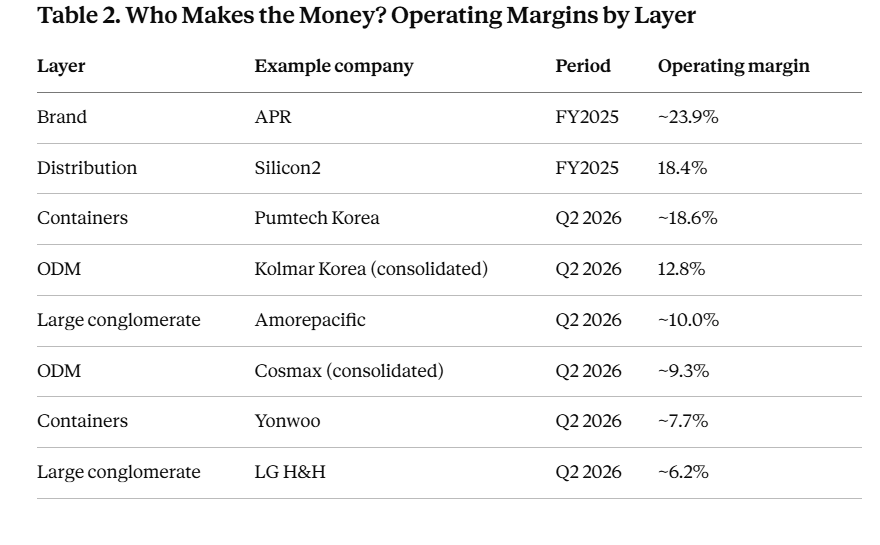
*Note: operating margins are calculated from reported revenue and operating profit figures. Periods and business scope differ across companies (Kolmar Korea, for instance, includes a pharmaceutical subsidiary). These are individual company data points, not averages for each layer.*
The hidden variables: when politics and culture shake the map
The map above describes companies and markets. What can overturn the entire map lies outside any individual firm. Because K-beauty has ridden the wave of the broader Korean cultural export — the Hallyu phenomenon — shifts in politics and cultural sentiment can translate directly into commercial damage. The clearest example is the THAAD affair.
The THAAD episode: a precedent. THAAD is the United States' Terminal High Altitude Area Defense system. When South Korea's government decided to deploy a battery in 2016, China objected, arguing the system threatened its own security. A wave of informal restrictions on South Korean content and consumer goods followed, commonly known as the Hallyu ban (한한령, or *hanhanllyeong*). It was never formally announced, and its easing has never been officially declared. In cosmetics, the signal came in early January 2017, when China's General Administration of Quality Supervision published a list of 28 cosmetics products that had failed inspection; 19 were South Korean. The industry read this as a political volley, though China stated no political motive.
The scale of the damage is quantifiable. According to data from the Korea International Trade Association cited in industry reports, South Korea's share of China's total cosmetics imports fell from 22.2% in 2017 to 17.8% in 2021. Amorepacific and LG H&H, which had the greatest exposure to China at the time, bore the brunt. Reports from around 2022 suggest China accounted for roughly 70% of Amorepacific's overseas revenue and more than 50% of LG H&H's. Their prolonged years of underperformance trace directly to that dependence.
But THAAD alone explains only half the story. The Chinese market was also changing from within. Chinese consumers developed a strong preference for domestic brands — the "guochao" (國潮, or national tide) trend — and Chinese local brands were simultaneously upgrading quality, sometimes using South Korean ODMs to do so. Reports indicate that the number of Chinese companies in China's top 20 cosmetics rankings rose from six in 2017 to eight in 2020. Japanese and European brands held the premium tier. A tightening of Chinese cosmetics regulations in 2021 added compliance burdens for smaller Korean exporters, and Covid-19 disrupted cross-border commerce. The political shock created a window in which competitors could gain ground; structural competitive shifts amplified the consequences. Both factors, not THAAD alone, explain what happened.
Where things stand now. The bilateral relationship is moving towards normalisation. Reports indicate that the Hallyu ban was raised at a summit earlier this year, and China participated with an official pavilion at the Busan Contents Market in June — the first such participation since the ban. No formal lifting has been announced, however, and China's content approval system remains in place. Industry observers caution against treating expanded exchanges as equivalent to an official reversal. Meanwhile, K-beauty has already diversified away from China. In the first half of 2025, the United States is South Korea's top cosmetics export market (20.7%) and China is second (14.4%). The market diversification that followed the THAAD episode has been real — but it also means that political risk could migrate to American or other markets.
What if the Korean Wave recedes? Much of K-beauty's international visibility derives from K-pop and Korean television drama. By that logic, a cooling of Hallyu sentiment could dampen demand for Korean cosmetics. The strength of that linkage, however, is difficult to quantify and the evidence is far from conclusive. A counter-argument exists: K-beauty's competitive edge is grounded in genuine product quality, accessible price points and the rapid product innovation that an efficient ODM ecosystem makes possible. If Hallyu opened the door, the products themselves are what keep consumers coming back. The dependency is a variable worth tracking — but not one to over-weight in the absence of hard data.
Anti-Korean sentiment in South-East Asia: signal or noise? In late February, a dispute at a K-pop concert in Kuala Lumpur, Malaysia — sparked when a South Korean fan was stopped from using a prohibited camera — escalated into a broader online conflict, with users from both countries trading insults. Some South-East Asian social media accounts reported calls to boycott Korean products. The evidence here is thin: the episode rests on a single-source report, no sales data exist to measure any commercial impact, and the original report itself acknowledged uncertainty about whether the sentiment would persist. At this stage it is best treated as a warning sign rather than a trend. The broader lesson is clear: consumer sentiment can be inflamed almost instantaneously by online community conflicts, and provocative speech from within South Korea can damage how overseas consumers perceive the country.
Other variables deserve attention. Since August last year, the United States has imposed a 15% tariff on South Korean cosmetics, where previously the Korea-US Free Trade Agreement had kept the rate at zero. The industry's initial reaction was relief that the rate was not higher, but analysts note that smaller indie brands and mid-sized companies with limited capital buffers are most exposed. Cosmax and Kolmar Korea both have manufacturing operations in the United States, which reduces their tariff burden. On the competitive front, Chinese cosmetics brands — collectively dubbed "C-beauty" — are increasingly targeting younger consumers internationally, particularly in colour cosmetics. Industry observers believe that the overlap with K-beauty's strengths in skincare and sun care remains limited, but they are watching the colour category closely.
Limits of the analogy
The analogy is useful; its failure modes are equally worth knowing.
First, ODMs go further than foundries. A foundry fabricates what a customer designs. A cosmetics ODM also proposes and develops formulations; brands often select from an ODM's existing formula library and ask for modifications. In semiconductor terms, the closer equivalent is a foundry combined with a design house.
Second, the barriers to entry differ markedly. Foundry economics require astronomical capital investment, and TSMC's dominance is structural. Cosmetics ODMs face lower capital requirements, and beyond the top two players there is a long tail of mid-sized operators. There is nothing in cosmetics that resembles the technology gulf or monopoly dynamic of leading-edge semiconductor fabrication.
Third, the sources of competitive advantage are different. A fabless chipmaker's moat is its intellectual property in chip design. An indie beauty brand's moat is its community, its marketing and its channel relationships. Cosmetics trends move fast; brand lifespans are far shorter than those of semiconductor design firms.
Fourth, the nicknames are only nicknames. Nvidia dominates its market through a combination of design supremacy and a deep software ecosystem; APR resembles it only in its rapid growth and high margins — it commands no comparable market power. Cosmax is the global ODM leader, but Kolmar Korea competes closely with it; there is no equivalent of TSMC's structural moat. Samsung Electronics spans semiconductors, home appliances and smartphones — a breadth of business that makes it quite unlike cosmetics-focused Amorepacific or LG H&H. The analogies describe position and role; they should not be stretched beyond that.
How to use this map
When reading K-beauty news, consider which layer a given story concerns. Ministry export statistics reveal the overall direction of travel. ODM quarterly results function as a leading indicator of whether indie brand order volumes are rising. Distribution news — Olive Young's US expansion, new listings in major overseas retail chains — shows whether brands are actually reaching consumers. Announcements of capacity expansions by packaging companies signal confidence further up the supply chain.
Outside company results, the variables most capable of shifting the entire map are: the state of South Korea-China relations (whether the Hallyu ban is genuinely being relaxed); US tariff policy; and the state of overseas consumer sentiment towards South Korea. Equally important is a caution in the other direction: strong results in one layer should not be read as evidence of a boom across the entire industry. Growth rates, margins and sensitivity to the economic cycle differ meaningfully from one layer to the next.