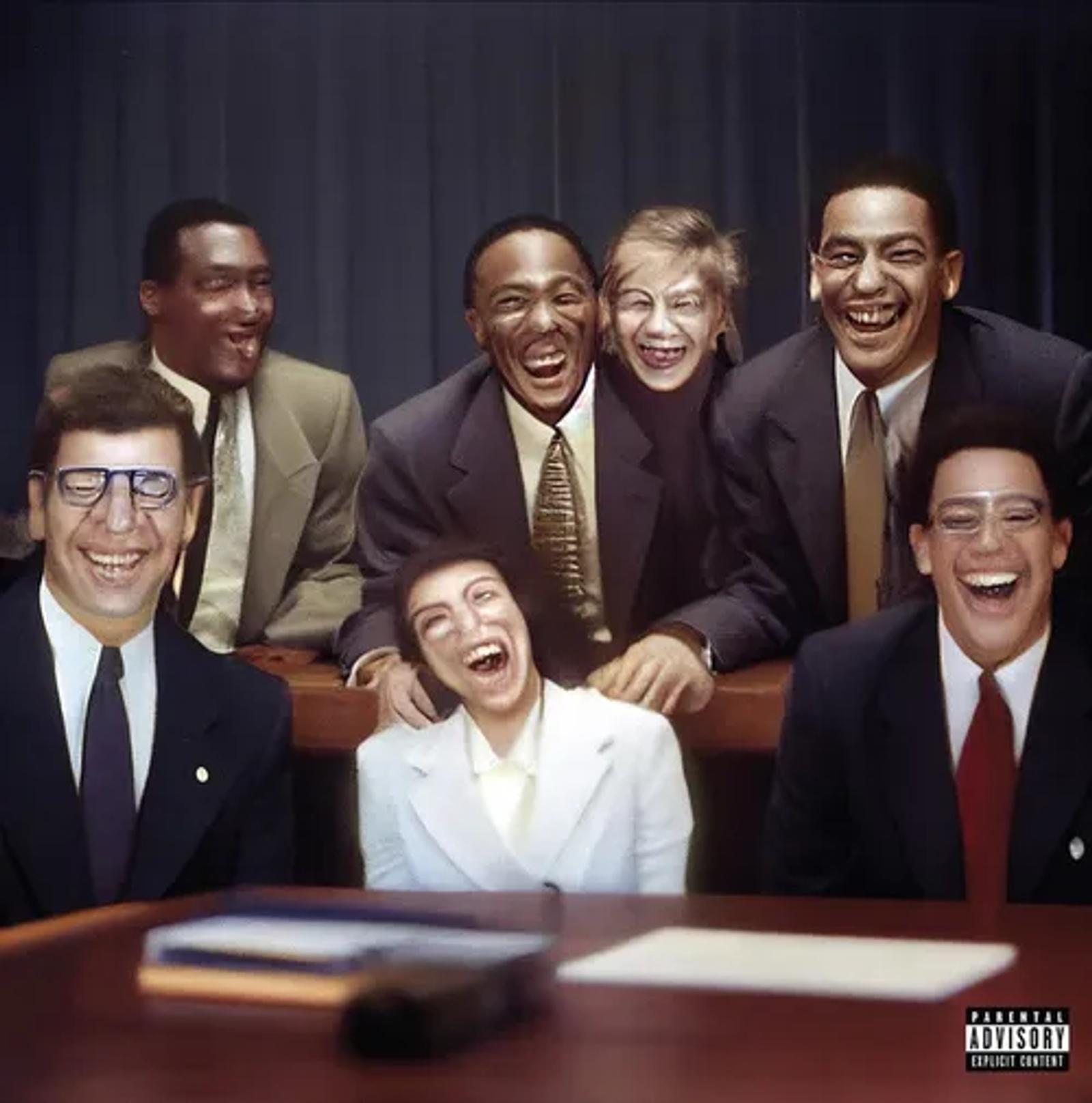
***Let's Start Here.* — Lil Yachty**
Hip-hop has never been particularly forgiving of the young. Few artists have drawn more censure from the genre's faithful than Lil Yachty, who was accused of disrespecting his elders and flouting the conventions of traditional rap. He emerged from SoundCloud, rose to early iconhood on the strength of mumble rap, and commanded the Yeezy runway on aura alone — yet a persistent chorus of critics dismissed him as an ignorant young rapper with no regard for hip-hop's history.
*Let's Start Here.* is his elegant rebuttal: a record that steps away from the genre that kept scoring him on its own terms. Rather than fight in the ring where he was always at a disadvantage, he walks into an entirely different one. What makes this departure remarkable is that he never quite leaves home. The album was released on Motown and Quality Control — the latter the Atlanta trap label that nurtured Migos and Lil Baby, the former a name synonymous with the Black musical canon — two imprints that together, improbably, deliver a psychedelic rock record.
Yachty had carried Pink Floyd's *The Dark Side of the Moon* with him for years. Drawing on that obsession, he assembled a collaborator list that includes producer Patrick Wimberly as its axis, alongside SadPony, Justin Raisen, Jacob Portrait of Unknown Mortal Orchestra, Magdalena Bay, and Jam City, then spent six months buried in sessions with a live band. The resulting sound satisfies both hip-hop and psychedelia devotees. The opening track, "the BLACK seminole.", grounds itself in a classically heavy drum texture; it is the instrumentation layered above it that conjures another era's nostalgia. At the intersection of Motown soul and psychedelic reverie, Diana Gordon's vocal rises to an almost operatic scale — yet the album never loses its sense of ownership. Yachty's voice and delivery remain, amid all those vintage instruments, at once the most timeless and the most contemporary thing on the record.
His compositional choices are bold throughout. On "pRETTy", he applies heavy vibrato to his voice, deploying it almost as an instrument in itself — shaping atmosphere and adding texture with impressive instinct. Fousheé's lyrics here are frank and explicit, carrying an emotional directness rarely heard within the psychedelic tradition: the sensibility is unmistakably hip-hop. The album glides through "the ride-" alongside Teezo Touchdown, and in moments such as the Roland-tinged echo of Yachty's voice dissolving into the brass arrangements of "running out of time", Black music and psychedelia overlap without either encroaching on the other. These are passages unique to this record, and they are quietly beautiful.
":(failure(:" functions much as a skit would in a conventional hip-hop album. Even in a spoken-word piece graced by the backing vocals of Alex G and Mac DeMarco, Yachty makes no effort to conceal his rapper's persona. He has no interest in recycling psychedelia's familiar grammar of gloom and nihilism. What the listener encounters instead is a young rapper confronting failure with candour and projecting something closer to optimism.
Extreme despondency — the reflex association with psychedelia — is conspicuously absent. Even on "THE zone~", when a driving electric bass, Juno-style synthesisers, and guitar lock in a central theme, and a comfortable upper register of humming stirs nostalgic feeling, the tone remains bright and only gently melancholic. The discipline holds through "WE SAW THE SUN!", where guitar echo and unhurried delay stay composed amid lavish production, the classic instruments swelling together like an ensemble. Through it all, Yachty never relinquishes control.
By "IVE OFFICIALLY LOST ViSiON!!!!", the album has become genuinely epic in scope. A softly textured sample eases the listener in before a fierce vocal enters and the guitar stakes out its theme. The piano that arrives mid-track carries the record's boldest statement in the most uncompromisingly hip-hop language on the album — an intensity reminiscent of the opening track. Here the record folds in on itself and opens again. It is a perfect pivot.
The second half, however, loses some of the first half's tension. "sAy sOMETHINg" and "sHouLd i B?" bounce by quickly and pleasantly, but the taut energy of the earlier tracks gradually loosens. That said, the ambition of the experiment — fifty-seven minutes on unfamiliar terrain, sustained to the end — demands respect.
And that ambition is rewarded in the final moments. On the closing track, "REACH THE SUNSHINE.", with Daniel Caesar, Yachty deliberately recalls the melodic theme of "the BLACK seminole." The return is too precise to be accidental. It is an architectural decision: fourteen tracks that might have scattered are drawn into a single circle by this last song. It is an accomplished ending. With *Let's Start Here.*, Lil Yachty has made his case not merely as a rapper, but as a musician.
Rating: ★★★☆☆ (3.0/5.0)
In brief: "A nostalgia born of restless movement between Black music and psychedelia."