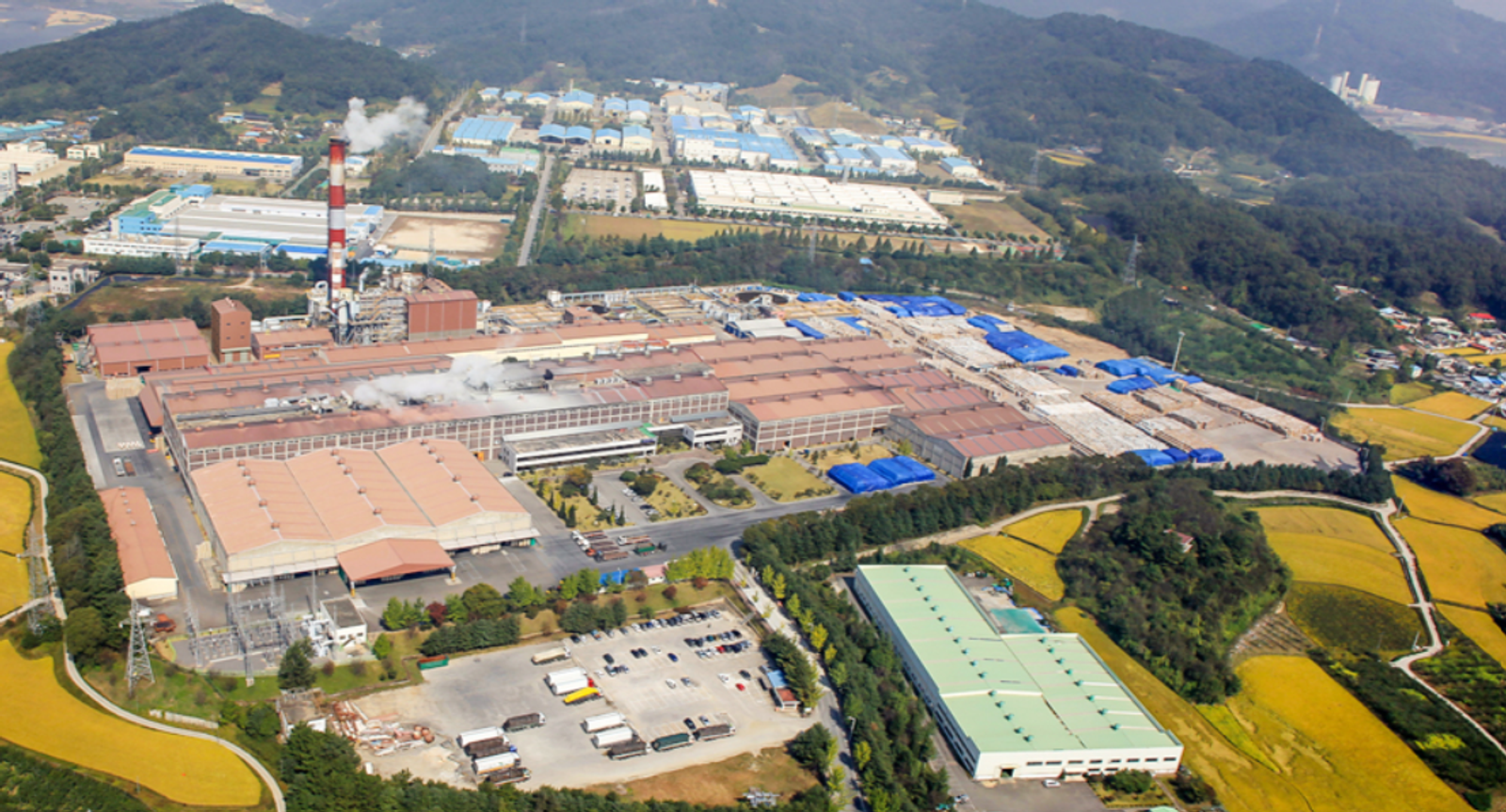
Company Overview
Asia Paper Manufacturing is the corrugated containerboard arm of the Asia Group conglomerate, producing the linerboard and fluting medium that form the raw materials for cardboard boxes. It supplies these materials on a business-to-business basis to box manufacturers, and occupies an entrenched position in South Korea's domestic containerboard market. The company generates reliable cash flows underpinned by steady demand from parcel delivery, distribution, and food packaging—industries that have expanded rapidly in tandem with e-commerce. Yet despite these qualities, its shares have long traded at a steep discount to book value, with a price-to-book ratio (PBR) well below one. This combination of chronic undervaluation and robust dividend capacity has made Asia Paper a textbook example of the kind of overlooked blue chip that South Korea's "value-up" initiative was designed to rehabilitate.
Several factors have propelled Asia Paper to the centre of the value-up debate. The explosion in parcel volumes tied to e-commerce growth has steadily improved the company's financial performance, yet its share price has failed to keep pace. Minority shareholders have responded with increasingly assertive activism. When the government launched its Korea Value-Up Programme—a policy effort to narrow the so-called "Korea Discount," the persistent gap between Korean equity valuations and those of comparable markets—Asia Paper became an unavoidable reference point. The company's record on shareholder returns and corporate governance offers a vivid illustration of how that national initiative plays out at the level of an individual firm.
Business Fundamentals and Financial Performance
The Structural Strengths of Containerboard
Asia Paper's core business is the manufacture of containerboard—specifically, the linerboard and fluting medium used to fabricate corrugated packaging. It sells exclusively to downstream box producers, giving it a stable, domestically anchored customer base insulated from export-market volatility. The surge in parcel volumes during and after the Covid-19 pandemic translated directly into heightened demand for containerboard, materially lifting the company's revenues and earnings.
Asia Paper sits within a group of three listed Asia Group subsidiaries—alongside Asia Cement and Asia Polyester—that are frequently discussed together in the context of governance and shareholder returns. By the second half of 2025, market speculation about the potential for bumper dividends from all three companies had become a notable talking point among investors.
Financial Performance by Year
Year | Revenue (bn KRW) | Operating Profit (bn KRW) | Net Profit (bn KRW) | Key Developments
2022 | ~580 | ~60 | ~50 | Sharp rise in raw-material costs
2023 | ~550 | ~50 | ~45 | Input costs begin to stabilise
2024 | ~570 | ~55 | ~48 | Treasury share buybacks accelerate
2025 | Estimated | Profitability improvement targeted | — | Value-up plan announced
*Figures are estimates based on regulatory filings and may differ from audited results.*
Asia Paper carries a high fixed-cost structure, and its profitability is driven largely by the spread between the price it receives for containerboard and the cost of the recovered paper (waste paper) that serves as its principal raw material. This makes earnings relatively sensitive to commodity cycles. That said, the company's oligopolistic market position has allowed it to maintain reasonably stable long-run margins.
The Value-Up Timeline
2023 — Minority Shareholders Take Aim
Shareholder activism around Asia Paper began in earnest in approximately 2023. Minority investors, frustrated by the persistently low PBR and what they regarded as inadequate returns, began publicly demanding higher dividends and the cancellation of treasury shares. The pressure exerted during this period is widely credited with catalysing subsequent shifts in company policy.
February 2024 — The Dividend Story Attracts Attention
In February 2024, Asia Paper's dividend record drew broader market attention. Financial media, including the outlet MoneyToday, highlighted the company as one that had consistently paid dividends supported by reliable demand for packaging materials, raising its profile as a high-yield, low-PBR investment.
August 2024 — Aggressive Buybacks, but Questions Remain
Major business publications including ChosunBiz reported extensively in August 2024 on a wave of aggressive share buybacks across the containerboard sector, with Asia Paper among the participants. The coverage noted that while buybacks were being presented as shareholder-friendly, many companies were retaining the repurchased shares in treasury rather than cancelling them—raising doubts about whether the exercise represented genuine value creation or merely its appearance. This period coincided with the government's value-up programme beginning to register at the company level.
September 2024 — Asia Group Seen Engaging, Under Duress
Governance-focused reporting in September 2024 observed that Asia Group, roughly a year after first being subjected to shareholder pressure, appeared to be engaging with the value-up programme. The question of whether governance improvements would extend across the group became a subject of market scrutiny.
May 2025 — Succession Uncertainty Clouds Governance Outlook
Reporting in May 2025 noted that the question of ownership succession within Asia Group remained unresolved. With the controlling family's succession plan unconfirmed, governance risk was identified as a contributor to the share-price discount—and a source of heightened wariness among minority shareholders.
July 2025 — Named Among Top 30 Shareholder-Friendly Companies
A specialist ranking published in July 2025 placed Asia Paper in the top 30 most shareholder-friendly listed companies in South Korea, alongside names including SK, KT, Hyundai Motor, Kia, SK Telecom, Samsung C&T, and KT&G. The recognition suggested that the company's cumulative efforts on dividends and buybacks were beginning to earn external validation.
August 2025 — Bumper Dividend Expectations Build for Asia Group's Three Listed Arms
By August 2025, market speculation about the possibility of large special dividends from Asia Paper, Asia Cement, and Asia Polyester had become widespread, drawing investor attention to all three stocks and signalling a group-wide shift in attitudes towards shareholder returns.
November 2025 — Minority Shareholders Renew Their Demands
In November 2025, Asia Paper's minority shareholders mounted another public campaign, demonstrating that their activism had evolved from an episodic protest into a sustained structural movement. Key demands reportedly included treasury share cancellation, higher dividends, and a strengthening of board independence.
June 2025 — Share Price Fails to Respond
Analysis published as of June 2025 noted that Asia Paper's share price had not recovered to book value despite its various shareholder-return measures, with the PBR remaining below one. The company was described as engaged in a value-up struggle: action without market reward.
March 2026 — Formal Corporate Value Enhancement Plan Published
In March 2026, Asia Paper published a formal corporate value enhancement plan—a comprehensive response to sustained minority-shareholder pressure and the government's policy framework. The plan rests on three pillars: improving profitability, cancelling treasury shares, and strengthening shareholder returns. It reportedly includes a specific schedule and scale for treasury share cancellation, as well as dividend targets.
April 2026 — Treasury Share Trust Agreement Terminated
In April 2026, Asia Paper announced the termination of its discretionary trust arrangement for share repurchases. Markets interpreted the move as either a change in the mechanism used for buybacks, or as a preliminary step towards cancelling the shares already held in treasury. Whether and when cancellation would actually occur, however, remained contingent on further disclosures.
Assessment
Remaining Challenges
For Asia Paper to achieve a durable re-rating, three structural challenges must be addressed.
First, completing the loop on treasury share cancellation. Buying back shares is, by itself, of limited benefit to shareholders if those shares are merely warehoused. Cancellation is what reduces the share count and thereby increases earnings and net assets per share. Having terminated its trust arrangement, the company now faces a clear test of whether it will follow through with actual cancellation.
Second, sustaining a recovery to a PBR above one. With the ratio still below one as of mid-2025, shareholder-return measures alone are insufficient. The company also needs to improve underlying profitability, strengthen investor relations, and communicate more effectively with the market.
Third, improving governance transparency. Criticism of the opacity surrounding the controlling family's succession plans, and of the limited independence of the board, has persisted. A higher proportion of genuinely independent outside directors and stronger protections for minority shareholders are among the structural changes being demanded.
Overall Assessment
Asia Paper deserves credit for having progressively expanded shareholder returns under the twin pressures of activist investors and government policy. The sequence of measures—higher dividends, share buybacks, and a formal value enhancement plan—signals that management has moved from silence to engagement. Recognition in the top-30 shareholder-friendliness ranking confirms that these efforts have not gone unnoticed externally. However, the fact that the share price has yet to reflect these efforts fully indicates that the structural discount has not been eliminated. The credibility of the 2026 plan depends entirely on its execution.
Controversies and Limitations
The Authenticity of Buybacks
ChosunBiz and other publications have challenged the sincerity of the share repurchase programmes undertaken by Asia Paper and its sector peers, arguing that buybacks without cancellation amount to a cosmetic exercise. Shares retained in treasury can subsequently be deployed for executive compensation or to serve the interests of controlling shareholders—making them a tool of ownership management rather than a genuine return of capital to investors. This concern points to a broader structural risk: that the value-up programme could be reduced to a compliance ritual rather than a substantive reform.
Recurring Shareholder Protests Signal Unresolved Conflict
The fact that minority shareholders returned to public action in November 2025, having already campaigned in 2024, is telling. Repeated demands are by definition evidence that earlier demands were not adequately met. This is not merely a company-specific problem; it reflects the continuing weakness of minority shareholder protections in South Korea's corporate governance framework.
Succession Risk and Governance Opacity
As of May 2025, the succession arrangements at Asia Group were described as opaque. Uncertainty about potential shifts in shareholding structures, intragroup transactions, and dividend policy as succession unfolds remains a deterrent for institutional investors considering significant positions in Asia Paper.
Earnings Volatility and the Sustainability of Returns
The containerboard business is acutely sensitive to the spread between recovered-paper input costs and containerboard selling prices. A deterioration in industry conditions could rapidly erode profitability, threatening the sustainability of the dividend commitments and share-cancellation pledges the company has made. Whether these undertakings can be honoured across the full industry cycle remains an open question.
Key Metrics at a Glance
Year | Dividend (KRW per share) | Treasury Share Activity | Operating Profit (bn KRW) | PBR | Notes
2022 | To be confirmed | Limited | ~60 | ~0.5x | Raw-material cost pressures
2023 | To be confirmed | Partial | ~50 | ~0.5x | Activist campaign begins
2024 | To be confirmed | Aggressive buybacks | ~55 | 0.5–0.6x | Value-up participation declared
2025 | Bumper dividend anticipated | Ongoing | Improvement targeted | Below 1x | Ranked top-30 shareholder-friendly
2026 | Enhanced returns pledged | Cancellation pursued | — | — | Value plan published; trust terminated
*PBR figures are market-based estimates for the relevant periods. Dividend figures require verification against official filings.*
In summary, Asia Paper is tracing a step-by-step value-up path: minority-shareholder pressure has begotten buybacks, buybacks have begotten a formal value enhancement plan, and that plan now points towards treasury share cancellation. Yet so long as the stock remains below book value, the market has not been fully persuaded. The decisive variable will be whether the commitments announced in 2026 are implemented in full—or quietly set aside.