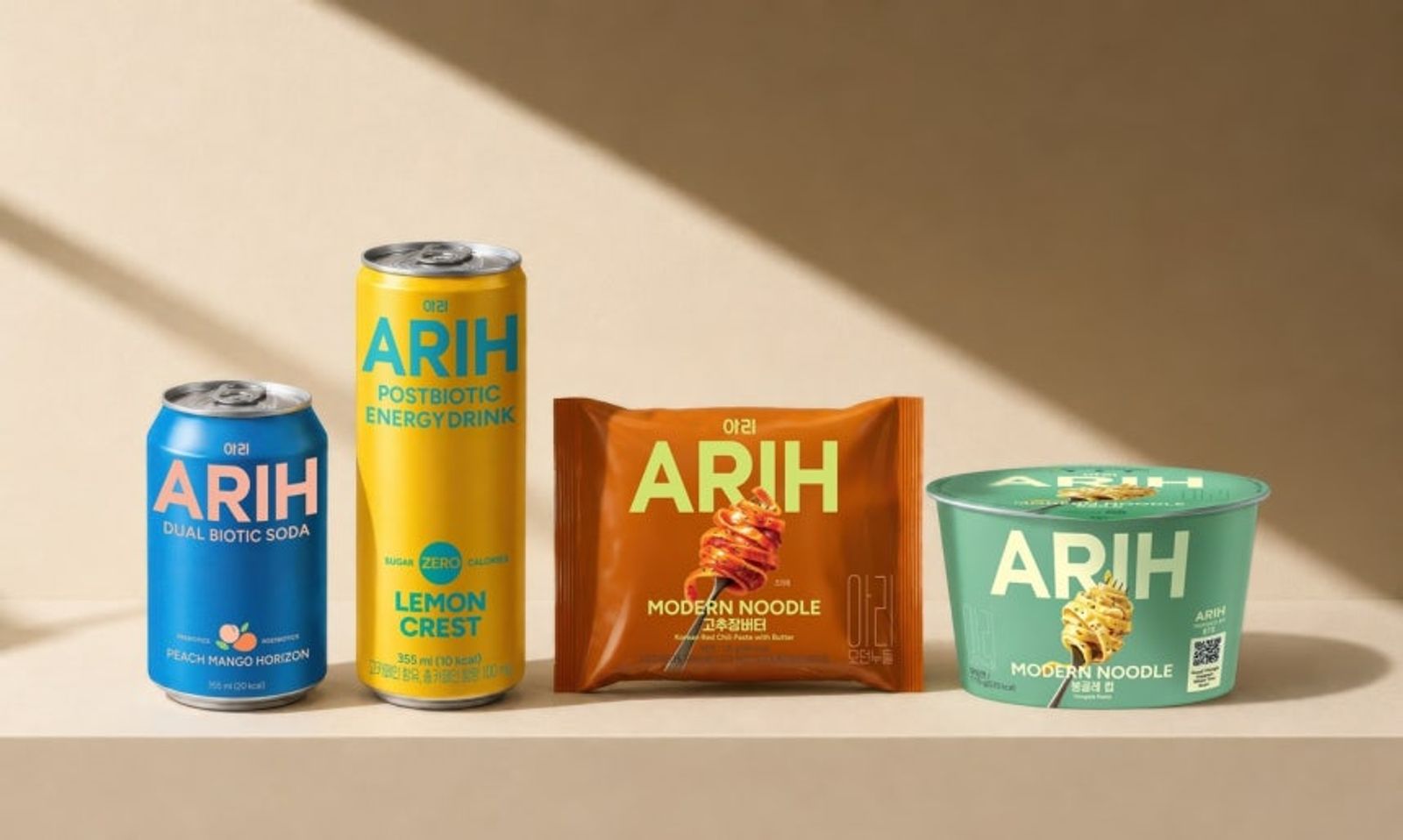
A food brand trading on the name of BTS, the South Korean pop group whose global fanbase rivals those of the world's biggest sports franchises, has simultaneously entered the Japanese and Canadian markets. Ari, as the brand is known, is the latest chapter in the story of K-pop intellectual property pushing into the food and beverage industry — and the most ambitious yet.
Fandom as a consumer base
Ari operates through a subsidiary or licensing structure under HYBE, the entertainment conglomerate that manages BTS. After building recognition across Asian markets, the brand has now chosen Japan and Canada as its first major international beachheads. Neither choice is accidental. Japan is home to one of BTS's largest and most free-spending fan communities — known collectively as ARMY — and represents a mature market in which Korean cultural exports have already permeated food, beauty, and fashion. Canada, meanwhile, serves as a regulatory testing ground for North America: its rules are more flexible than those of the United States, and cities such as Vancouver and Toronto, with their large Asian-diaspora populations, function as hubs for Korean cultural consumption. The working theory in the industry is that a proven Canadian model becomes the springboard for a full American push.
Researchers who study what has become known as the "fandom economy" classify the pairing of K-pop artists with food and beverage brands as a textbook case of "attachment consumption" — the phenomenon whereby fans express emotional bonds through purchases. Repeat buying rates and brand loyalty in this category run markedly higher than in conventional food marketing. According to analysis by the Korea Creative Content Agency, the consumer-goods market linked to K-pop has grown at an average annual rate of more than 18% over the past five years.
Not the first venture, but a different kind
BTS members have long appeared in advertisements for drinks and food products, and limited-edition collaborations bearing individual members' likenesses are a familiar commercial format. What distinguishes Ari is its structure: it is an independent brand rather than a sponsored campaign or a one-off tie-in. This reflects a broader strategic shift among K-pop agencies, which are seeking to reduce their dependence on music revenues by building IP-based businesses that generate income of their own.
The precedents from China are instructive — though not entirely reassuring. Products endorsed by Chinese celebrities such as Wang Yibo and Xiao Zhan have sold hundreds of thousands of units on launch day. Yet these frenzies produced a disturbing side effect: fans bulk-buying beverages only to discard them unopened, a practice that drew sharp public criticism and prompted regulatory intervention. Whether Ari can cultivate a healthier, more sustainable model of fan-driven consumption will depend heavily on how it is managed.
Structural risks
The risks are real and several. The most obvious is the brand's dependence on the artists themselves. When a brand's identity is inseparable from a particular celebrity, any disruption to that celebrity's career — whether through scandal, absence, or simply fading relevance — can prove fatal to the product. BTS members began their mandatory South Korean military service on a staggered schedule from 2022, and the group is not expected to resume full activities until around 2026. Sustaining brand momentum through that hiatus is a non-trivial challenge.
The food and beverage industry also demands capabilities that are entirely different from those required to sell concert tickets or branded merchandise. Japan enforces some of the world's most rigorous food hygiene and labelling standards. Canada's Food Inspection Agency is known for a demanding certification process. A passionate fanbase generates demand; it does not, on its own, guarantee reliable supply chains or consistent quality control. Failures on either front could turn a brand advantage into a liability.
The harder question: beyond the fanbase
A professor of consumer studies at Seoul National University puts the central challenge plainly: "The reason BTS's food brand attracts such attention is that it represents an attempt to transform an idol's intellectual property from a one-time marketing tool into an independent business asset capable of generating its own revenue. Whether it succeeds will depend on how far beyond the existing fanbase the brand can reach." A business that sells only to committed fans is structurally vulnerable — its revenues will rise and fall with the size and enthusiasm of that fan community, rather than tracking broader market demand.
Euromonitor, the market-research firm, has projected that the fandom-linked food and beverage market across the Asia-Pacific region will grow at 15–20% annually from 2025 onwards. Ari's simultaneous entry into Japan and Canada reads as a calculated attempt to capture that growth early.
A test case for K-pop's next frontier
Ari's international expansion fits neatly within HYBE's broader ambition to reinvent itself as an entertainment technology company. The strategy is to extend the K-pop IP ecosystem from music and concerts into food, beauty, and lifestyle — transforming fans from listeners into consumption partners across every dimension of daily life.
If Ari establishes itself in overseas markets just as BTS resumes full group activities in 2026, the convergence could provide the industry with a compelling proof of concept for K-pop IP in the food sector. If, on the other hand, quality controversies or waning fan engagement undermine the venture, it will serve as a cautionary tale instead. Either way, the experiment of placing the BTS name on a dinner table — rather than a stage — will reveal just how far the boundaries between K-pop and consumer industry can be stretched.