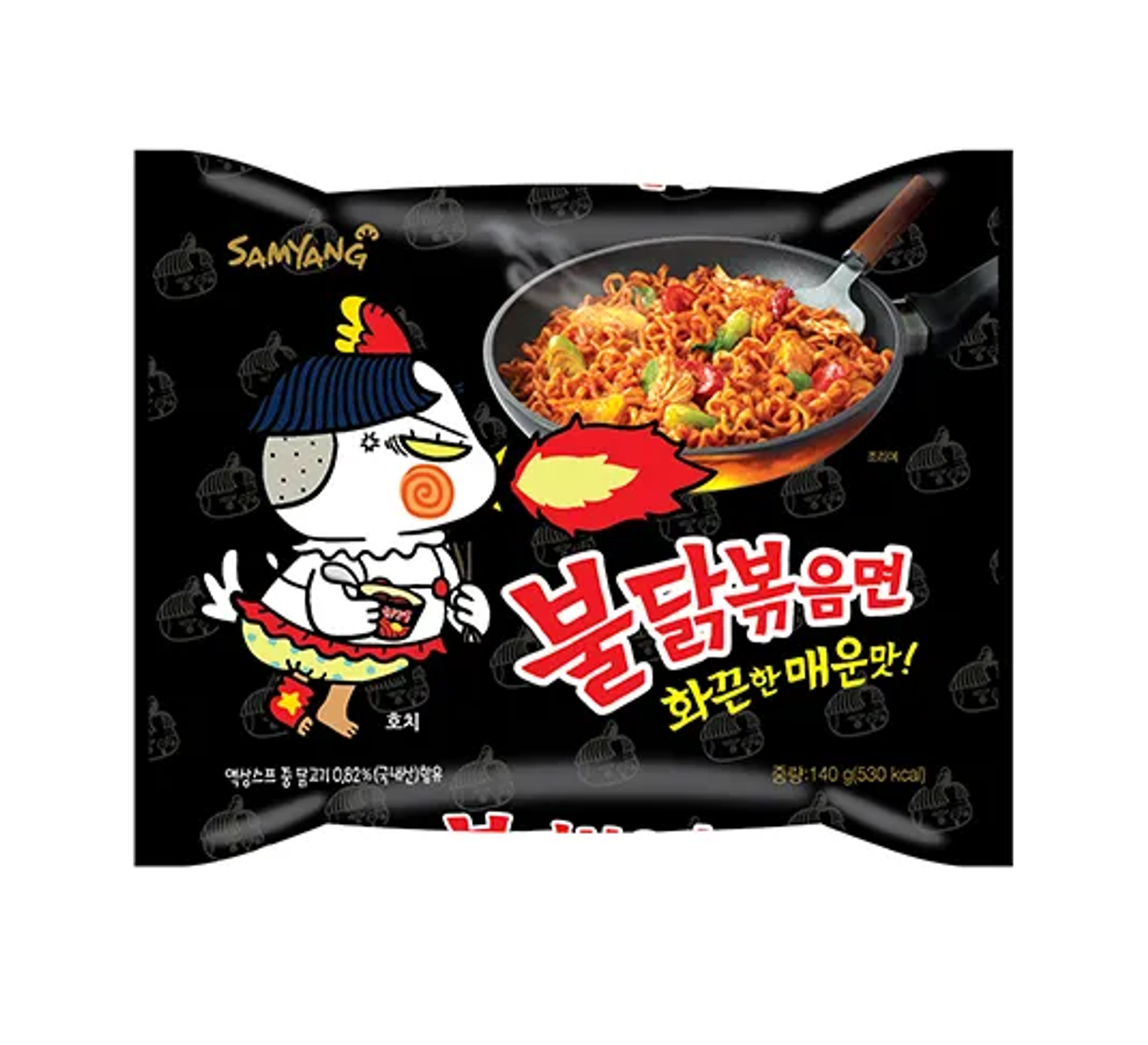
Samyang Foods has established a local subsidiary in Brazil, marking its first direct foray into Latin America. The company, which has driven a global appetite for spicy food through its Buldak ("Fire Chicken") instant noodle brand, has already conquered Asia, North America and Europe. Now it is turning to South America — and doing so on its own terms rather than through intermediaries. Industry observers read the move as a simultaneous bet on localisation and logistics efficiency, not merely an extension of existing export flows.
Why Brazil, Why Now
Brazil is Latin America's largest economy and home to 210 million consumers. World Bank data show that the country's middle-income population has grown steadily since the 2010s, and among younger Koreans and consumers alike, demand for Korean cultural exports has surged. According to the Korean Cultural Centre in Brazil, the country hosts the largest K-pop and K-drama fanbase in all of Latin America — enthusiasm that has translated naturally into curiosity about Korean food.
Buldak noodles were already well known to Brazilian consumers before this expansion, largely through the "Fire Noodle Challenge" that spread across YouTube and TikTok. Searches for Korean instant noodles on Mercado Libre, Latin America's dominant e-commerce platform, reportedly tripled between 2022 and 2024. Demand, in other words, had already been validated; what Samyang lacked was a permanent structure through which to capture it systematically.
The Strategic Logic of Going Direct
Until now, Samyang's Latin American sales relied almost entirely on local import agents — an arrangement that kept upfront costs low but eroded both pricing power and brand control. Layered distribution margins pushed consumer prices higher than they needed to be, while the company's ability to execute promotions and marketing campaigns nimbly was limited by the distance between decision-makers and the market.
A wholly owned subsidiary eliminates those structural constraints. Through it, Samyang can negotiate directly with major retail chains — including Carrefour Brasil and Grupo Pão de Açúcar — and exercise real-time control over pricing and shelf presence. The Brazilian entity is also expected to serve as a regional distribution hub, supplying neighbouring markets such as Argentina, Chile and Colombia.
An industry executive noted that Brazil's membership of Mercosur — the South American trade bloc — lowers intra-regional trade barriers and makes it the natural gateway for a continental rollout. "The subsidiary is not targeting Brazil alone," he said. "It is a long-term strategic position covering all of Latin America."
Samyang's Global Trajectory
The company's overseas sales have grown sharply in recent years. International revenue surpassed 50% of total sales in 2019 and had exceeded 70% by 2023, underpinned by strong performance in China, the United States and South-East Asia. The American market offers the most instructive precedent: after establishing a US subsidiary in the late 2010s, Samyang secured listings at Costco, Walmart and Amazon, becoming one of the principal players in the American Korean-noodle category. A similar playbook is expected to unfold in Brazil.
Timing also matters competitively. While Nongshim — Samyang's larger domestic rival — has concentrated its international efforts on the United States, China and Japan, Latin America has remained relatively underpenetrated by Korean food companies. Other domestic peers such as Ottogi and Paldo have a negligible presence in the region. By moving first, Samyang has a chance to set the terms of the category before competition intensifies.
Structural Challenges
The outlook is not without complications. Brazil is notorious for its labyrinthine tax system and steep import duties. Effective tariff rates on processed foods can reach 20–35%, and on top of those, importers must navigate several overlapping levies: a federal excise tax (IPI), a municipal services tax (ISS) and a state-level value-added tax (ICMS). This cumulative burden is so well recognised that Brazilians have coined a term for it — "Custo Brasil" (the Brazil Cost) — and it has long deterred foreign businesses from establishing a serious local presence.
Currency risk adds another layer of uncertainty. The Brazilian real has historically been volatile against the dollar, making revenue forecasting difficult. During the Covid-19 pandemic in 2020, a sharp depreciation of the real hit the profitability of several foreign companies operating in the country.
Some analysts argue that Samyang's willingness to proceed despite these headwinds signals genuine conviction in the strength of local demand. Others caution that, as long as Samyang continues to import rather than manufacture locally, tariff costs will remain a persistent drag on margins.
K-Food Policy and the Bigger Picture
Samyang's move fits within a broader push to internationalise South Korean food exports. According to the Ministry of Agriculture, Food and Rural Affairs, South Korea's agricultural and food exports hit a record $9.3 billion in 2023, with processed goods — instant noodles, dried seaweed, and kimchi among them — accounting for a growing share. The government has set a target of surpassing $10 billion in food exports and has identified Latin America as a priority emerging market.
Experts suggest that the impact of direct investment by private companies can be amplified when combined with public-sector support. The Korea Trade-Investment Promotion Agency (KOTRA) operates a trade office in São Paulo that provides regulatory and distribution intelligence, while the Korea Agro-Fisheries & Food Trade Corporation (aT) runs K-food promotional events in the region. Together, these resources could provide meaningful practical support for Samyang's new subsidiary.
Taken in full, Samyang's decision to plant a flag in Brazil represents more than a single company's overseas expansion. It marks a symbolic inflection point — the moment K-food's ambitions shifted from the Asia-Pacific to the Americas. How well the burn of Buldak goes down in the land of samba will serve as an important test not just for Samyang, but for South Korea's food industry as a whole.