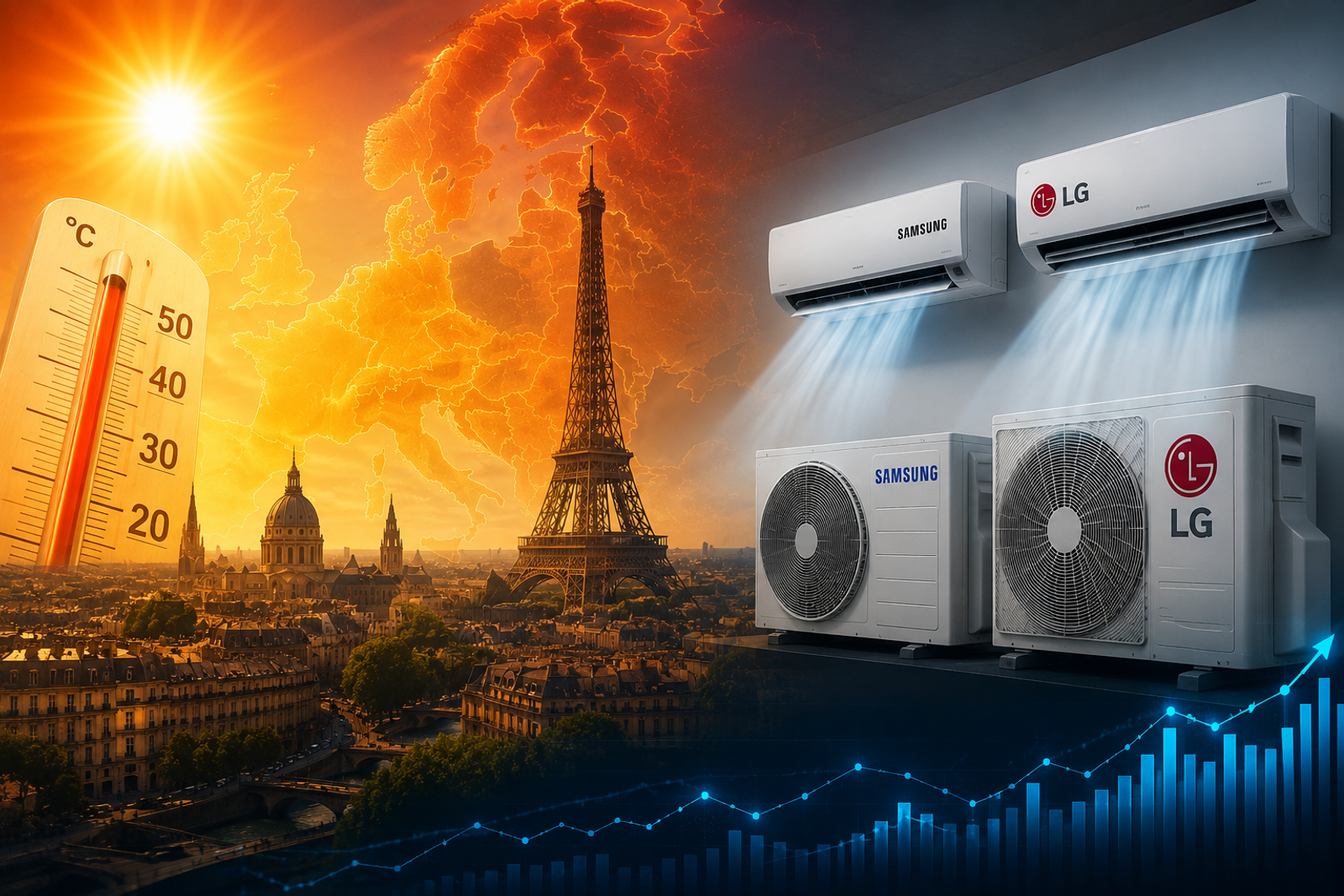
Europe has long been considered a barren landscape for air-conditioning manufacturers. That is changing fast. Repeated bouts of record-breaking summer heat are forcing consumers, builders, and policymakers alike to reconsider a technology that much of the continent once regarded as an American extravagance. For Samsung and LG, two of South Korea's largest conglomerates, the shift represents one of the more compelling growth opportunities in an otherwise mature global appliance market.
From anomaly to norm
The statistics tell a stark story. According to the European Environment Agency, average summer temperatures across the continent have risen by between 1.5 and 2 degrees Celsius above pre-industrial levels. The deadly French heatwave of 2003, which killed an estimated 15,000 people, was once treated as a once-in-a-generation catastrophe. It now looks like a harbinger. Western Europe sweltered again in 2019, and in 2022 Britain recorded temperatures above 40°C for the first time in history.
The International Energy Agency projects that the global stock of air-conditioning units will nearly triple to 5.6 billion by 2050, and it identifies Europe as one of the key growth markets driving that expansion. The reason is simple arithmetic: penetration rates remain extraordinarily low. While roughly 90% of American and Japanese households own an air conditioner, the figures in Europe are a fraction of that. Even in sun-scorched southern Europe — Spain, Italy, Greece — only 40–50% of homes have one. In France the rate is around 25%. In Germany, Britain, and Scandinavia, it falls to between 5% and 15%. That gap represents a vast latent market.
A structural tailwind for Samsung and LG
Both companies are well positioned to capture a share of that demand. Samsung and LG already enjoy strong brand recognition across European consumer-electronics markets, giving them a foundation that newer entrants lack. LG has spent years cultivating the premium end of the European market with inverter-driven residential units and commercial air-conditioning systems. Samsung has made inroads with its Wind-Free series, which circulates cool air without directing a draught at occupants — a feature that has resonated with European sensibilities.
The market data are encouraging. According to Euromonitor International, the European cooling-equipment market has grown at an annual rate of 6–8% since 2022, and that momentum is expected to continue. During peak heatwave periods, sales of air conditioners through Europe's largest appliance retailers have repeatedly surged 30–50% year-on-year.
Stiff competition
Market growth, however, does not automatically translate into a Korean clean sweep. Japan's Daikin is the dominant force in European air conditioning, with an extensive manufacturing and service network on the continent that has earned it an almost-European reputation among consumers. Mitsubishi Electric and Panasonic are also entrenched. Meanwhile, Chinese manufacturers — chiefly Midea and Gree — are pressing hard at the lower end of the market, intensifying price competition.
Regulatory complexity adds another layer of difficulty. The European Union's Ecodesign Regulation sets progressively tighter energy-efficiency standards for cooling equipment, and revisions to the F-Gas Regulation will impose stricter controls on refrigerants used in air conditioners by 2030. For technologically sophisticated manufacturers, tougher standards can function as a barrier that keeps cheaper, less efficient rivals out. But compliance also requires costly and disruptive product-line overhauls.
Hidden obstacles: buildings and culture
Beyond competition and regulation, the physical fabric of European cities poses practical challenges. A large proportion of residential buildings in north-western Europe — Britain, Germany, France — were designed and constructed long before air conditioning was considered necessary. Installing an outdoor compressor unit frequently involves navigating cramped spaces, intrusive pipework, and, in many historic city centres, strict planning rules that restrict modifications to building façades.
Cultural resistance, though fading, has not entirely disappeared. A segment of European consumers still associates air conditioning with profligate energy use and environmental harm, preferring heat pumps, passive ventilation, or simply open windows. Experts note, however, that successive heatwaves are eroding these attitudes with notable speed.
The heat-pump connection
Perhaps the most important strategic dimension of the European opportunity lies in the convergence of air conditioning with heat pumps. Technically, the two are closely related: a heat pump can cool a building in summer and heat it in winter, making it an all-seasons alternative to both air conditioners and gas boilers. Since Russia's invasion of Ukraine accelerated Europe's drive to reduce dependence on natural gas, the EU has actively promoted heat-pump adoption as a pillar of its energy-security and climate strategy.
LG has moved early, offering residential and commercial heat-pump products across European markets and positioning itself as a supplier of integrated heating and cooling solutions. Samsung has entered the segment under its EHS (Samsung EHS) brand. In effect, the EU's net-zero policies are collapsing the air-conditioning and heat-pump markets into a single growth story — one that rewards manufacturers capable of supplying both.
Opportunity is clear; execution is everything
The structural case for Europe as a growth market for Samsung and LG is compelling. Temperatures are rising, penetration rates are low, and policy is pushing consumers towards electrified heating and cooling. But translating that opportunity into durable profits will require the two companies to tackle several challenges simultaneously: deepening local distribution networks, expanding after-sales service infrastructure, keeping pace with tightening EU efficiency standards, and building competitive heat-pump product ranges.
There is an uncomfortable irony in the fact that the climate crisis is becoming a growth engine for the cooling industry. Whether South Korea's two appliance giants can reshape the European market to their advantage will ultimately depend on the quality of their technology investment and localisation strategies over the next five to ten years.