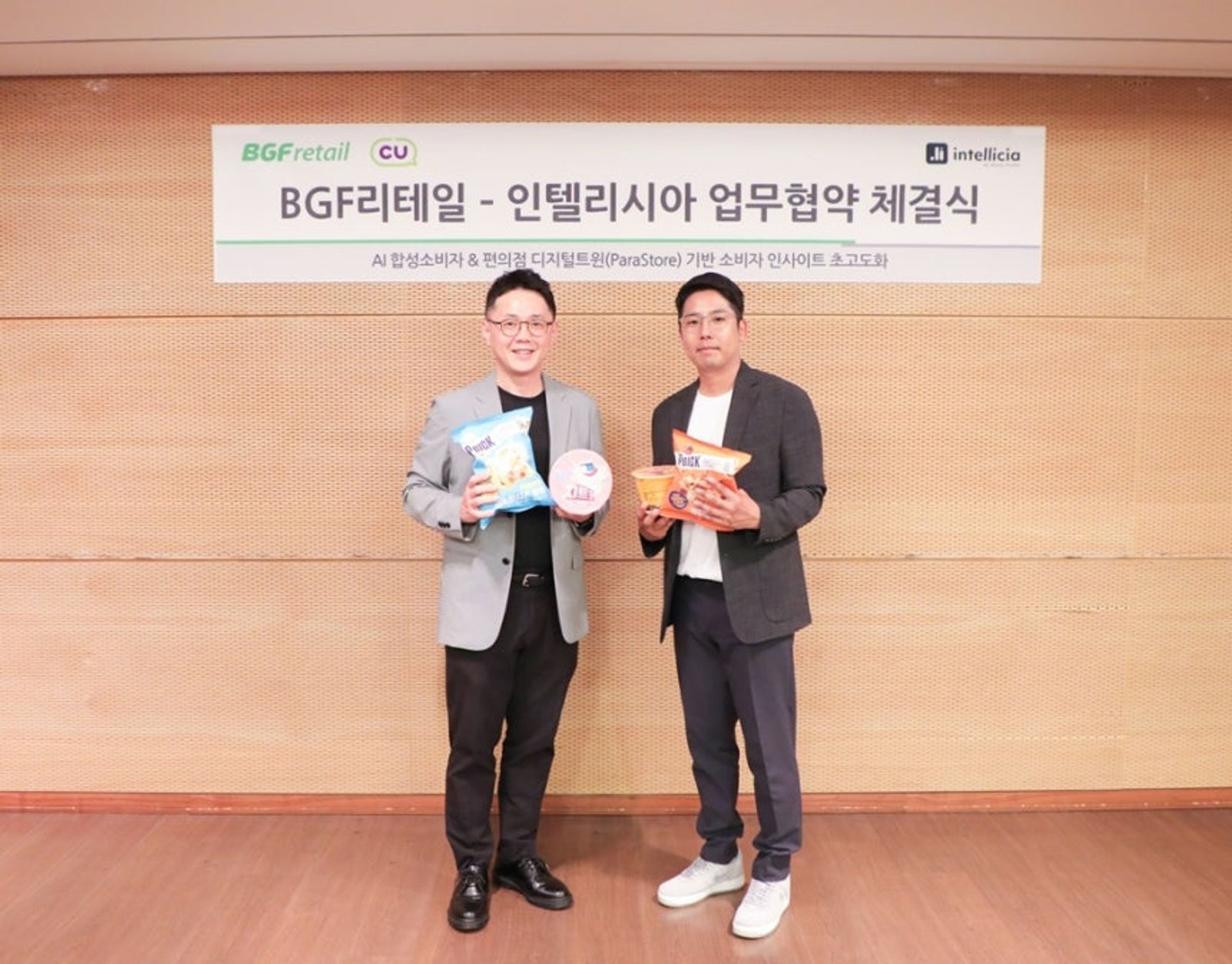
BGF Retail, operator of South Korea's CU convenience-store chain, has signed a memorandum of understanding with Intellicia, an artificial-intelligence start-up, to adopt what the two companies call "AI synthetic consumer" technology. It is the first time a Korean convenience-store operator has moved to deploy AI-generated virtual consumer modelling at scale — and it signals a fundamental shift in how the retail industry intends to use data.
What is a synthetic consumer?
A synthetic consumer is an AI-generated persona trained on real shoppers' purchasing patterns, demographic profiles, and lifestyle data. The virtual persona does not correspond to any actual individual, but is designed to be statistically representative of a broader consumer segment. Gartner, the research firm, forecast in a 2025 report that by 2027 more than 30% of corporate consumer research will rely on synthetic data.
Intellicia combines large language models (LLMs) with behavioural data to simulate the purchase decision-making of specific consumer groups. BGF Retail plans to use the technology to predict market responses before launching new products, pre-validate promotional campaigns, and optimise the product mix for individual store locations.
Why now? The structural pressures on South Korean convenience stores
South Korea's convenience-store market is close to saturation. According to the Ministry of Trade, Industry and Energy, the number of convenience stores in the country exceeded 56,000 in 2024, and competition for market share among the leading brands — CU, GS25 and 7-Eleven — has been fierce for years. In this environment, the decisive battlegrounds have narrowed to product-development capability and the ability to exploit customer data.
BGF Retail launches thousands of new products every year. Yet the industry's open secret is that only 20–30% of new products succeed. Given the time and cost of traditional market research, and the limitations of consumer panels, synthetic consumer technology is emerging as a promising way to relieve that bottleneck.
Private-label (PB) products are one area where the stakes are particularly high. BGF Retail's own-brand lines reportedly accounted for around 35% of its total sales in 2023, meaning that better product planning translates directly into improved margins. Analysts argue that if synthetic consumer technology is integrated into the private-label development cycle, the cost of failures at the planning stage could be dramatically reduced.
What global retailers have already done
The technology is already producing measurable results in retail elsewhere. Walmart said it cut inventory losses by more than 15% after incorporating synthetic-data-based consumer behaviour models into its logistics and stock management from 2023. Britain's Tesco used virtual consumer simulations to cut the time needed to design new store layouts by 40%.
Japan's convenience-store industry offers perhaps the most instructive precedent. Seven-Eleven Japan, the world's largest convenience-store chain by outlet count, partnered with NEC to deploy an AI-powered demand-forecasting system that reduced waste losses by tens of billions of yen a year. Against the backdrop of Japanese retail models being adopted in South Korea, BGF Retail's move is being interpreted as a pre-emptive strike.
Privacy and ethics: a contested territory
One of the central selling points of synthetic consumer technology is that it models consumer behaviour without using real personal data. As data-protection regulation tightens, this is attracting attention as a way to reduce legal risk whilst broadening the scope of data analysis.
Critics are not persuaded. AI ethics researchers warn that synthetic data can faithfully reproduce — or even amplify — the biases embedded in the real-world data used to train it. A synthetic consumer trained on a dataset that under-represents certain age groups or income brackets risks distorting the purchasing behaviour of those groups, which could in turn narrow the diversity of products developed and marginalise certain consumers.
Data specialists are blunt about the implications: "The quality of synthetic data is directly tied to the quality of the source data," one noted. "Whether BGF Retail's membership and purchase-history data can be deployed with sufficient precision as training material will determine whether this technology succeeds or fails."
AI adoption accelerates across retail
BGF Retail's MOU is the most visible sign yet of a broader AI transformation sweeping South Korean retail. Lotte Shopping is already rolling out AI-powered personalised recommendation systems across all its channels; Shinsegae Group is investing hundreds of billions of won in AI-driven logistics optimisation; and GS Retail is accelerating its own AI demand-forecasting rollout. The AI race among the three dominant convenience-store operators has already begun.
According to IDC, the market research firm, South Korean retailers' AI-related IT spending is expected to exceed 1.2 trillion won (roughly $880m) in 2025 and grow at an average annual rate of 22% through to 2028. AI has ceased to be a strategic option for retailers and has become a condition of survival.
What happens next matters more than the announcement
The MOU is only a starting point. Experts are unanimous that the real test for BGF Retail is how deeply it embeds synthetic consumer technology into its actual product-planning and marketing decision-making processes. The technology itself matters less than the accompanying investments in data literacy across the organisation, the integration of algorithmic insights with on-the-ground retail experience, and the establishment of clear ethical guidelines.
Regulatory clarity is also needed. South Korea's rules governing the use of synthetic data in marketing and consumer analysis remain underdeveloped. Without updated guidelines from the Personal Information Protection Commission and the Fair Trade Commission, companies' ability to exploit the technology may be hamstrung by legal uncertainty.
The convenience-store industry is stepping onto unfamiliar terrain. Whether AI synthetic consumers prove to be little more than a cost-cutting tool, or whether they open the door to a more sophisticated and personalised retail ecosystem for businesses and shoppers alike, is a question that only years of real-world evidence will answer.