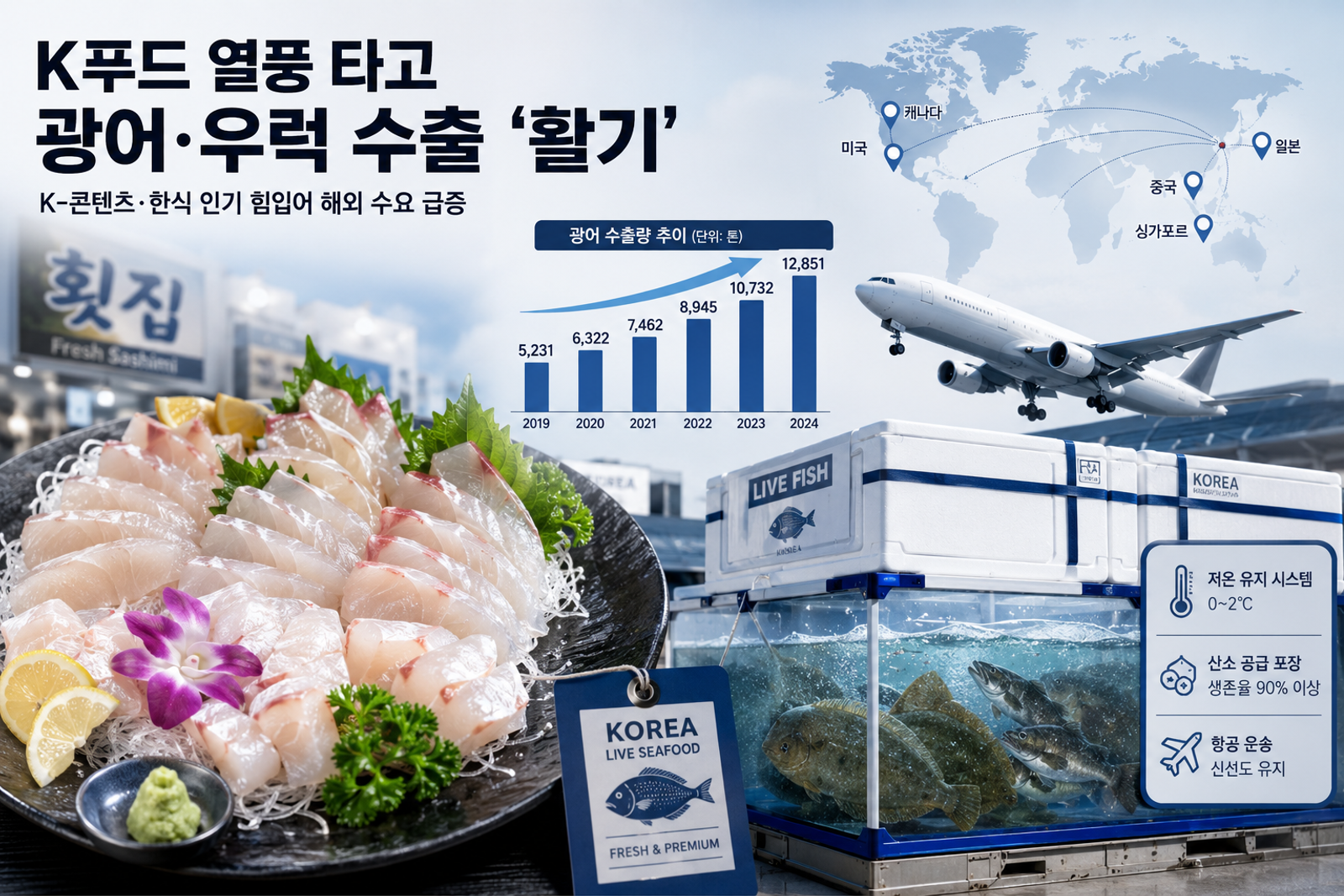
Oliver and black rockfish — once thought of purely as staples of Korean sashimi restaurants — are finding an unexpected export lifeline on the back of the global K-food phenomenon. As overseas consumers, primed by Korean dramas and social-media food content, grow curious about Korean raw-fish culture, exports of farmed seafood are rising briskly.
The numbers tell the story
Data from South Korea's Ministry of Oceans and Fisheries and the Korea Maritime Institute (KMI) show that exports of olive flounder (known domestically as *gwangeo*) have grown steadily over recent years. Japan, the United States and China are the primary markets, but what is particularly striking is that demand is spreading beyond Korean diaspora communities in North America to mainstream local consumers. Black rockfish (*uреок*), meanwhile, is carving out a niche as a premium live-fish product in Chinese-speaking markets across Hong Kong and Singapore.
South Korea is a world leader in olive flounder aquaculture. Annual farmed production exceeds 40,000 tonnes, supported by well-developed aquaculture infrastructure centred on Jeju Island and the southern coast. Export prices of around $10 per kilogram generate considerably higher value than ordinary frozen seafood.
K-dramas and mukbang videos create demand for raw fish
Experts point to the Korean content boom as the principal driver of export growth. As Korean dramas and variety shows spread through global platforms such as Netflix, scenes of bustling sashimi restaurants — and the quintessential pairing of raw fish with soju — have piqued the curiosity of viewers abroad. YouTube food channels featuring videos of olive flounder being prepared for sashimi have racked up millions of views in the same vein.
A researcher at KMI's Fisheries Outlook Centre noted that "the globalisation of Korean food, which began with kimchi, instant noodles and pork belly, is now extending into seafood." Live and ultra-fresh premium fish, unlike processed foods, can command substantial margins, making export growth directly relevant to the incomes of fish farmers, the researcher added.
Cold-chain logistics and freshness are the critical challenges
Maintaining freshness is the greatest obstacle to live-fish exports. Olive flounder and rockfish fetch their highest prices when shipped alive or in an ultra-fresh chilled state, but air-freight costs and survival-rate management determine whether exports are actually profitable. Korean seafood logistics firms have developed oxygenated packaging and low-temperature recirculating-water technology to push survival rates above 90%, yet rising air-freight tariffs remain a persistent burden.
Japan's experience offers a useful precedent. In the 1980s and 1990s, Japanese exporters branded sea bream and yellowtail using the *ikejime* (live-kill) technique and successfully penetrated the premium restaurant markets of Hong Kong and Singapore. South Korea is now debating an analogous strategy, positioning its own live-fish handling methods as a point of differentiation.
High hopes, structural hurdles
Expectations among fish farmers are high. Jeju olive flounder producers, long battered by domestic price volatility — farmgate prices can fall to around 7,000–8,000 won per kilogram during periods of oversupply — see export diversification as a route to more stable revenues.
Yet structural obstacles are real. Tightened phytosanitary rules in importing countries, compliance with antibiotic-residue standards, and the acquisition of international sustainability certifications such as the Aquaculture Stewardship Council (ASC) label all present significant market-access barriers. Requirements imposed by the US Food and Drug Administration and EU import regulations demand levels of documentation and management systems that individual small-scale fish farms struggle to meet on their own.
Industry experts broadly agree that "individual farm-level exports have inherent limits, and a collective strategy — through export-specialist co-operatives or shared brands — is essential." Jeju provincial authorities are already pursuing overseas marketing linked to a geographical indication for "Jeju olive flounder," while the central government is expanding export voucher support schemes.
Korea's place in the global seafood market
The global seafood trade is worth more than $150 billion annually and continues to grow. Within that, the premium live- and fresh-fish segment is expanding rapidly alongside a growing Asian middle class. Competitor nations — Norway and Chile with salmon, Japan with yellowtail and sea bream — have already achieved considerable success exporting high-value species. South Korea is now entering this market in earnest, with olive flounder and rockfish leading the charge.
The Ministry of Oceans and Fisheries has set a target of $3 billion in seafood exports by 2027. Investment in cold-chain infrastructure, partnerships with Korean restaurants abroad, and support for participation in international seafood trade fairs are among the priorities identified to increase the share of farmed fish in that total.
The transition from exporting kimchi and instant noodles to shipping live fish marks a potential turning point for a Korean seafood industry seeking to reduce its reliance on the home market. But experts are united in their warning: if the momentum is to prove durable rather than a fleeting trend, it must be underpinned by simultaneous advances on three fronts — quality standardisation, brand-building, and logistics sophistication.