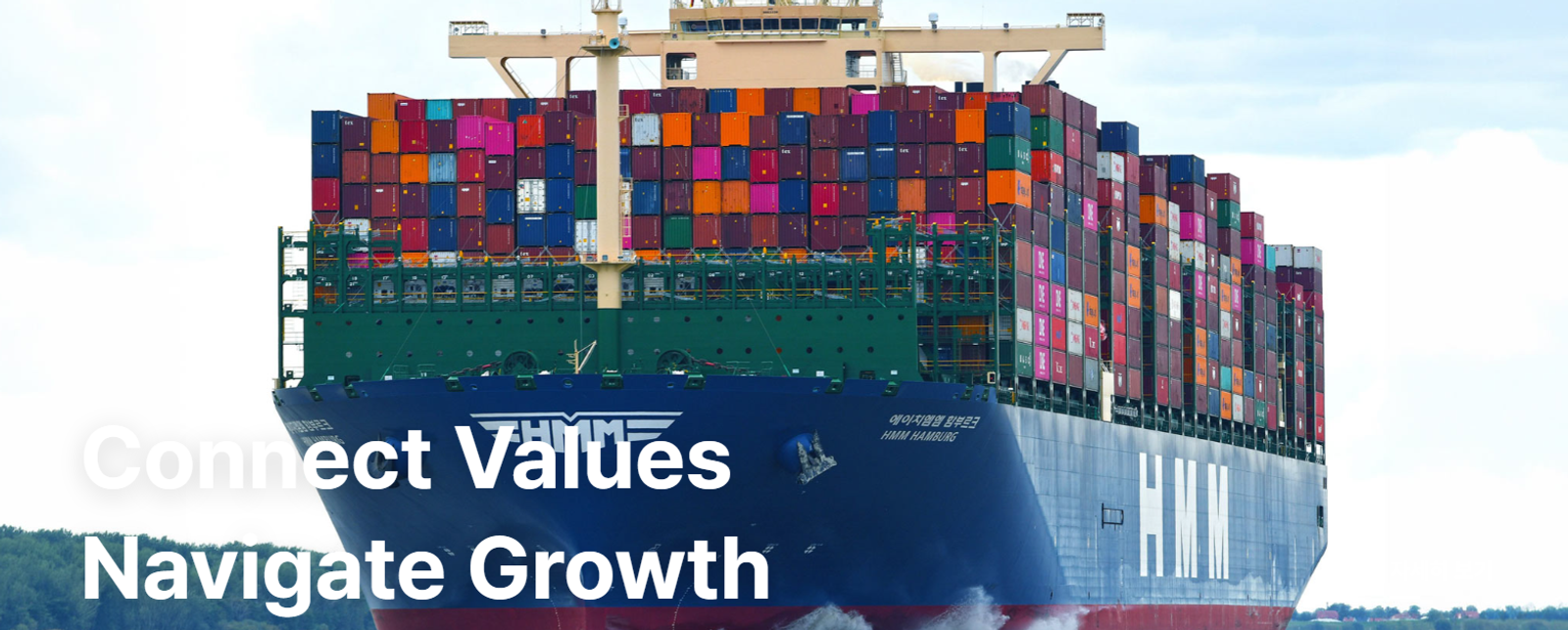
Daeshin Securities upgraded HMM (KOSPI: 011200) to "buy" on the 26th and raised its six-month target price from 23,000 won to 29,000 won, citing expectations that geopolitical supply bottlenecks stemming from Middle East tensions will keep ocean freight rates elevated for longer than previously assumed.
Second-quarter results
HMM reported second-quarter 2026 revenue of 3.402 trillion won and operating profit of 354.1 billion won. Revenue rose 29.7% year on year and 25.1% quarter on quarter. Operating profit climbed 51.9% compared with the same period a year earlier, though it came in slightly below market consensus. The shortfall reflected higher cargo-handling costs as volumes expanded, and a lag of roughly two months before rising oil prices fed through into fuel expenses.
Third-quarter outlook
Daeshin projects third-quarter operating profit of 696 billion won — up 96.5% quarter on quarter and 134.5% year on year. The brokerage expects freight rates locked in during the second quarter to carry over into third-quarter revenues, compounded by strong seasonal demand on trans-Pacific routes ahead of the American peak shopping period.
Valuation
The new 29,000 won target is derived by applying a price-to-book ratio (PBR) of 1.0 times to a 12-month forward book value per share of 29,238 won. At HMM's closing price of 22,850 won on the 24th, the stock trades at 0.8 times book — a meaningful re-rating from the 0.5 times PBR recorded for full-year 2024, suggesting the market is gradually ascribing more value to the company.
Why freight rates have not risen as fast as the headline index
Daeshin attributed the fact that HMM's average achieved rates lagged the rise in the Shanghai Containerised Freight Index (SCFI) to relative softness on trans-Pacific routes and a shift in the company's service mix. The SCFI tracks near-term spot rates on sailings from the Far East and does not instantaneously reflect the long-term contract rates and voyage-completion schedules that determine a carrier's actual revenues. As a result, some of the benefit from rising rates has spilled over into the third quarter.
Structural supply constraints
Despite a growing wave of newbuild vessel deliveries, effective capacity in the market remains tight. Daeshin estimates that rerouting around the Suez Canal — ships diverting via the Cape of Good Hope — is absorbing roughly 6–8% of global supply, while risk in the Strait of Hormuz accounts for a further 1%. Middle East-related disruptions alone are thus constraining available capacity by as much as 9%. Port congestion adds an estimated 5.3% additional supply reduction on a three-year average basis. The combination explains why freight rates have held up despite nominal fleet overcapacity on paper.
Diverging fortunes by trade lane
The two main trade lanes are moving in opposite directions in the second half of the year. On trans-Pacific routes, demand for consumer goods ahead of the back-to-school season and the year-end holiday period is expected to remain solid through August. On Europe routes, however, rates are likely to soften: shippers had front-loaded cargo earlier in the year to get ahead of potential tariffs, and that pull-forward demand has now been absorbed.
Earnings estimates revised sharply higher
Daeshin raised its full-year 2026 operating profit estimate by 63.3%, from 1.138 trillion won to 1.858 trillion won, and lifted its 2027 estimate by 40.3%, from 969 billion won to 1.36 trillion won. Revenue projections stand at 12.831 trillion won for 2026 and 11.64 trillion won for 2027.
Bulk shipping emerges as a surprise contributor
Within HMM's business mix, the bulk segment stands out. While the container division is projected to generate 2026 operating profit of 1.388 trillion won, the bulk division is expected to contribute 464.5 billion won — more than three times its 2025 level of 143 billion won. The forecast assumes the Baltic Dry Index (BDI) averages 2,570 points in 2026, up 53.1% from 1,679 points in 2025.
Shareholder returns remain modest
Investors should temper expectations on capital returns. HMM plans to pay a dividend of 700 won per share for 2026, implying a payout ratio of 35%. The company's stated policy through 2030 is to return whichever is lower: a 30% payout ratio or a 5% dividend yield on the current share price. No immediate share buyback or cancellation programme has been announced.
Risks to the bullish case
This report reflects the optimistic view of a single brokerage and should be read with that caveat in mind. Were Middle East tensions to ease faster than expected, vessels rerouted via the Cape could return to the Suez Canal, releasing a significant slug of supply back into the market. The large pipeline of newbuilds due for delivery in 2026–27 remains a structural overhang. HMM's ownership structure is also a persistent source of discount: Korea Development Bank holds a 35.42% stake and the Korea Ocean Business Corporation 35.08%, meaning two state-owned institutions control more than 70% of the company — a concentration that investors continue to factor into valuations. The current share price of 22,850 won sits roughly 6.7% below the 52-week high of 24,500 won.