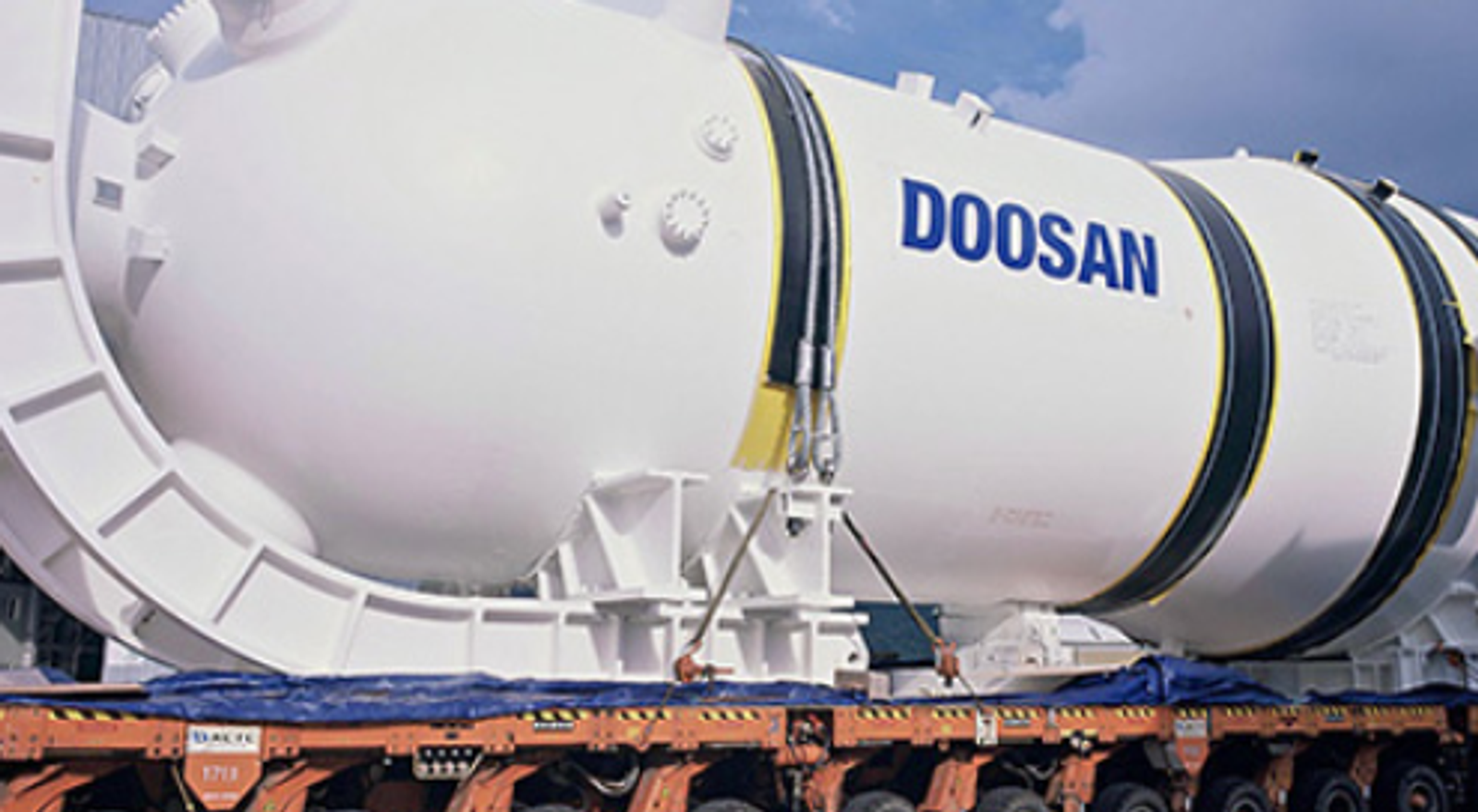
South Korea and the United States are reported to have reached a broad agreement on nuclear energy co-operation, including the construction of eight large-scale reactors on American soil. Against that backdrop, Kiwoom Securities on September 8th maintained its overweight stance on South Korea's utilities sector and named Doosan Enerbility as its top pick.
According to Kiwoom analyst Cho Jae-won, details of investment discussions between the two governments were leaked to the press following a closed-door ruling-party policy meeting on September 7th. The first Korean investment project in the United States is likely to be a gas-fired combined-cycle power station, with total project costs set at $22 billion (approximately 30 trillion won).
Rather than building the full 6.3 gigawatts at once, the gas plant will be developed in phases. The first stage involves constructing a 1.3GW gas-fired facility, with combined-cycle capacity added in 1GW increments thereafter. The phased structure reflects the Korean government's cautious approach: validate profitability before committing to further capital.
The eight large nuclear reactors are expected to follow as the second wave of Korean investment in the United States. While a framework agreement has reportedly been reached, the specific sites, reactor design, financing structure and total investment amount remain to be negotiated.
The choice of reactor design is the pivotal variable that will determine which South Korean companies benefit most. Kiwoom's analysis sets out two scenarios. If Westinghouse's AP1000 design is selected, Doosan Enerbility would expect to supply reactor pressure vessels and steam generators, generating orders of roughly 400 billion to 500 billion won per unit. If South Korea's own APR1400 design is chosen instead, Doosan could supply the full suite of primary equipment plus turbines and generators, worth an estimated 2.5 trillion to 3 trillion won per unit — as much as six times more. The reactor selection will therefore have a direct and material impact on the revenues of South Korean nuclear companies.
Korea Hydro & Nuclear Power's engineering arm, KEPCO Engineering & Construction (also known as KEPCO E&C or 한전기술), faces a more uneven outcome. Should the AP1000 be adopted, its prospects for securing an overall design contract are uncertain, limiting its upside. Under an APR1400 scenario, however, it could win both the overall plant design and the nuclear island design, translating into 600 billion to 800 billion won per unit. Kiwoom noted that the market has yet to price in any US expansion benefit for KEPCO E&C, leaving meaningful upside potential — but given the uncertainty around an AP1000 outcome, the broker recommended trimming positions into any sharp near-term share-price rally.
South Korean nuclear stocks had already shown relative strength earlier this year. Between January and April, shares in Doosan Enerbility and KEPCO E&C held up well even as North American peers such as Cameco and BWX Technologies (BWXT) traded sideways or retreated. Since May, however, both Korean names have pulled back from their peaks. The question now is whether the latest news on US-Korea nuclear co-operation can reignite the rally.
Kiwoom is cautious on that front. The brokerage does not believe the current disclosures alone are sufficient to drive shares back to their previous highs. The timing of construction starts and the pace of investment remain uncertain, and the critical variable of reactor design has yet to be resolved. The Korean government's insistence on a staged, profitability-first approach further tempers expectations for a swift re-rating.
Beyond the American opportunity, South Korea's nuclear export pipeline — what the industry calls "Team Korea" — spans several other markets. The country holds preferred-bidder status for units 3 and 4 at the Temelin plant in the Czech Republic, with exclusivity running until 2030. Vietnam's Ninh Thuan 2 project (two units) is advancing at an estimated value of 15 trillion to 18 trillion won. The UAE's Barakah units 5 through 8 are expected to go to tender in 2027–28, and South Korea is competing against Russia's Rosatom for the four-unit Sinop project in Turkey. Domestically, the government's forthcoming 12th Basic Plan for Electricity Supply and Demand is also expected to include provisions for additional reactor construction.
For investors seeking exposure with less binary risk, Kiwoom offered Korea Electric Power Corporation (KEPCO) — the state-owned utility — as an alternative. The brokerage acknowledged that KEPCO's return on equity is heavily sensitive to global oil prices, creating structural earnings volatility. Nevertheless, with the stock trading close to its historical price-to-book lows, the valuation case is increasingly compelling, and the scope for further earnings downgrades appears limited.
In an optimal scenario — eight reactors built to the APR1400 design — Doosan Enerbility alone could theoretically secure up to 24 trillion won in orders. That figure, however, represents the most favourable possible outcome. Until the reactor design is confirmed, construction timelines are set, and the framework for sharing investment between the two governments is agreed, the true scale of the opportunity cannot be determined. For investors, the pragmatic approach is to monitor each stage of negotiations before adding exposure.