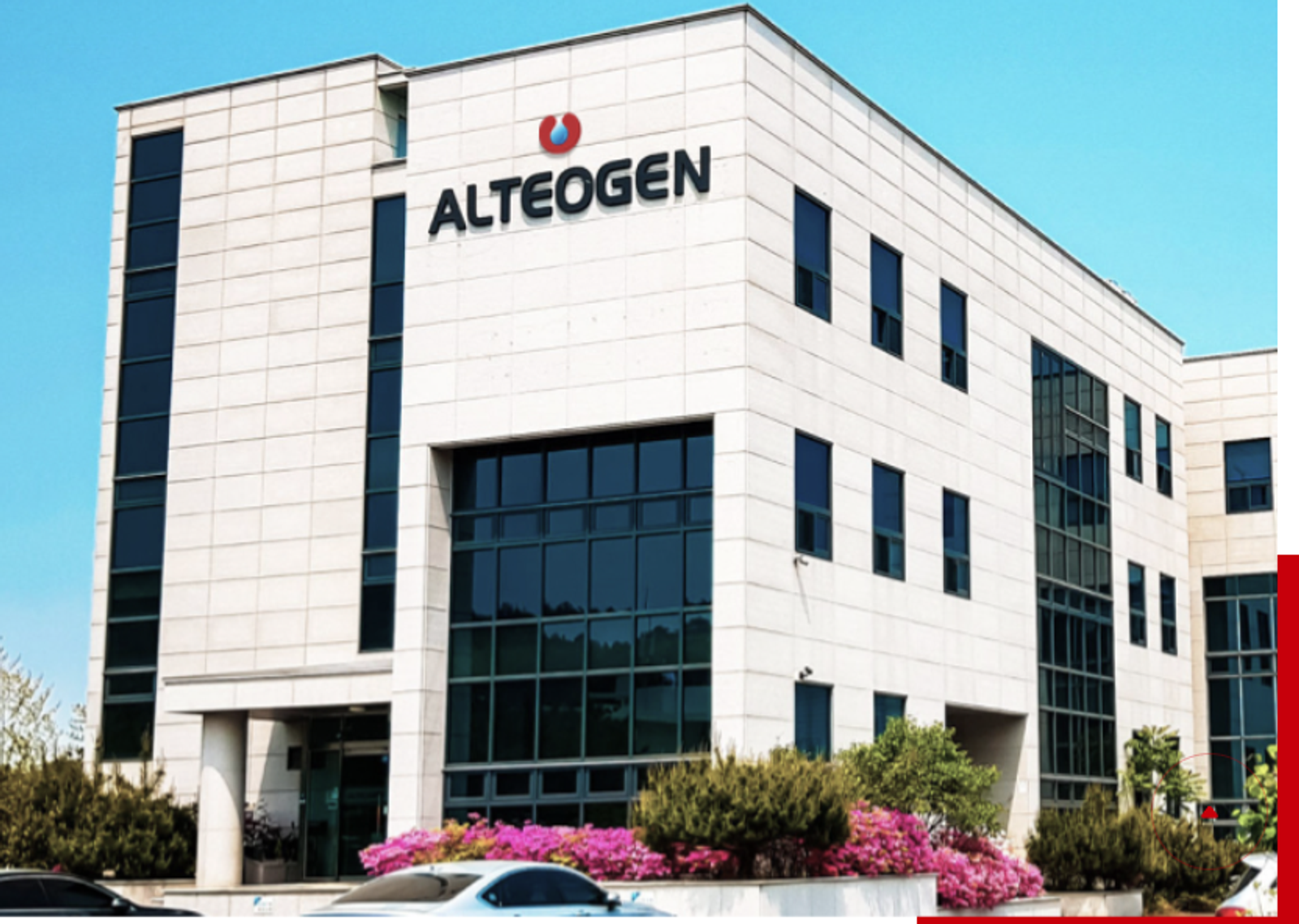
Daishin Securities on the 3rd maintained its "buy" rating on Alteogen (KOSDAQ: 196170) while raising its six-month target price by 9.8%, from 410,000 won to 450,000 won. Based on the closing price of 298,500 won on September 2nd, the implied upside stands at 50.8%.
The immediate catalyst for the upgrade was a subcutaneous (SC) formulation technology-licensing agreement that Alteogen signed with Novartis on September 2nd. Structured as an option deal, the contract allows Novartis to develop and commercialise multiple biopharmaceuticals in SC form using Alteogen's ALT-B4 platform. Should all options be exercised and every milestone met, Alteogen stands to receive up to $3.223bn (approximately 4.3trn won), with sales royalties payable on top of that.
Daishin revised its discounted cash flow (DCF)-based equity valuation upwards from 28.5trn won to 31.4trn won. The broker cautioned, however, that because specific targets and their number have not been disclosed, it applied conservative assumptions regarding the commercial value of each target and the probability of option exercise.
The Novartis deal is Alteogen's fourth ALT-B4 licensing transaction of the year. Earlier agreements included a deal with GSK in January 2026 (Jemperli; total contract value $285m), one with Biogen in March (Felzartamab and one other asset; $579m), and a further deal on August 5th with an undisclosed pharmaceutical company ($365m). Since Alteogen's inaugural licensing contract with Sanofi in 2019, the company has now completed ten technology-export deals in total.
ALT-B4 is a recombinant hyaluronidase-based platform that converts existing intravenous (IV) drugs into subcutaneous formulations, improving both patient convenience and cost efficiency. Initially, deals centred on monoclonal antibodies (mAbs), but the platform's applicability has since expanded to antibody-drug conjugates (ADCs) and nucleic acid therapies (RNA-based treatments). Novartis is understood to have evaluated ALT-B4's potential across multiple modalities before signing the agreement.
Alteogen's closest comparable is Halozyme Therapeutics, a Nasdaq-listed American company whose ENHANZE technology underpins licensing agreements with the likes of MSD and Janssen. Halozyme's projected 2026 revenue stands at $1.839bn, with a price-to-earnings ratio of roughly 12.9 times. Alteogen's equivalent forward P/E is a considerably steeper 62.1 times — a reflection of its current growth model, which relies primarily on milestone receipts in the early stages of technology commercialisation, and of the market's willingness to price in future potential. Should commercialisation and option exercises fall short of expectations, however, that elevated valuation could become a burden.
On the financial side, Alteogen's projected 2026 revenue is 520bn won, up 141% from 216bn won in the prior year, with an operating profit margin of 62.3%. This represents a dramatic turnaround from 2024, when the company reported revenue of 103bn won and operating profit of just 25bn won. The primary growth driver is rising sales milestones linked to the expanding prescription of Keytruda Qlex — MSD's subcutaneous formulation of pembrolizumab (Keytruda) — in the United States. Following the assignment of a J-code (a US billing designation that facilitates reimbursement for injectable drugs), Keytruda Qlex's share of the US market has risen sharply, reaching 10.6% as of July 2026.
A busy clinical calendar lies ahead for the second half of the year. Sanofi's SC formulation of Dupixent is expected to complete a Phase 1 trial in the third quarter of 2026 and advance to Phase 3 in the fourth. GSK's Jemperli and Biogen's Felzartamab are both anticipated to enter Phase 1 trials in SC form during the same period.
Investors should nonetheless weigh several risks. The Novartis agreement is an option-based structure whose specific targets remain undisclosed; for the headline figure of $3.2bn to be realised in full, each individual target must be selected, every option exercised, and a series of development and commercial milestones achieved in sequence. Clinical failure or unexercised options would substantially reduce actual receipts. Meanwhile, at current prices, Alteogen's market capitalisation stands at approximately 20.79trn won — a rich multiple for a company generating around 500bn won in annual revenue — leaving the share price highly sensitive to clinical outcomes and milestone delivery.