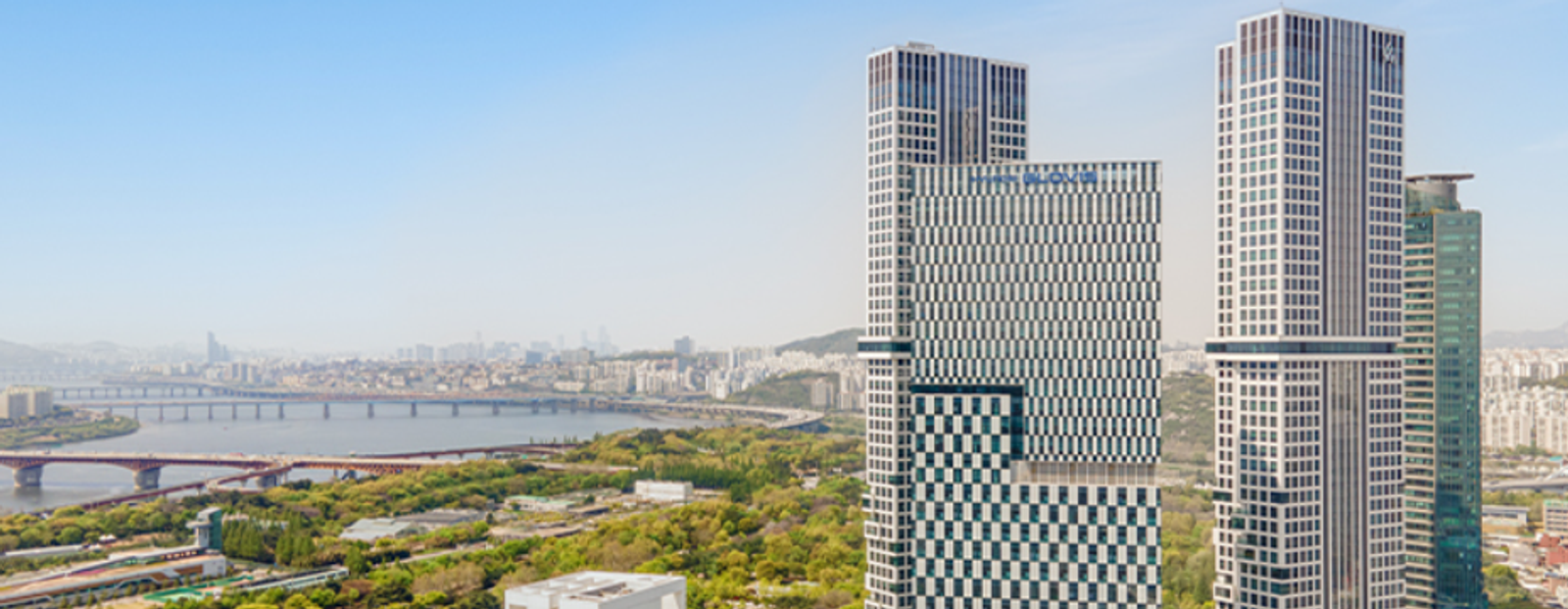
Company Overview
DL E&C was carved out of Daelim Industrial, one of South Korea's established construction conglomerates, when the DL Group restructured in 2021. The company operates across residential construction, industrial plant engineering and civil infrastructure — while rapidly building a portfolio in new businesses such as small modular reactors (SMRs) and carbon capture and storage (CCS).
Despite ranking among South Korea's larger listed builders by market capitalisation, DL E&C spent much of 2022 to 2024 mired in a prolonged de-rating, as a property downturn collided with sharply rising construction costs. Its price-to-book ratio (PBR) became entrenched at 0.3 to 0.4 times — a level of undervaluation so extreme that the company has become a standard reference case in debates surrounding the Korean government's "Value-up Programme", an initiative modelled loosely on Japan's push to lift corporate valuations.
Under chief executive Park Sang-shin, DL E&C has moved to reposition itself: tightening project selection, improving margins, shifting its dividend timetable and leaning into nuclear energy as a growth narrative. Markets have begun to take notice.
Business foundations and financial performance
*Business structure*
Revenue is generated across three main segments: architecture and housing (marketed under the apartment brand *e-Pyeonhansesang*, meaning "comfortable world"), plant engineering, and civil and environmental works. Housing accounts for more than half of total revenues, making earnings closely tethered to domestic property conditions.
Between 2022 and 2023, a simultaneous surge in raw-material costs, disputes over construction fees and rising unsold-inventory concerns caused profitability to deteriorate sharply. In response, Mr Park declared a strategic shift from 2023 onwards — away from volume-chasing towards margin discipline, weeding out low-return projects and tightening on-site cost controls.
*Overseas expansion into new energy*
Two platforms have emerged as pillars of DL E&C's international growth ambitions. The first is SMRs. The company took an early equity stake in X-energy, a US-based SMR developer, and that investment has since risen roughly sixfold in value over three years — crystallised when X-energy listed on the Nasdaq in April 2026. In March 2026, DL E&C announced it had won an SMR design contract in the United States, the first such award for a Korean construction firm, formally signalling its entry into the nuclear supply chain. Potential reconstruction contracts in Iran have also been cited as an additional overseas catalyst.
The second platform is CCS, where the company is positioning itself ahead of anticipated regulatory demand for carbon abatement infrastructure.
*Financial track record*
The table below summarises DL E&C's recent performance. All figures are approximate, based on published reports and market estimates; some pre-date final audited disclosures.
Year | Revenue | Operating profit | Operating margin | Notes
2021 | c.₩7.0tn | c.₩500bn | c.7.1% | First year post-spin-off; healthy margins
2022 | c.₩7.2tn | c.₩280bn | c.3.9% | Cost inflation begins to bite
2023 | c.₩6.8tn | c.₩150bn | c.2.2% | Margin trough; pivot to selective bidding
2024 | c.₩6.5tn | c.₩220bn | c.3.4% | Early signs of operational improvement
2025 | c.₩6.2tn | c.₩300bn (est.) | c.4.8% | SMR and CCS contracts beginning to materialise
*(₩1tn ≈ US$730m at 2025 average exchange rates)*
The Value-up timeline
*2023 — Declaring a new discipline*
After Mr Park took charge, DL E&C publicly committed to what it termed a "safety is survival" management philosophy — formally excluding low-margin project bids and reinforcing cost governance at construction sites. The pivot from top-line growth to profitability was the prerequisite, in management's framing, for any sustainable expansion of shareholder returns.
*2024 — New energy investments meet rising shareholder pressure*
As the early returns from SMR and CCS investments became visible, investors began re-categorising DL E&C — not merely as a construction stock, but as a play on the nuclear energy supply chain. Simultaneously, South Korea's parliament began debating amendments to the Commercial Act that would strengthen minority shareholder protections. Investors grew more vocal about treasury share disposal and dividend policy.
*September 2025 — A dual narrative takes hold*
With Commercial Act reform gathering momentum, DL E&C attracted attention for what analysts described as a twin investment proposition: shareholder return potential combined with nuclear energy exposure. The company's large treasury share holdings came under scrutiny, with some research suggesting that cancelling those shares could meaningfully lift its PBR. Proposed amendments that would mandate treasury share cancellation focused market attention further.
*December 2025 — Dividend record-date reform*
DL E&C changed the date on which shareholders must be registered to qualify for its dividend. Under the previous convention — standard across most Korean listed companies — the record date coincided with the financial year-end (31 December), leaving investors uncertain about the dividend amount until the annual general meeting months later. The reform means shareholders can now know the dividend quantum before committing capital, aligning the company more closely with international governance norms. Regulators and analysts broadly welcomed the move as consistent with the Value-up Programme's goals, though critics noted it was procedural rather than structural: without addressing underlying governance arrangements, they argued, such tweaks would have limited impact on the discount.
*March 2026 — First US SMR design contract; shares surge*
DL E&C publicly confirmed it had secured the first SMR design contract awarded to a Korean builder in the United States — a landmark that lent credibility to years of investment and positioning. At the annual general meeting the same month, Mr Park presented this alongside expanded dividend commitments. The stock rose 22% in a single session, reflecting the combined effect of the nuclear announcement and shareholder-return signals.
*April 2026 — X-energy lists on Nasdaq*
The Nasdaq listing of X-energy, in which DL E&C had invested several years earlier, pushed the value of that stake to approximately six times its original cost. Markets interpreted the gain positively: not only as validation of the company's early-mover instinct in SMRs, but as a potential source of future capital to fund shareholder returns should the stake be monetised.
Challenges and risks
*Governance: the persistent discount*
The most consistently cited obstacle to DL E&C's revaluation is its ownership structure. DL E&C is controlled by DL Co. (the holding company of the former Daelim group), which is in turn dominated by the founding family — a structure common among South Korea's family-controlled conglomerates, known as chaebol. Market analysts have repeatedly cautioned that within such a structure, the continuity and transparency of minority-friendly policies cannot be taken for granted. The procedural improvement to dividend timing, while welcome, does not in itself address questions about whether the controlling shareholder's interests consistently align with those of outside investors.
DL E&C also holds a substantial quantity of treasury shares. Investors remain uncertain whether these will be cancelled — which would reduce the share count and improve per-share metrics — or retained for employee compensation or future re-sale, which would dilute the benefit to ordinary shareholders.
*Domestic construction headwinds*
The structural pressures facing South Korea's residential construction sector have not dissipated. Unsold inventory, disputes over construction costs, and risks embedded in project-finance (PF) structures continue to weigh on the sector as a whole. Whether the SMR and CCS businesses can grow large enough to offset these drags on profitability remains the central question for medium-term investors.
*The Saudi penalty: overseas risk made real*
In June 2026, news broke that Saudi Arabian authorities had levied a fine of approximately ₩853.3bn (roughly US$620m) on DL E&C. The share price fell sharply on the announcement. Should the penalty crystallise into an actual cash outflow of that magnitude, it would represent a serious drain on financial reserves and would constrain the company's capacity to fund shareholder returns — undermining the very narrative it has spent years constructing. The episode was widely read as a reminder that the overseas-expansion strategy carries execution and legal risks that are not always visible in headline contract announcements.
*Sector-wide re-rating unlikely to come quickly*
Even setting aside company-specific factors, Korean construction stocks face a structural valuation handicap. PF risks, property-market uncertainty and volatile cost environments compress sector multiples across the board. Individual companies — however disciplined their management or promising their new-energy strategies — are unlikely to escape the sectoral gravity entirely.
Summary metrics
Year | DPS (per share) | Treasury share actions | Operating profit (est.) | PBR (year-end)
2021 | c.₩2,000 | — | c.₩500bn | c.0.5×
2022 | c.₩1,500 | — | c.₩280bn | c.0.35×
2023 | c.₩1,000 | — | c.₩150bn | c.0.3×
2024 | c.₩1,200 | Discussions begin | c.₩220bn | c.0.35×
2025 | TBC (est. higher) | Record-date reform implemented | c.₩300bn (est.) | c.0.4×
2026 | TBC | X-energy gain; Saudi fine overhang | Under review | 0.4–0.5× (est.)
*All figures are approximate, based on published reports and market estimates, and may differ from final audited results.*
Assessment
DL E&C's value-up story stands out within the Korean construction sector for its relative specificity and follow-through. The combination of margin-first operational discipline, early-mover positioning in nuclear energy, and procedural improvements to shareholder communications represents a more coherent approach than most peers have attempted.
Yet the PBR remains stubbornly below 0.5 times — a signal that the market's conviction is partial at best. Analysts broadly agree that a durable re-rating requires more than process improvements: cancellation of treasury shares, explicit dividend-payout commitments and meaningful strengthening of board independence are the measures most frequently cited as necessary. The Saudi fine has introduced a new variable of considerable magnitude. Until governance structures are reformed in substance rather than form, and until the overhang from the fine is resolved, investors are likely to keep their scepticism — and their discount — firmly in place.