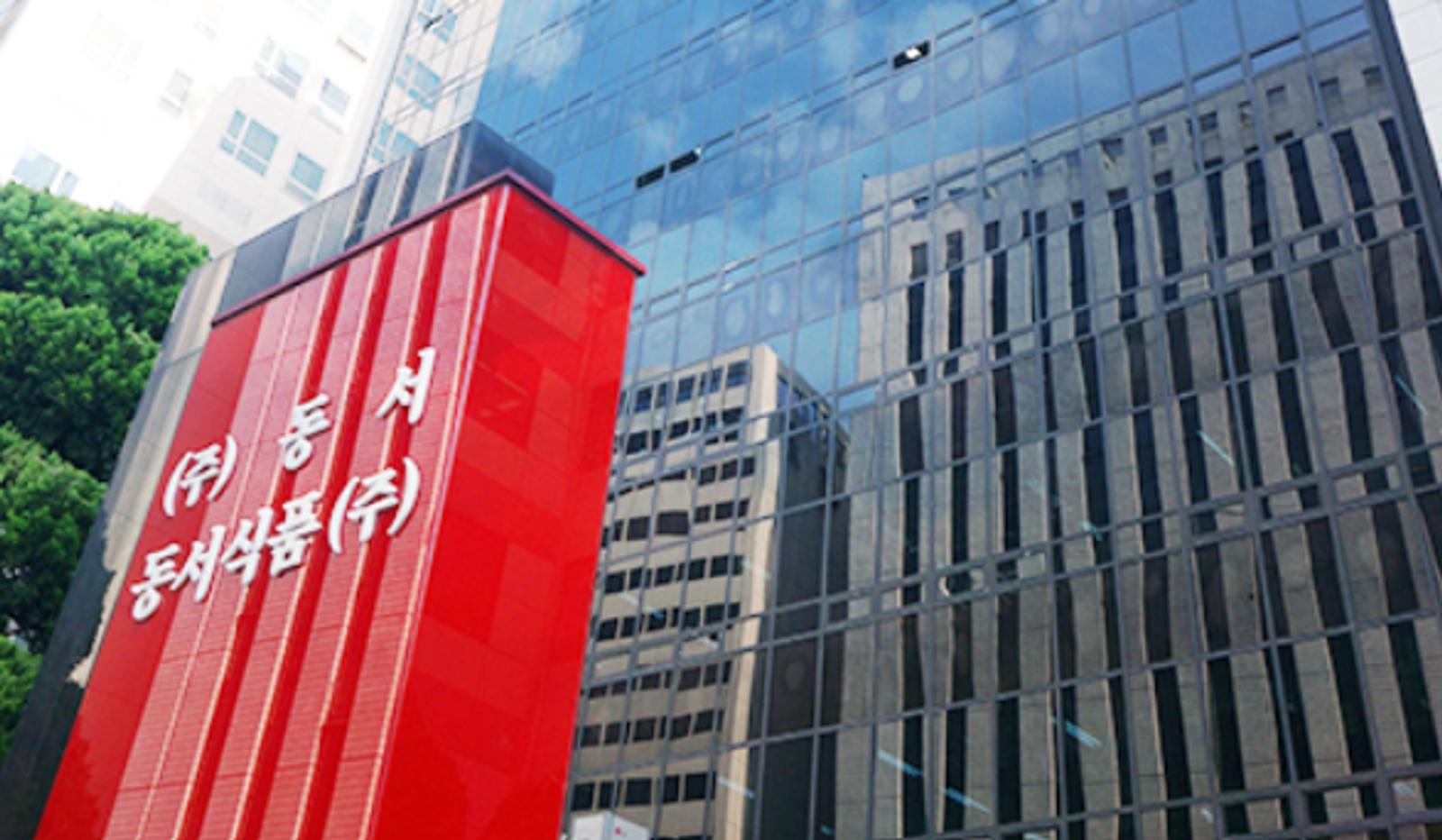
Company overview
Dongsuh is the dominant force in South Korea's instant coffee market. It is the largest shareholder and effective holding company of Dongsuh Foods, which owns the Maxim brand — a household name that commands more than 70% of the domestic coffee-mix market. Listed on the KOSPI, Dongsuh holds a 50% stake in Dongsuh Foods, and the dividends it receives from that subsidiary are its primary source of income. This arrangement has always been the central variable governing how much Dongsuh can return to its own shareholders.
The steady cash flows generated by Dongsuh Foods have allowed Dongsuh to accumulate substantial retained earnings, estimated at roughly 1.6 trillion won (approximately $1.2bn) as of 2026. That financial strength has been the starting point for discussions about shareholder returns. Yet the holding-company structure has attracted persistent criticism: because the founding family holds a large stake in Dongsuh, any expansion of dividend payments disproportionately benefits the owners rather than minority shareholders. Dongsuh's value-up story plays out between these two poles — genuine progress on shareholder returns versus a structural arrangement that concentrates gains at the top.
Business foundations and financial performance
*How the business works*
Dongsuh's earnings are almost entirely a function of its investment in Dongsuh Foods. Half the profits that Dongsuh Foods generates flow upward to Dongsuh as dividends, meaning that any fluctuation in the subsidiary's performance translates directly into Dongsuh's capacity to reward shareholders. Dongsuh also holds stakes in other group affiliates, including Dongsuh Oils & Fats and Dongsuh International, but their financial contribution is negligible by comparison.
The instant coffee-mix market in South Korea is widely regarded as having entered structural maturity, as consumers gradually shift towards brewed coffee. Dongsuh Foods has defended its profitability by trading consumers up to premium product lines such as Maxim T.O.P. and Kanu, raising average selling prices to offset the volume pressure.
*Financial performance, by year*
Year | Operating profit (consolidated, est.) | Net profit (consolidated, est.) | Retained earnings
2022 | ~180bn won | ~150bn won | —
2023 | ~190bn won | ~160bn won | —
2024 | ~180bn won | ~140bn won | —
2025 | ~170bn won | ~130bn won (decline) | ~1.5 trillion won
2026 (forecast) | — | — | ~1.6 trillion won
Notably, according to reports from March 2026, Dongsuh chose to raise its dividend even as net profit fell year on year. The decision drew attention precisely because it demonstrated that the 1.6 trillion won stockpile of retained earnings can serve as a buffer, sustaining payouts through lean periods.
Value-up milestones
*March 2024 — Before the programme: market scrutiny intensifies*
Around March 2024, the South Korean government began promoting its "Corporate Value-up Programme," a policy initiative designed to lift the persistently low valuations of Korean listed companies (many of which trade below book value, a longstanding grievance among domestic and foreign investors). Dongsuh was firmly in the low-valuation camp, with its price-to-book ratio (PBR) below 1. Although its dividend yield was relatively attractive, the company had taken no steps towards share buybacks or cancellations. Markets began questioning whether the dividends flowing from Dongsuh Foods were ultimately benefiting minority shareholders or principally enriching the founding family.
*July 2025 — First interim dividend: 24.7bn won paid*
In July 2025, Dongsuh paid an interim dividend for the first time in its history. The total payout amounted to 24.7bn won. Management stated that it hoped the move would enhance the share price through the value-up programme. The decision was read as a signal that the company intended to increase the frequency of shareholder returns, moving beyond its traditional practice of a single year-end dividend. In September of the same year, press reports noted that the number of Korean companies paying interim dividends had surged 26% year on year; Dongsuh was named alongside LG and Dongwon as a first-time participant.
*August 2025 — Backlash: critics question who really benefits*
Shortly after the interim dividend announcement, sceptical coverage emerged. Reporting in August 2025 pointed out that Kim Sang-heon, Kim Seok-su, and their family — the controlling shareholders of Dongsuh — stood to be the largest beneficiaries of any dividend increase, by virtue of their substantial stake. Critics argued that the language of "enhanced shareholder returns" was obscuring a more prosaic reality: the expansion of payouts was, above all, a mechanism for channelling cash to the founding family. The question of whether minority shareholders were receiving a fair share of the benefits moved into plain sight.
*March 2026 — Formal value-up disclosure: "ROE of 5%, payout ratio of 40%"*
On 3rd March 2026, Dongsuh published an official "Corporate Value Enhancement Plan." Its substance was spare: the company committed to maintaining a return on equity (ROE) of approximately 5% and a dividend payout ratio of around 40%. Market reaction was cool. The disclosure ran to just four lines and offered no roadmap, no intermediate targets, and no mechanism for accountability. The following day, the company reportedly acknowledged the criticism, indicating that future disclosures would be more detailed. The document quickly became known in Korean financial circles as the "four-line value-up statement" — a phrase that captured both the letter of compliance and the spirit of its inadequacy.
*March 2026 — Dividend raised despite lower profits*
On 12th March 2026, further reports confirmed that Dongsuh had increased its dividend payout even though net profit for the prior year had declined. The company pointed to its 1.6 trillion won in accumulated retained earnings as justification. Markets interpreted this as evidence of a firm commitment to sustaining shareholder returns through the earnings cycle. At the same time, analysts questioned whether dividends funded by drawing down a retained-earnings balance — rather than by growing underlying profits — constituted a durable long-term policy.
Challenges and assessment
*Outstanding challenges*
Three tasks stand out if Dongsuh is to make meaningful progress under the value-up programme.
First, its disclosures must become substantially more specific. The March 2026 statement reduced its commitments to two numbers — ROE and payout ratio — without explaining how they would be achieved, on what timetable, or how progress would be monitored. The company has acknowledged this shortcoming; the test is whether subsequent filings deliver on the promise.
Second, Dongsuh has so far confined its shareholder-return toolkit to dividends alone. Introducing share buybacks and cancellations — mechanisms that lift earnings per share and reduce the share count — would offer a credible path towards recovering a PBR of 1. Their absence is conspicuous.
Third, the company needs a clearer communication strategy around its holding-company structure. Investors deserve a transparent account of how the dividend flows from Dongsuh Foods ultimately reach minority shareholders, and why the existing structure serves their interests.
*Overall assessment*
The market's verdict on Dongsuh's value-up effort can be summarised as: started, but moving slowly. Introducing an interim dividend for the first time and formally committing to a 40% payout ratio represent genuine steps forward. The 1.6 trillion won retained-earnings cushion is a real asset.
But the thinness of the value-up disclosure, the absence of buyback or cancellation activity, and the structural reality that dividend increases disproportionately reward the founding family are all obstacles to building full market confidence. Until Dongsuh presents a more rigorous and credible roadmap, recovery to a PBR of 1 will remain elusive.
Controversies and structural limitations
*The "owner-family dividend feast" criticism*
The most persistent criticism levelled at Dongsuh is that the practical beneficiary of any dividend expansion is the founding family. According to August 2025 reporting, the Kim family holds a significant proportion of Dongsuh's shares, meaning that every increment in the dividend increases the absolute cash transferred to the controlling shareholders. The introduction of an interim dividend can reasonably be described as shareholder-friendly in principle; in practice, the asymmetry between what minority investors receive and what the controlling family collects is the heart of the controversy.
*A disclosure that said almost nothing*
The March 2026 value-up filing drew ridicule for its brevity. Against a backdrop in which the Korea Exchange had been encouraging companies to publish substantive, voluntary value-up disclosures, Dongsuh's four-line statement — citing only its ROE and payout-ratio targets — was widely characterised as the minimum possible formal response. Market participants noted that without specific implementation plans, a target PBR or share-price benchmark, or any monitoring framework, the filing carried limited practical meaning.
*The holding-company discount*
Dongsuh functions as a de facto holding company for Dongsuh Foods, yet it is perceived by investors much as a pure holding company would be — with the attendant valuation penalty. Because Dongsuh Foods is unlisted, investors cannot easily see through to its true value, and that opacity is routinely cited as one reason Dongsuh's PBR has persistently remained below 1. Correcting this "holding-company discount" may ultimately require governance reforms that go well beyond dividend policy.
*Concentration risk in a maturing market*
Dongsuh's capacity to return capital to shareholders is almost entirely dependent on the performance of a single business operating in a mature and structurally challenged market. If Dongsuh Foods comes under greater pressure — from the continuing shift to brewed coffee, from raw-material cost increases, or from competitive encroachment — Dongsuh's dividend-funding capacity shrinks accordingly. Retained earnings provide a short-term buffer but cannot serve as a permanent substitute for growing profits. Diversifying the earnings base remains a medium-to-long-term imperative.
Key figures at a glance
Year | Payout ratio (est.) | Interim dividend | Share cancellation | Operating profit (est.) | PBR (est.)
2023 | ~35–40% | None | None | ~190bn won | Below 1×
2024 | ~35–40% | None | None | ~180bn won | Below 1×
2025 | ~40% | 24.7bn won (first ever) | None | ~170bn won | Below 1×
2026 | 40% formalised | Continuation signalled | Not announced | — | Below 1×