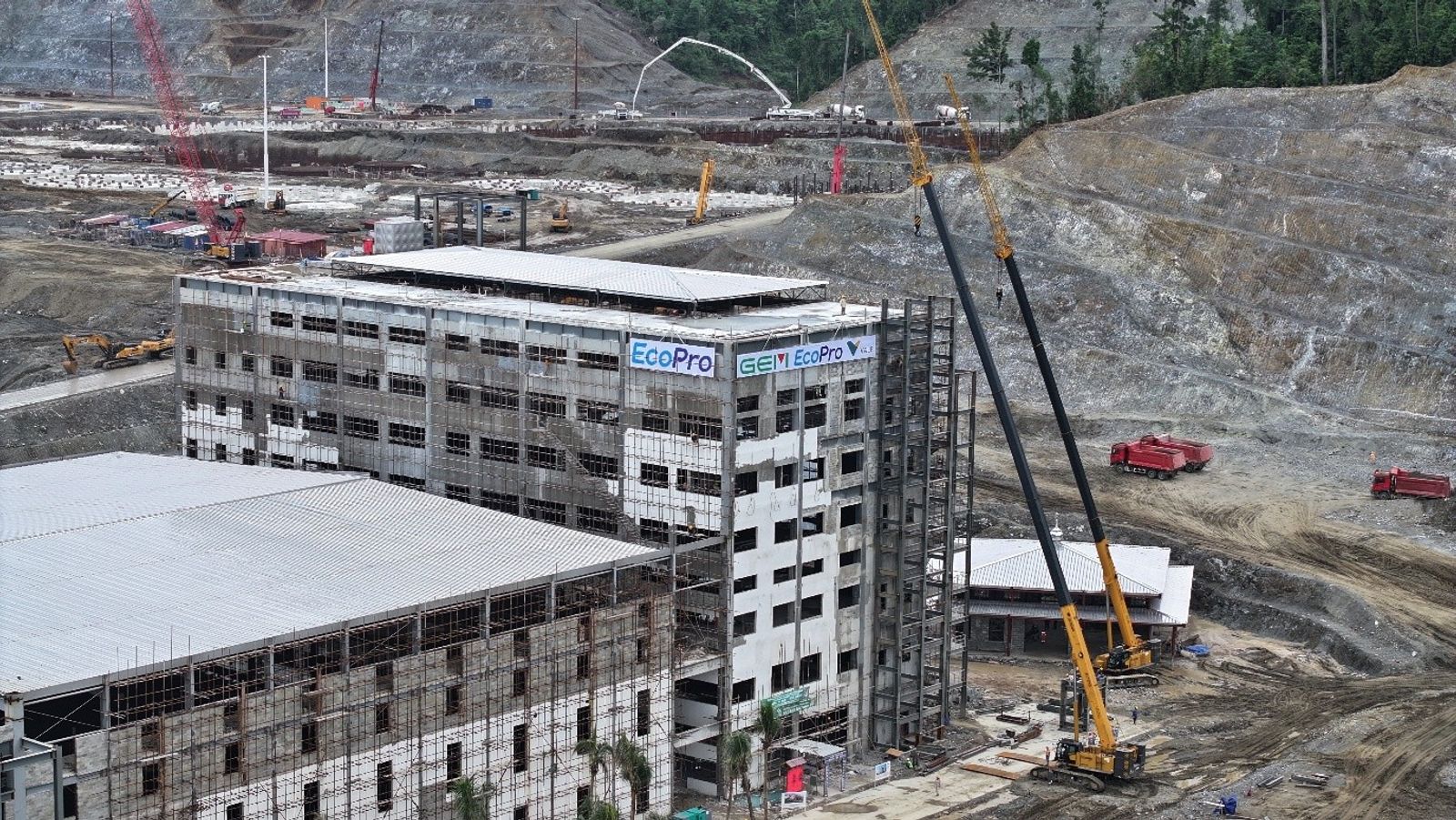
EcoPro BM, South Korea's leading cathode-material maker, has approved a ₩1.2 trillion (roughly $900m) rights issue to accelerate its push into Indonesian nickel sourcing and Hungarian cathode production. The market's verdict is deeply split. Fears of significant share dilution, compounded by a prolonged slump in the battery sector, have fuelled sharp criticism that the move destroys shareholder value. Defenders counter that it is an unavoidable step to secure the company's long-term competitive position.
Structure and rationale
The capital raise is the financial backbone of EcoPro BM's global vertical-integration strategy. In Indonesia, the company is developing a precursor joint venture to secure direct supplies of nickel, cobalt, and manganese — the critical minerals at the heart of electric-vehicle batteries. In Debrecen, Hungary, its local subsidiary (EcoPro BM Hungary) began mass production in 2024 and is being groomed as a forward base to supply cathode materials directly to European carmakers. As Samsung SDI and SK On expand their own European gigafactories, securing a local materials supply chain has shifted from a strategic option to a competitive necessity.
In Indonesia, the calculus is about cost. Chinese firms have already taken a dominant grip on nickel-processing infrastructure there, and establishing an independent procurement route is essential for Korean manufacturers to remain price-competitive.
The case against: dilution in a downturn
The critics have a strong case. Issuing shares worth ₩1.2 trillion will meaningfully dilute existing shareholders. A sharp post-announcement share-price drop — a well-worn pattern in South Korean equity markets whenever large rights issues are disclosed — has already materialised. A wave of major share issuances by battery-materials companies in 2022–23 inflicted painful losses on retail investors, and EcoPro BM is no stranger to that dynamic.
The deeper problem is the industry cycle. Electric-vehicle adoption has slowed more sharply than most forecasters predicted, cooling global battery demand. LG Energy Solution and Samsung SDI both fell short of earnings expectations in 2024–25, which translated into reduced cathode orders and lower plant-utilisation rates at EcoPro BM. Against that backdrop, raising more than a trillion won from outside investors to fund overseas capacity additions looks to many like transferring financial risk squarely onto shareholders.
Investment bankers warn that, with the cycle bottom still unclear, the earnings-per-share dilution will compound the longer the recovery takes. The opportunity cost of fresh capital deployed into half-idle assets is not trivial.
The case for: structural tailwinds are real
Yet the company's long-term growth logic rests on solid structural foundations. The EU Battery Regulation will require carbon-footprint declarations from 2027 and mandatory recycled-content thresholds from 2030. The practical effect will be to favour materials sourced from within Europe or from partner countries — a framework in which EcoPro BM's Hungarian plant sits squarely in the path of regulatory tailwinds.
The Indonesian investment follows a similar logic. With America's Inflation Reduction Act (IRA) and the EU's Critical Raw Materials Act both pushing manufacturers to reduce dependence on Chinese inputs, a vertically integrated supply chain rooted in Indonesian nickel offers both pricing leverage and margin protection over the medium term. China's CNGR and Huayou Cobalt have already achieved this kind of integration; South Korean materials companies that fail to do likewise risk being squeezed out of the global race.
Timing is everything: lessons from history
Japan's Sumitomo Metal Mining invested early in nickel mines in the Philippines and New Caledonia in the early 2010s, and reaped a decisive cost advantage when the battery-materials boom arrived. By contrast, several mid-sized Korean materials producers waited until the cycle turned before expanding capacity, and found themselves ramping up production precisely at the peak — with predictably damaging results. In an industry where investment decisions take five to seven years to manifest in earnings, waiting for the boom before committing capital is already too late.
EcoPro BM's move can be read through the same lens. The present share-price weakness and industry trough may, in hindsight, prove to be the ideal moment to invest. The uncomfortable truth, however, is that nobody yet knows when the trough will end.
Verdict: strategy is sound, execution is the variable
Weighing both arguments, the structural case for long-term growth carries more conviction. Three powerful macro forces — tightening EU regulation, IRA-driven supply-chain realignment, and the drive to reduce Chinese dependency — provide strong justification for EcoPro BM's localisation and vertical-integration strategy. The ₩1.2 trillion rights issue is not merely a funding exercise; it is a bet on who will dominate the battery-materials landscape in the 2030s.
That said, shareholder concerns cannot be dismissed as mere short-termism. The risks are real: the timing of an EV-demand recovery, the actual utilisation rates and profitability of the Hungarian and Indonesian operations, and the financial burden of servicing fresh capital in a still-elevated interest-rate environment all remain uncertain. The long-term growth thesis only holds if the assets being built come on stream on schedule and generate returns.
Ultimately, whether this rights issue succeeds will depend less on the wisdom of the strategy than on the quality of execution and the timing of the industry's recovery. For shareholders accepting the dilution, the rational response is to hold management rigorously accountable to its stated investment schedule and monetisation roadmap. Whether EcoPro BM can convert today's pain into tomorrow's competitive strength is a question the market itself will answer — within three to five years.