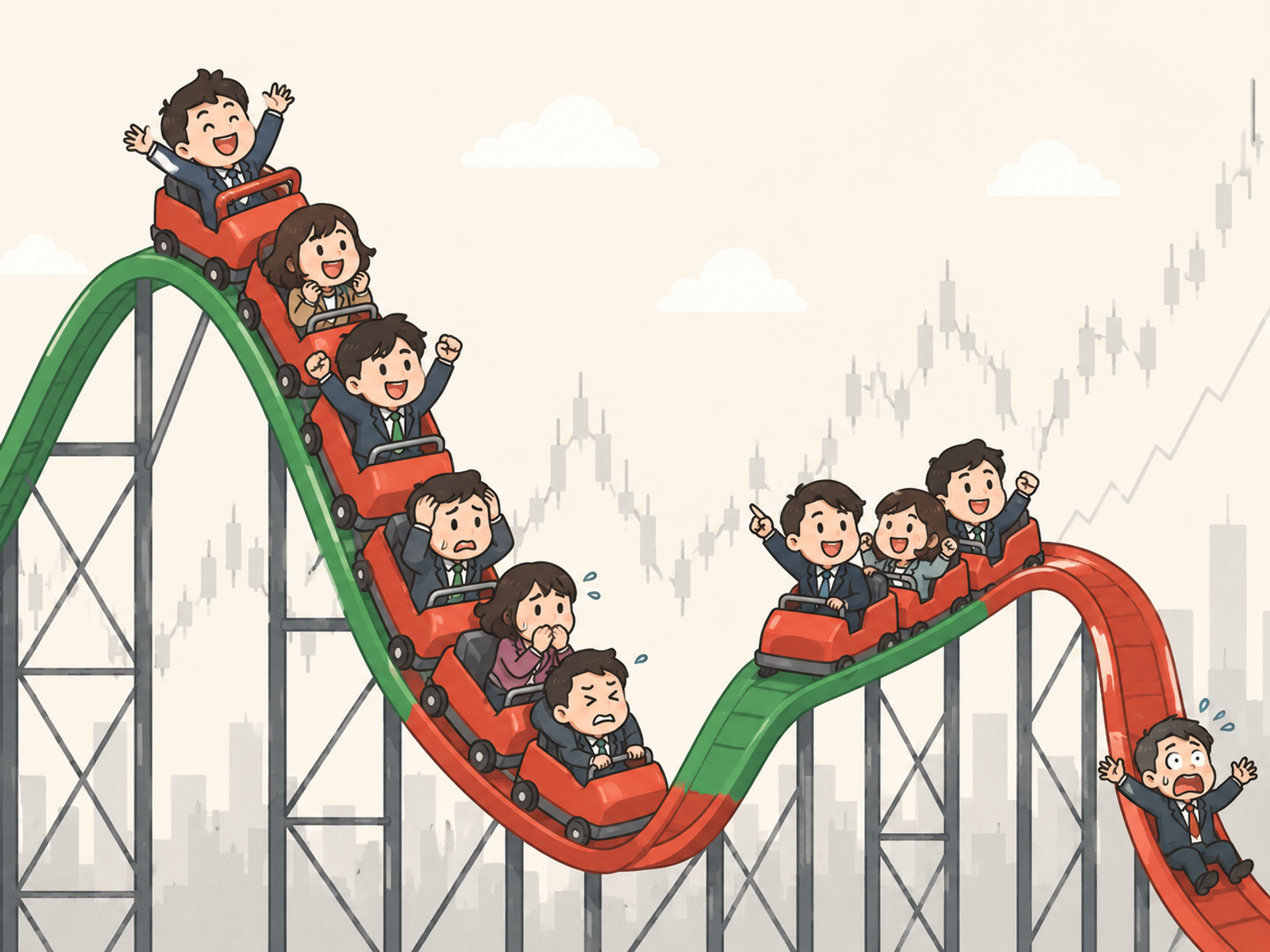
One number captures the character of South Korea's stockmarket this year. Since the country's circuit-breaker mechanism—which halts trading when prices move too sharply—was introduced roughly two decades ago, it had been triggered just 15 times in total, or about once every 18 months on average. Yet in 2026 alone it has already fired five times: on 4th March, 9th March, 8th June, 23rd June, and 26th June. In fewer than six months, the market has racked up nearly a third of all activations in the instrument's entire history.
June's pattern is especially striking. On 23rd June the KOSPI—South Korea's benchmark index, equivalent to the S&P 500 in terms of market significance—plunged 9.99%. Just three trading days later, on 26th June, it fell another 8.18%, triggering the circuit-breaker again. One headline described the episode as "two days up, then another Black Friday." The swings are not merely large; they are accelerating in frequency.
Different triggers, the same underlying fault
Understanding this abnormal volatility requires looking past the surface causes of each episode. March's sell-offs were triggered by geopolitical tensions between the United States and Iran. The 8th June collapse reflected fears that rising memory chip prices were beginning to slow investment by big technology companies, compounded by profit-taking after a rapid run-up. The 23rd June crash was preceded by anxiety ahead of Micron's earnings release, the failure of South Korean equities to win inclusion in a key MSCI index, and a domestic dispute over capital-gains taxation. The 26th June drop was attributed, once again, to concerns about weakening memory demand and the volatility that comes with excessive concentration in semiconductor stocks.
Each event appears to have its own name. But strip away the headlines and the same structure recurs every time. As one analyst put it after the 26th June fall: "Concerns about a memory demand slowdown are exaggerated. What explains most of today's decline is the excessive concentration in semiconductors and the supply-demand volatility that flows from it." Parallel diagnoses noted the additional pressure from sustained foreign selling and from large institutional investors—including the National Pension Service, South Korea's enormous state fund—being compelled to trim overweight positions.
The external triggers (wars, earnings reports, index decisions, tax controversies) are merely sparks. What turns each spark into a conflagration is a structural amplifier that remains in place: the KOSPI's extreme dependence on just two companies, Samsung Electronics and SK Hynix; the further magnification of that concentration through leveraged exchange-traded funds; and the sheer weight of profit-taking pressure that builds whenever stocks rise as steeply as these two have. Whatever name the next trigger wears, as long as this structure persists, even small shocks will produce large tremors.
When a 7% drop becomes routine noise
The market's own attitude towards volatility has begun to shift, and that shift is itself worth noting. After the 23rd June plunge, one widely circulated assessment argued that "given how much broader the market's volatility range has become, a 7% correction today is no more significant than a 3% fall would have been in the past—there is no need to read too much into it." A decline that would once have been interpreted as a turning-point signal is now being filed away as ordinary background noise.
This desensitisation has two possible readings. It could mean the market is growing more resilient, better able to absorb shocks without suffering lasting damage. Or it could mean that the threshold for alarm has drifted dangerously upward—that when a genuinely critical signal eventually arrives, investors will be too numb to recognise it in time.
History offers some comfort
Not everything about this picture is bleak. A review of how markets have behaved following past circuit-breaker events reveals a consistent recovery pattern. On average, the KOSPI has regained roughly 9.9% within 32 trading days (about six and a half weeks) of a circuit-breaker activation, and approximately 20% within 60 trading days (around three months). Even after severe geopolitical shocks—the September 11th attacks, the Israel-Lebanon conflict of 2006, Russia's invasion of Ukraine—markets typically continued falling for up to ten trading days, but then tended to turn around by the twentieth trading day.
The implication is clear. Sharp falls are alarming, but history suggests they rarely mark the permanent destruction of an upward trend. The real question is how investors manage those six weeks to three months of uncertainty before recovery begins.
Two strategies for a volatile market
In a market where turbulence has become structural, investors are broadly splitting into two camps. The two approaches begin from opposite premises, yet each carries genuine logic.
Strategy one: stay with the leaders
The first strategy holds that the concentration in Samsung and SK Hynix is not a distortion but a rational repricing—and that the correct response is to ride it out, and even add to positions on dips. The evidence cited is straightforward: earnings estimates keep rising. In early May, SK Securities set price targets of 500,000 won for Samsung and 3,000,000 won for SK Hynix. A month later, Nomura went further, targeting 590,000 won and 4,000,000 won respectively. Shinhan Investment Securities forecast operating profits for the two companies in 2026 of 36.7 trillion won and 26.7 trillion won respectively, describing them as "two stocks capturing the same cycle's gains in different ways—not a forced choice between them."
The analytical backbone of this strategy is a forecast of continued price increases for DRAM and NAND flash memory chips, which analysts expect to drive semiconductor earnings higher through at least the second half of 2027, and potentially into early 2028. "Google and the other hyperscalers, and Nvidia, are not in any position where they need to cut AI investment for lack of funds," one semiconductor analyst observed, recommending that investors focus on large-caps and use price declines as buying opportunities rather than selling signals. In other words: treat the crashes not as exits but as entry points.
Strategy two: look beyond the crowded trade
The second strategy accepts that the semiconductor thesis may be sound, but argues that concentrating a portfolio there amplifies exactly the volatility that makes the market so uncomfortable. Regardless of whether the trade is fundamentally justified, reducing exposure to the dominant names and spreading capital into unloved sectors with solid earnings and low valuations is, on this view, simply good risk management.
Sectors that have been discussed in this context include shipbuilding, defence, and electrical-grid equipment—industries that have not shared in the semiconductor rally but whose underlying businesses remain intact, sidelined only by the market's distracted gaze rather than by any deterioration in fundamentals.
Why both strategies coexist
These two approaches are not as mutually exclusive as they appear. The reason both are operating simultaneously is that sentiment towards semiconductors remains overwhelmingly bullish. Price targets are being raised twice within the span of a single month; leveraged single-stock ETFs tied to Samsung and SK Hynix are absorbing billions of dollars in fresh capital. For an investor to abandon the crowded trade entirely on the premise that it must soon crack would be to risk badly underperforming a market whose leading position may yet be sustained by genuine earnings growth.
Yet strategy one alone is not obviously correct either. Even analysts deeply familiar with the memory industry are sounding cautious notes. One reason so many are now using price-to-book ratios (PBR) rather than price-to-earnings ratios (PER) to set their targets is telling: it reflects a refusal to assume that memory has permanently shed its cyclical character. Long-term supply agreements (LTAs) have given earnings greater visibility than in previous cycles, lending weight to the argument that the old boom-bust pattern is behind us. But the counter-argument is formidable: in a recession, or after a sudden rise in interest rates, or if Chinese competitors significantly expand supply, even five-year contracts can be cancelled—buyers will simply forfeit their deposits and walk away. It has happened before. The super-cycle of 2017–18 produced a wave of long-term contracts; by 2019, order cuts had arrived anyway, and a down-cycle followed.
Holding both strategies at once
There is no single-line answer that resolves the tension between these two approaches. But there is a practical way to hold both. The core of a portfolio can remain anchored in stocks whose valuations are supported by current fundamentals—principally the two semiconductor giants—while a portion is deliberately allocated to neglected sectors, providing a hedge against the possibility that the cycle turns abruptly. As one asset management professional put it: "This is the moment for maintaining core positions in semiconductors and industrials while reviewing overlooked satellite assets." The balance is not a hedge against being wrong on one side; it is an acknowledgement that reasonable people can be right on both sides simultaneously, and that portfolios should reflect that uncertainty.
Rules of thumb for a high-volatility environment
Beyond the strategic question of where to allocate capital, a few principles are worth keeping in mind when navigating a market this volatile.
Understand what leveraged products actually do. Leveraged ETFs amplify gains in a rising market and losses in a falling one. When trillions of won are flowing into instruments of this kind tied to just two underlying stocks, those products become additional amplifiers of the very concentration and volatility that make the market dangerous. Investors should price this in.
Distinguish between structural selling and temporary profit-taking. Most sharp falls after a strong rally reflect the entirely human desire to lock in gains—not a fundamental breakdown in the investment case. Knowing this creates the possibility of reading a crash as "accumulated selling pressure being released" rather than "the market collapsing." That said, not every drop is a buying opportunity: the first question should always be whether fundamentals have genuinely deteriorated or whether only the price has moved.
Have realistic expectations about recovery timescales. History suggests recovery takes between six weeks and three months. An investor who enters a falling market without the financial capacity to wait that long risks being forced out before the rebound materialises.
Volatility as the new normal
The signal South Korea's stockmarket is sending is, in the end, simple. Volatility is no longer an exception; it is the baseline condition. The fact that a mechanism triggered 15 times over 20 years has now fired five times in six months means the market is operating on a fundamentally different amplitude than before. The underlying causes—semiconductor concentration, leveraged positioning, profit-taking pressure—have not been resolved. Until they are, the next trigger, whatever it happens to be called, is likely to produce swings of similar magnitude.
Whether the concentration itself represents a dangerous bubble or a legitimate revaluation backed by earnings is a question on which the market has not reached consensus. Analysts raising price targets every few weeks and analysts insisting on conservative, asset-based valuations while warning of a cyclical reversal inhabit the same market at the same time. The appropriate investor response is not to decide that one side is entirely wrong, but to ensure that a portfolio is positioned for both possibilities.
The key thing to watch: if and when the next circuit-breaker fires, what triggers it—and whether that trigger is, once again, a variation on the same semiconductor-concentration story. If the pattern holds, the conclusion will become increasingly difficult to escape: the problem is not the news flow. It is the market's structure.
Circuit-breaker activations in 2026
Date | Decline | Stated trigger | Underlying structure
4th March | ~8.1% | US-Iran geopolitical risk | Semiconductor concentration + profit-taking
9th March | ~8.1% | Continued geopolitical risk | Same
8th June | 8.37% | Memory price pressure; fears of slowing big-tech investment | Same
23rd June | 9.99% | Micron earnings anxiety; MSCI inclusion failure; capital-gains tax dispute | Same
26th June | 8.18% | Memory demand slowdown fears | Same