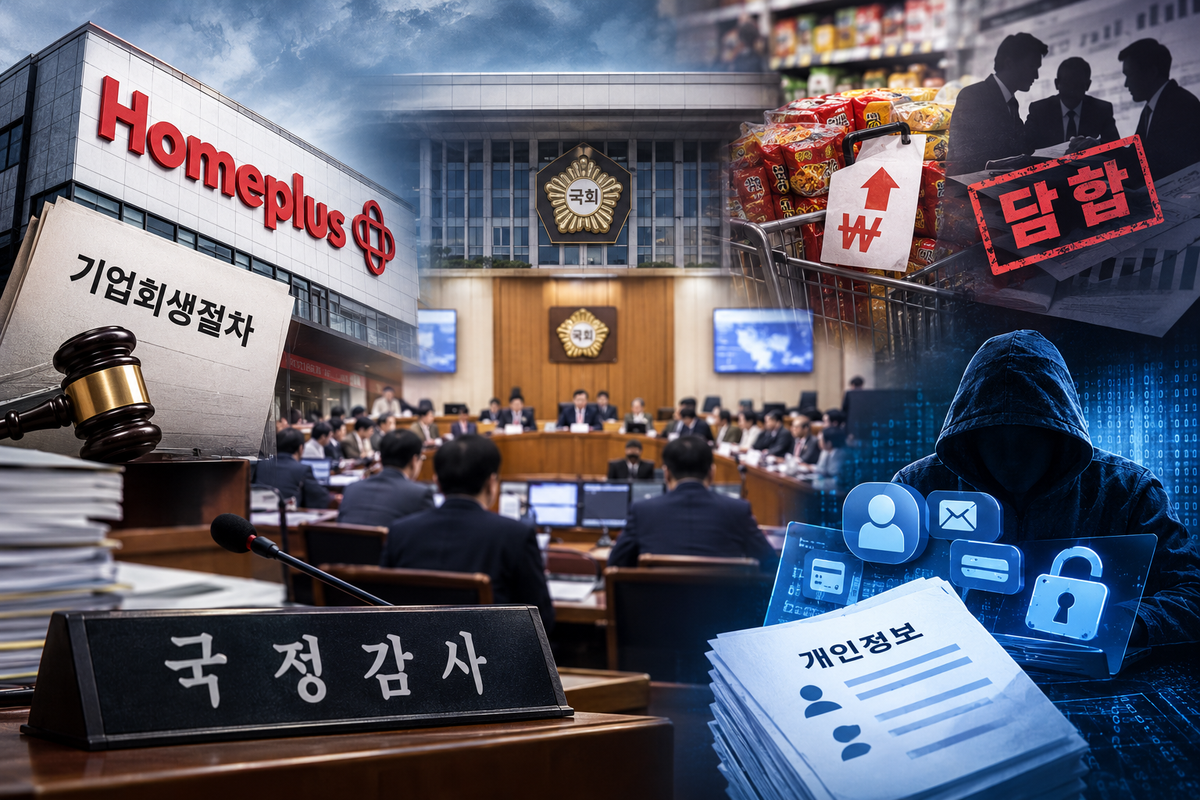
The 2026 parliamentary audit season has brought unusual intensity to the hearings of South Korea's National Assembly. Two powerful committees — the Political Affairs Committee and the Trade, Industry, Energy, SMEs and Startups Committee — are interrogating the retail and food industries on three simultaneous fronts: the court-supervised rehabilitation of Homeplus, the country's second-largest hypermarket chain; allegations of price collusion spanning everyday staples; and a pattern of consumer data breaches affecting tens of millions of people. Together, these issues are exposing structural failings that go well beyond any single company.
Homeplus: the end of "too big to fail"
The sight of Homeplus — once a retail giant with annual revenues exceeding 7 trillion won (roughly $5 billion) — entering court-supervised rehabilitation has sent a symbolic shock through the industry. The consensus explanation is straightforward: the chain was burdened by debt accumulated during its leveraged buyout (LBO) by MBK Partners, a private equity firm, while simultaneously suffering from the long-term structural decline of physical retail.
Lawmakers from across the political spectrum have trained their fire on MBK Partners, accusing the firm of prioritising asset disposals and dividend extraction over operational investment and the protection of suppliers. Their concerns are not abstract. Since Homeplus filed for rehabilitation, hundreds of small and medium-sized suppliers have struggled to recover outstanding payments, raising fears of a cascade of secondary business failures.
Industry analysts argue this episode should be read not as the isolated failure of one company, but as a systemic warning about the vulnerability of private-equity-owned retail businesses. The comparison to the British department store BHS — which collapsed after a private equity acquisition, devastating pensioners and suppliers alike — has been raised as a cautionary precedent. South Korea, commentators say, has reached the point where it can no longer avoid a serious policy debate about regulatory safeguards for private equity ownership of large retail infrastructure.
Collusion: the cartel behind the grocery bill
A second major theme at the hearings is the suspicion of price-fixing among food and retail companies. The Korea Fair Trade Commission (KFTC) is understood to be investigating evidence that multiple manufacturers and distributors co-ordinated the timing and magnitude of price increases across several essential categories, including instant noodles, flour, sugar, and sesame oil.
KFTC data show that food price inflation has consistently outpaced the overall consumer price index throughout the 2020s. Rising input costs are a genuine external factor, but economists have noted a harder-to-explain pattern: companies across the same product categories have repeatedly implemented near-identical price increases within weeks of each other — a degree of synchronicity difficult to attribute to independent market responses.
The Korea Development Institute (KDI), South Korea's leading state-funded economic think-tank, has previously warned that in the oligopolistic markets that characterise much of the domestic food industry, tacit collusion is both harder to detect than explicit price-fixing agreements and more damaging to consumers in aggregate. At the hearings, lawmakers have pressed hard on the pace of the KFTC's investigations and the severity of any potential sanctions. Industry representatives have countered with arguments about unavoidable cost pressures, and the exchanges have grown increasingly acrimonious.
Data protection: tens of millions of records at risk
The third line of inquiry concerns consumer data. Large membership-based retailers hold vast troves of information — purchase histories, location data, and payment details — for tens of millions of customers. Repeated incidents of hacking and insider leaks have called into question whether companies are investing adequately in data security.
Statistics from South Korea's Personal Information Protection Commission show that reported data breaches in the retail and e-commerce sector have risen every year for the past three years. The concern is compounded by the integration of offline loyalty programmes with online platforms: when a unified database is breached, the potential damage multiplies rapidly.
Critics at the hearings drew an unflattering comparison with the European Union's General Data Protection Regulation, which can impose fines of up to 4% of a company's global annual revenue for serious breaches. South Korea's domestic penalties remain considerably lower, creating what one lawmaker described as a "cost-benefit calculation" in which companies may rationally choose to pay fines rather than invest sufficiently in security infrastructure.
A common root
For all their surface differences, the three issues share a common structural origin. South Korea's regulatory system remains oriented towards after-the-fact punishment rather than pre-emptive supervision, which means damage tends to accumulate before the state acts. Both consumers and suppliers find themselves at a structural disadvantage in oligopolistic markets: consumers have limited alternatives, while small suppliers fear that reporting unfair practices will cost them their trading relationships. And across all three areas, legislation and regulatory capacity have lagged well behind the pace of digital transformation and financial innovation.
What comes next
The hearings are likely to catalyse a broader debate about regulatory redesign for the retail sector. Several legislative proposals are already in circulation: a mandatory supplier protection fund to be established whenever a private equity firm acquires a major retailer; tighter disclosure requirements whenever food companies raise prices; and a higher ceiling on fines under the Personal Information Protection Act.
Experts are broadly sceptical, however, that legislation alone will be sufficient. The KFTC and the Personal Information Protection Commission would also need substantially greater enforcement capacity. Laws and rules, they caution, cannot by themselves overcome the inertia of entrenched market structures. The deeper challenge is to design a regulatory ecosystem that genuinely guarantees consumers' right to information and meaningful choice. Whether these parliamentary hearings produce durable reform or merely the ritual theatre of political grandstanding is a question the industry, and South Korean civil society, are watching closely.