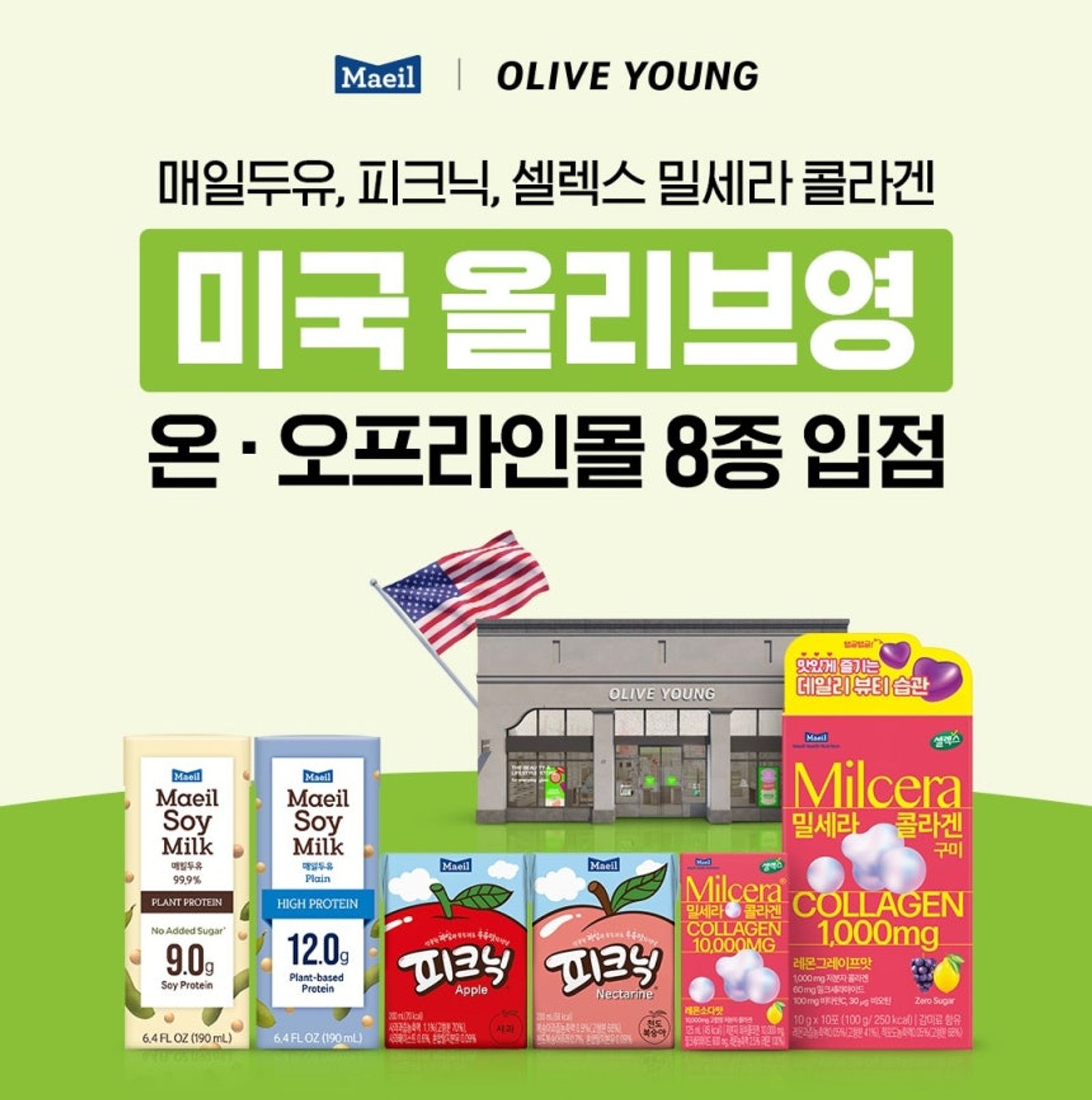
Maeil Dairies, one of South Korea's largest food and beverage groups, has secured a listing on Olive Young USA — the American arm of South Korea's dominant health-and-beauty retailer — as part of a push into the North American market. The move signals something more significant than a routine export deal: the company is attempting to reinvent itself as a "K-wellness" brand, offering a window into how Korean food conglomerates are redesigning their overseas distribution strategies to escape the constraints of a saturated home market.
Olive Young USA: a bridgehead for K-wellness
Olive Young has evolved rapidly from its origins as South Korea's leading health-and-beauty chain into a global platform for K-culture consumption. Its American operation supplies Korean beauty and health products to North American consumers primarily through online channels, and has cultivated a devoted following among millennials and Generation Z consumers riding the wave of enthusiasm for Korean skincare. Maeil's decision to enter through this channel appears to reflect a calculated bet: by associating its products with a trusted K-brand environment, it can transfer credibility more efficiently than by building distribution from scratch.
The products Maeil is leading with are its Sellex adult nutrition range and a line of functional beverages. Sellex — built around concepts of protein supplementation and the prevention of sarcopenia (age-related muscle loss) — has already established itself as one of Maeil's core domestic growth engines. In North America, the company says it intends to position Sellex not as a generic "Korean drink" but as a clinically grounded functional wellness product.
Why now, and why North America?
The domestic South Korean dairy market is under severe structural pressure. According to Statistics Korea, milk consumption has been in sustained decline since the 2010s, compounded by a shrinking school-age population that has reduced demand from the school-meal programme. Facing these headwinds, Maeil and its peers — including rival Namyang Dairy — have made international diversification a strategic priority.
North America is particularly attractive because of the explosive growth of health and wellness spending. According to Grand View Research, a US market research firm, the global wellness food market was worth approximately $800 billion in 2023 and is expanding at an annual rate of 5–6%. American consumers' interest in high-protein foods, low-sugar functional beverages, and anti-ageing nutrition products has intensified since the pandemic. Products like Sellex sit squarely in the path of that demand.
Beyond ramen and kimchi: the next wave of K-food
Maeil's push fits within a broader qualitative shift in South Korean food exports. According to the Ministry of Agriculture, Food and Rural Affairs, South Korea set a record for food export revenues in 2023. The composition of those exports is also changing: from ramen, kimchi and frozen foods towards health supplements, probiotics and functional nutrition products. As the global perception of "K-food" consolidates around an image of healthfulness and trendiness, wellness products are increasingly seen as the next wave.
There are instructive precedents in Japan. Meiji and Morinaga — Japanese dairy and nutrition companies — have successfully built premium, science-based positioning across Asian markets. Meiji, for instance, used protein supplements and functional yogurts to establish a premium image in South-East Asia. Maeil can draw lessons from these examples, though with an important caveat: Japanese firms built their international distribution and localisation capabilities over decades. Maeil's challenge is to compress that timeline and build brand recognition quickly.
Grounds for optimism and caution
Industry opinion is divided. Optimists point out that Olive Young USA offers a ready-made, pre-qualified consumer base — North American shoppers who are already receptive to Korean brands — which meaningfully lowers the barriers to entry. With K-brand equity at a high-water mark, the timing, they argue, is propitious.
Sceptics are less sanguine. The North American wellness market is defended by formidable incumbents: GNC, Nestlé Health Science, and Abbott's Ensure, to name a few. The protein and nutrition supplement category in particular is one where American consumers are acutely sensitive to ingredient quality, clinical evidence, and brand credibility. Converting Korean identity into a premium halo — as happened with K-beauty — will require substantial marketing investment and a rigorous localisation strategy.
"The Olive Young channel has a built-in audience that is already comfortable with K-culture, which gives a real advantage in the early stage of awareness-building," said one researcher specialising in the food industry. "But to drive repeat purchases — which is ultimately what matters — the company will need to resolve two challenges simultaneously: demonstrating product efficacy convincingly, and being price-competitive."
What comes next
Maeil's venture is emblematic of a wider transition in South Korean industry: the shift from exporting manufactured goods to exporting brands. Rather than simply selling products, the strategy involves selling a lifestyle proposition — "K-wellness" — which, if successful, promises to generate both stronger margins and durable brand equity.
The South Korean government is also exploring ways to designate K-wellness as a strategic export sector and to expand marketing support abroad. However, analysts caution that without genuine corporate capability in global brand-building and the ability to navigate local regulatory environments, the momentum could prove fleeting.
Whether Maeil can use Olive Young as a stepping stone to establish an independent presence in the North American wellness market — or whether this will prove to be another short-lived export experiment — is likely to become clear within the next two to three years. Either way, the outcome will serve as an important reference point for the many South Korean food and healthcare companies wrestling with exactly the same question.